
The Killing of Alex Pretti Is a Reminder That All State Laws Are Backed Up by Violence
If enforcing a law isn't worth killing someone over, it probably shouldn't be a law.
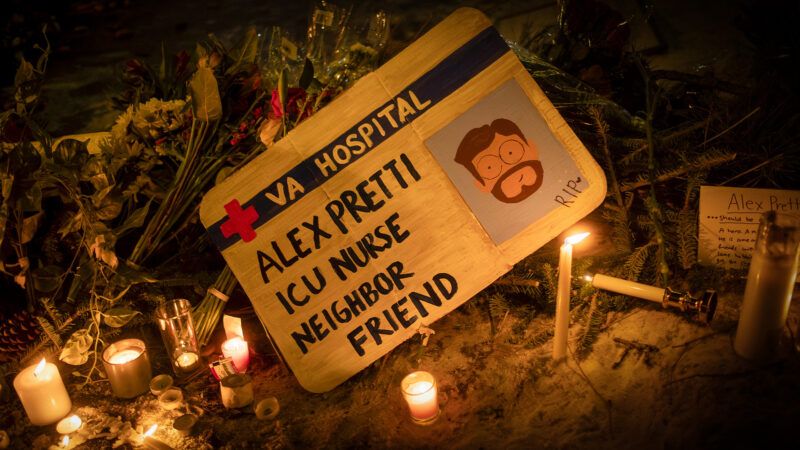
The killing of Alex Pretti by U.S. Border Patrol agents in Minneapolis, Minnesota, is hard to defend for anyone who watched the video of his horrifying slaying.
Only a few of the most rapid anti-immigration hawks on social media are still arguing that Immigration and Customs Enforcement (ICE) agents were in the right when they shot a restrained, unarmed Pretti multiple times.
Even President Donald Trump has walked back some of his immediate slanders of Pretti. The administration is now seemingly making moves to get its operation in Minneapolis under control.
Lest they cede too much ground to anti-ICE protestors, more sophisticated conservatives are saying that while the Pretti shooting was regrettable or unnecessary, the 37-year-old intensive care unit nurse would still be alive if he had merely chosen to stay home instead of interfering with the Trump administration's immigration crackdown in the Twin Cities.
Hear political commentator Megyn Kelly say that it's easy to avoid being shot by federal agents if only one stays indoors.
Megyn Kelly: "I know I'm supposed to feel sorry for Alex Pretti but I don't. You know why I wasn't shot by Border Patrol this weekend? Because I kept my ass inside and out of their operations."
pic.twitter.com/CNZkoUmXj9— Republicans against Trump (@RpsAgainstTrump) January 27, 2026
Or witness National Review's Rich Lowry's frustration on X that protesters' resistance to ICE is generating more and more on-camera abuses by ICE agents that undermine the legitimacy of their mission.
The Left is in a cycle of constant self-radicalization—the resistance to ICE creates the predicate for tragedies that are used to justify ever-more resistance and the demand for the de-facto nullification of federal immigration law in Minneapolis
— Rich Lowry (@RichLowry) January 25, 2026
There's something trivially true about both sentiments when applied to Pretti and Renee Good, the woman shot in her car by an ICE agent a few weeks prior.
Had both stayed home and out of ICE's way, they'd still be alive. Had neither been shot, the surge in support for abolishing ICE and the public's general souring on the administration's immigration crackdown would not have happened.
Their true statements still involve a remarkable amount of blame-shifting from perpetrator to victim, particularly in Pretti's case.
Kelly and Lowry's points also contain a pretty damning admission about the nature of the state's immigration restrictions: the less popular they are, the more violence will be required to enforce them.
All state laws ultimately rest on the threat of violent enforcement. Libertarians have long been making this point.
That's what the old adage "taxation is theft" is meant to highlight. If you don't pay your taxes, eventually men with guns will take your money and put you in prison. If you resist, you might well get shot.
The fact that IRS agents aren't periodically gunning people down in the streets doesn't mean this threat of violence isn't real. And the fact that most people dutifully file a tax return each year doesn't make taxation fully consensual.
People's peaceful submission to the taxman rests in part on an acknowledgement of the costs of resistance and an acceptance that a world where people pay their taxes is a better one than a world where people don't.
Even libertarians who believe taxation is theft, but have not gone into full tax-strike mode, agree with the latter point. Their willingness to pay taxes, even under protest, reveals a belief that it's better to whittle down the state through normal political means of legislation, advocacy, and education than outright resistance.
It would be wrong to call this arrangement a "social contract." But it is a social truce between individuals and the state.
Of course, that truce would not last long if IRS agents regularly gunned down people who didn't submit their W-4s or claimed unjustified business expenses.
Whatever truce existed on the issue of immigration enforcement has likewise broken down under the Trump administration's flashy, violent, and incompetent deportation drives in Minneapolis and elsewhere.
As people watch masked federal agents drag their fellow citizens from their homes, raid businesses, arrest people at their work, and assault peaceful protestors, their willingness to accept the execution of immigration restrictions they vehemently disagree with declines.
Instead of staying home, they go out into the street to protest, to film ICE agents, to blow whistles, etc. That opposition has elicited more violence from federal officials, and thus more resistance from individual citizens.
Lowry describes this as "self-radicalization," but it is more accurately described as individual activation against persistent state violence and abuse.
A common right-wing defense of the Trump administration's immigration crackdown is to say, "This is what I voted for." Very well. But a lot of people did not vote for Trump's immigration crackdown. Even fewer are pleased with its implementation.
Whatever social truce that would have allowed for a more hawkish enforcement of immigration laws has evaporated.
Supporters of that hawkish enforcement need to acknowledge that their vote is no longer enough. They're left with either supporting continued ICE violence and more shootings of citizens like Pretti or accepting that their goal of more deportations isn't worth more bloodshed.
ICE protestors likewise have to decide for themselves how much risk they're willing to accept when protesting the efforts of ICE agents.
One would hope that largely progressive protestors' exposure to state violence might engender in them a wider appreciation that many laws—not just visa requirements—are enforced at the barrel of a gun.
For instance, Pete Buttigieg, the former Democratic presidential candidate and Biden administration transportation secretary, irritatingly called on libertarians to "step up" and join the anti-ICE chorus.
If there was ever a moment for libertarians and conservatives to step up and join the rest of us, we're in it.
Americans have to unite and stop this descent from a freedom-loving nation into the kind of place where masked, militarized government agents are sent to politically…
— Pete Buttigieg (@PeteButtigieg) January 24, 2026
Libertarians have long been in favor of abolishing ICE, along with most aspects of immigration enforcement. They've also been adamant supporters of Second Amendment rights, something Buttigieg, a supporter of expanded firearms restrictions, can't say.
In the wake of the Pretti shooting, administration officials pointed to the fact that he was legally carrying a firearm to justify ICE agents' shooting him. In that context, perhaps Buttigieg and his fellow progressives could also "step up" and concede that enforcing additional restrictions on now-legal gun ownership is not worth killing people over either.
If one isn't willing to accept federal agents' guns going off in the context of immigration enforcement, you should question the many other state mandates that could ultimately be enforced with deadly violence.
