
Border Patrol Agents Killed Alex Pretti. Why Is Border Patrol in Minneapolis at All?
Federal agencies have considerable authority outside their given jurisdiction, even when they don't have the training to match.
Over the weekend in Minneapolis, agents with U.S. Customs and Border Protection (CBP) shot and killed bystander Alex Pretti. It was the second time a federal officer killed a protester in Minneapolis in the month of January, after Immigration and Customs Enforcement (ICE) agent Jonathan Ross shot Renee Good in her car just two weeks earlier.
Right away, officials said Pretti—who had a legally registered handgun in a holster—was trying to kill or injure the officers, who shot him in self-defense. This claim is contradicted by numerous videos of the interaction, which show Pretti holding a cell phone and never appearing to reach for his weapon. It also casts doubt on the Department of Homeland Security's (DHS) pledge to investigate the shooting, especially after having prejudged the outcome.
One aspect of the shooting that shouldn't go unaddressed is what the CBP—which many Americans know as "border patrol"—was doing in Minneapolis, hundreds of miles from the nearest international border, at all. In fact, federal agents have considerable authority even outside their given jurisdiction. But this can have deadly consequences, especially when they're also operating outside what they're trained for.
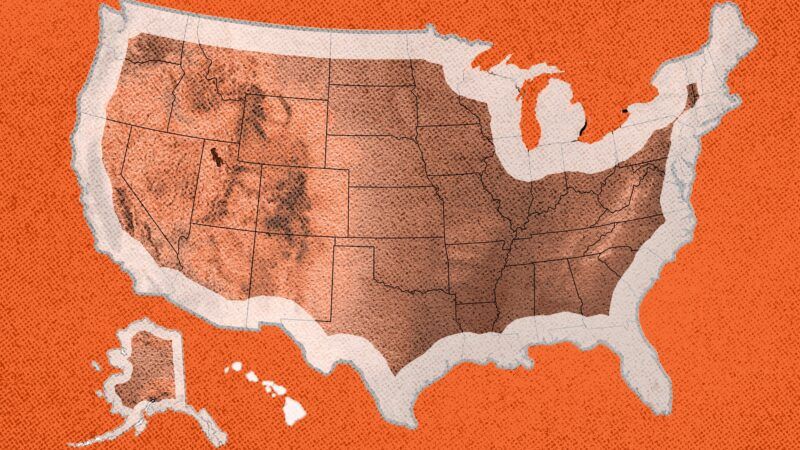
U.S. law allows the CBP to conduct stops and searches "within a reasonable distance from any external boundary of the United States." Federal regulations define reasonable distance as "within 100 air miles" from any international border—be it the land borders with Mexico or Canada, or the eastern or western coastlines.
This includes many of the largest American cities, including New York, Chicago, Boston, and Washington, D.C., plus all of Florida and most of New England and California.
As a result, two out of every three Americans live within CBP's jurisdiction and are subject to being stopped and searched as if they were crossing the border from Canada or Mexico.
But Minneapolis falls outside the 100-mile zone; so, for that matter, do Charlotte and New Orleans, where the CBP was deployed in November. In fact, border officers have considerable authority even outside of the already-generous "border zone."
Under the Immigration and Naturalization Act, both CBP and ICE "share a set of nationwide enforcement authorities," according to the American Immigration Council—like the ability to stop, interrogate, or arrest anyone suspected of being in the U.S. illegally or even of having committed a felony unrelated to their immigration status. "The Trump administration has taken this authority to the extreme, sending Border Patrol and ICE 'roving patrols' to terrorize communities."
The DHS justified its action in Minneapolis by saying it was necessary to target immigrants from Somalia. This came after news broke nationally in December about a yearslong scheme in which fraudsters, including numerous people of Somali descent, used Minnesota day care centers to bilk Medicare out of billions of dollars.
Soon after, President Donald Trump claimed Somalians "contribute nothing. I don't want them in our country." He also said Rep. Ilhan Omar (D–Minn.), herself a Somali refugee, and her "friends" were "garbage," and said the U.S. shouldn't "keep taking in garbage into our country."
"Almost 58% of the Somalis in Minnesota were born in the U.S.," the Associated Press reported. "And of the foreign-born Somalis there, 87% are naturalized U.S. citizens."
Still, agents surged into the state at Trump's request. "The largest DHS operation ever is happening right now in Minnesota," the department posted on X. Trump and DHS Secretary Kristi Noem, it added, "have rallied DHS law enforcement personnel to keep Americans safe and ERADICATE fraud."
But even if the government had only the best intentions, to find and remove only the most egregious offenders, that wouldn't justify the Minneapolis operation by the department's own logic. If the reason is to "keep Americans safe and ERADICATE fraud," that wouldn't explain sending thousands of armed troops into a city because a few dozen of its nearly 80,000 Somali residents have been arrested for a nonviolent crime.
Besides, ICE and CBP aren't trained to swarm into a city like an occupying army. We're now seeing the tragic results of that lack of preparedness.
"It's clear that these people who we're seeing, these federal government officers in Minneapolis, are obviously overwhelmed and poorly trained and inexperienced," former DHS adviser Tom Nolan told NBC News. "So when you see them on the street engaging with people, that's a security concern right there, because they don't know what they're doing."
"What I clearly see is Border Patrol agents put in harm's way when they have minimal training to the circumstances they're being pushed into," added Jason Houser, a former DHS and ICE official under President Joe Biden.
"We're seeing routinely substandard law enforcement practices that would just never be accepted at the local level," Arizona State University criminology professor Ed Maguire told ABC News earlier this month, after Good's death at the hands of an ICE agent. "Then there seems to be just an absence of standard accountability practices."
"It's highly unlikely that your typical ICE agent has a great deal of experience with public order tactics or control," agreed criminal justice professor Ian Adams.
Indeed, while much of ICE's use of force policy is redacted, versions that have become available through lawsuits show that de-escalation is not prioritized, and agents are allowed to use deadly force "immediately."
There is a difference between enforcing immigration laws and besieging a major city for spite. ("This operation is driven by nothing more than the Trump Administration's desire to punish political opponents and score partisan points," claims a lawsuit filed against DHS officials by the state attorney general.) Rather than simply getting violent criminals off the street, the Trump administration is stationing federal agents, who are ill-equipped for the task, as an occupying force in a major city.
Under current federal rules, the CBP has the authority to operate in cities far from an American border. But as the death of Alex Pretti demonstrates, that doesn't mean it should.
