
Ken Levine on BioShock, Ayn Rand, and Libertarianism
"What does completely, completely unregulated commerce look like?" Ken Levine's Bioshock will tell you.
There aren't many video games about political philosophy. Even fewer are about Ayn Rand and the outer limits of Objectivism. But BioShock is exactly that.
Released in 2007 to huge sales and near-universal acclaim, the first-person, science fiction shooter went on to become a touchstone in gaming, bringing moral and philosophical nuance to a genre defined by lowbrow shoot-'em-ups. The game is an interrogation of the notion of choice, giving players a sense of moral agency while toying with the formal conventions of video games in ways that reveal how empty many interactive game choices really are.
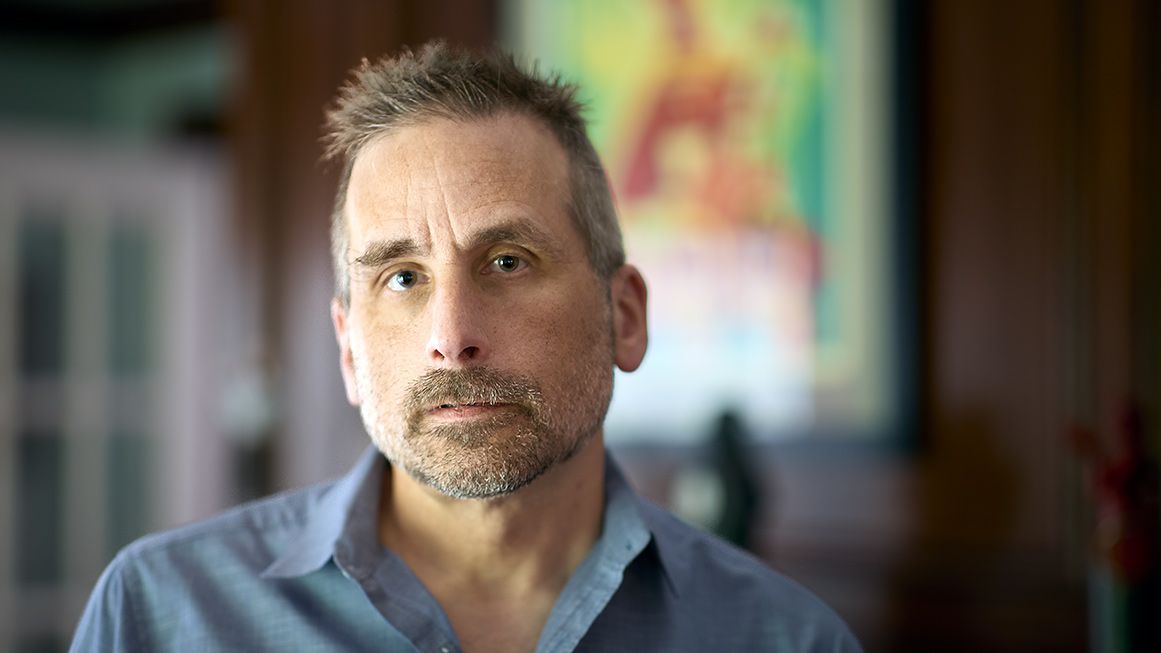
BioShock was created by Ken Levine, one of gaming's most elusive figures. He has sometimes described himself as both an individualist and a capitalist, and he says the game was inspired by Rand's uncompromising vision for society—and a question about what would happen if that vision were taken to a dystopian extreme.
In October, Levine spoke with Reason's Peter Suderman about how video games have changed, whether he'd be able to make BioShock now, and just how he ended up making a game about Rand in the first place.
Reason: How did you come to make a big-budget, first-person shooter video game about libertarianism, Objectivism, and Ayn Rand?
Levine: I had just read The Fountainhead. I wasn't particularly politically tuned into anything. I didn't really realize who [Rand] was and her larger philosophical mission.
But Rand writes a great potboiler, right? It's a great story about this architect and everybody's trying to destroy him. He stays true to his principles, and he's handsome and charming, and there's this woman who's just in love with him. And it was a great story, but I started to get the themes, which I thought were certainly interesting—her notion of altruism being a negative thing. That's obviously very different than what you're sort of brought up with, but I just found it a really interesting thought experiment.
The challenge I saw in the books is they were very much written by somebody who wanted her side to win, and therefore the characters can be a little one-dimensional. You have the architect and then you have the critic character—who's an amazing villain, who bribes him, blackmails him to change his work and to give up his artistic principles and he just won't, even to the point where he burns down an architectural construct he built rather than compromising it.
Also Rand, she's just a great speaker. She's a great character when she talks.
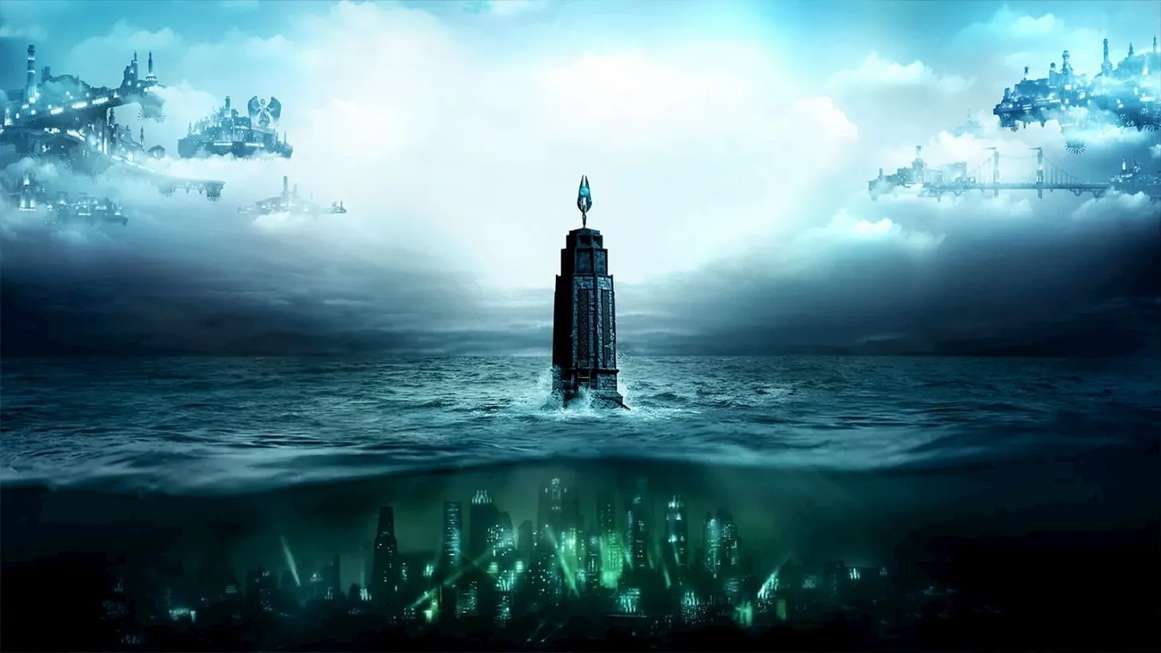
For those who don't know, the game takes the Rand idea and brings it to its extreme, very similar to what you see a lot of people talking about with seasteading and wanting to build a city on the ocean or underwater. I said, "Well, let's do a bit of a fantastical story about an Ayn Rand–like figure who does try to build a society where everybody adheres to her principles and nobody's going to come take that away from them, a sort of ultra anarcho-capitalist society where there are no limitations on growth, there are no limitations on creativity."
She had given me—just through her voice—such a great persona that I was really able to just transliterate that voice into this character, Andrew Ryan, who had a very similar background to her. Was born in czarist Russia, but then the Soviets came in and destroyed his family, just like what happened to Rand's family. I definitely thought that was a great origin story about somebody who was just constantly terrified of the Bolsheviks showing up at the door and turning his life upside-down again. I got that as a human being, and I'm like: "OK, let me see if I can try to tell a Randian-like story, but try to do it where the people are more like people I know, real people who have flaws." But I had no interest in saying, "Oh, screw Objectivism. I'm just going to make fun of it." I really want to engage with it, but how it intersects with real people rather than characters in a book.
Do you view the first BioShock as a critique of Objectivism?
No, I don't think it is particularly. I never set out to take down Objectivism or libertarians. Just the whole concept of this very interesting worldview: Can you make a better world if you really focus on just yourself and improving yourself?
And the idea, going back to Adam Smith, right? The baker doesn't bake bread because he wants to help other people; he bakes bread because he wants to make money to feed his family, but when doing so, he feeds the entire community. I just wanted to start with that principle, which is kind of true and brilliant. It's market economies, and I'm a big believer in market economies.
But then we said, "Well, what if you took the regulatory structure and you just completely destroyed it?" And of course, it's a video game. If I was writing a novel, I might've used a little more subtlety, but it's a video game. And so—because a player is not reading text on a page, he's engaging in this world, it's a first-person shooter—I try to think: What does completely, completely unregulated commerce look like?
Part of what makes BioShock such an enduring game and so powerful is that you wrote it so that both sides can see their ideas reflected in it.
Absolutely. I think it's really uninteresting to answer questions in art. I'd much rather pose interesting questions.
One of the things I'm proudest of is: I've talked to a lot of libertarians, a lot of Randians. I've never talked to one who played the game who doesn't like the game. I really try to think through what would be the positives out of a society like that—because there are going to be positives, right? When you really empower artists and thinkers and scientists in a way that allows them to avoid the extremes of the regulatory state. But then also at the same time examining, well, where is that line where regulation becomes critical to a functioning society? And that's what always interests me, not black and white issues. I like living in the gray.
Games are a tricky medium to tell a story. It's a game where you shove a gun in the person's hand and the primary interaction you're having is shooting things. So to do all the other stuff, we focus so much of the attention on the world you're doing it in.
Going back to our first game, System Shock 2, we always try to make the space believable that humans live there. By the time we got to BioShock, we were like, "OK, what is this world? If this world was created by this guy with these principles, what would the delta between this society be with our society?" And there's just an endless ground of material to dig up.
I get it, because I made a character of an artist in it who wants no limits to their art. In fact, his art actually even ends up involving murdering some of his acolytes and making them into a part of a triptych or a quadtych on display because he didn't believe in any limitations to his art.
As somebody who is an artist, who has a reputation for being uncompromising about the way you tell your stories, was that something that you felt a little bit of a connection with?
Yeah. Because, look, I'm very lucky that Take-Two, the company I work for, does not really come in and tell me what to do.
It almost happened on BioShock. There was a contingent that was pushing to get rid of the Little Sisters because they were worried about the backlash.
For those that don't know, the Little Sisters are these little girls who carry around this incredibly valuable resource in their stomach that you use to essentially gene splice yourself into anything you want. And part of the game is deciding: Do you do that to those girls or do you forgo that and try to survive in this deadly situation without those benefits? I wanted to give that economic question to the player.
That's interesting that you say that that's an economic question. If you understand game design, it's an economic question where you can decide which way you are going to build and power up your character over the course of the game. And that's an economy. But in the game, as a narrative question, it's presented as a moral quandary—as "What kind of person are you going to be?" How did you come up with that choice?
There's this thing in games called boss monsters where generally every few levels, you end up in a room with this big, tough boss and you fight them. I always hated those, because they felt like you were constraining the player. And I'm like, "Well, what if our boss monster in the game were these bosses you never had to fight and they were just defending these little girls?" And those became the Big Daddies and the Little Sisters. And the Big Daddies' mission was because the little girls were so economically valuable in the city, they were basically their escorts as they wandered around collecting this material which they ingest into their stomach, which they convert into this valuable resource.
The first idea I had was the notion of this protector character. Then I'm like, "Well, now that I've got Rand and I've got this protector character and you're really talking about anarcho-capitalism at the bottom of the sea, where might this go?" We came up with the notion that people could—and it's happening now, it wasn't happening at the time, but with CRISPR, you now have gene splicing.
But we sat down and we talked about what if you needed these little kids for your own survival to splice yourself so you could have survivability in this very dangerous collapsed society. And give the player an interesting choice to make, but also really carry that throughout the entire story and reflect the themes of Rand and when you need to regulate the market and when you do not.
That's always been an interesting question to me, as sort of a capitalist but very much understanding the need for regulation.
BioShock came out in 2007, and you were describing something that doesn't sound very obviously commercial on paper—a philosophical video game based on the ideas of Rand. But the game turned out to be this huge hit. What was it that pulled people in and keeps pulling people into this game and to this world?
I remember being at Rockefeller Center with my wife and we were still trying to figure out what the aesthetic was. We hadn't determined the aesthetic.
If you've been to Rockefeller Center, it's one of the only four square blocks, or a square block, in New York City that's one architectural style. It's all this beautiful expression of art deco. I saw it, and I remembered the cover of Atlas Shrugged I had was an art deco drawing of Atlas.
Rand loved those built urban environments.
Yep. Hated neoclassicism, loved modernism and art deco. And my wife and I just started taking pictures of the wall, the doorknob, the light fixture, everything. And I brought it back to the team when I got home and I'm like, "This is what this game looks like."
We locked into a visual art style and that really helped. If you look at the opening of BioShock, I basically try to take Rand's entire philosophy and crystallize it down to a 60-second Andrew Ryan speech and really deal with the principles and choices and being responsible for your choices and owning your life. And a resentment of the government and the church and all these people are trying to take control over you. And a sense of objective reality, that there is an objective reality.
When that game came out in 2007, the world of video game development was very different. Do you think that you could make BioShock now? And if you did, what would the reaction to it be like?
I don't think BioShock per se. Infinite, the next game, I think definitely would be a very different conversation. But BioShock, we did have a couple of journalists who tried to ambush me with things because you have the option to harvest or essentially kill these little girls to gain this resource.
The game lets you be a moral monster.
People did talk to me about it and they were very concerned. And that element almost got pulled from the game because the publisher got nervous. But we had a great defender of ours at the publisher who said, "No, without that there's no game." And so they let us do it.
It was really before social media. I'm sure you can't really do anything now without somebody getting upset about something. The next game, we got some shit about a bunch of stuff when it became much more about social media. Politics were a big discussion in the games industry, which they really weren't in 2007. We were one of the first to really bring any kind of real political notion into games. And people really just seemed to generally, universally like it.
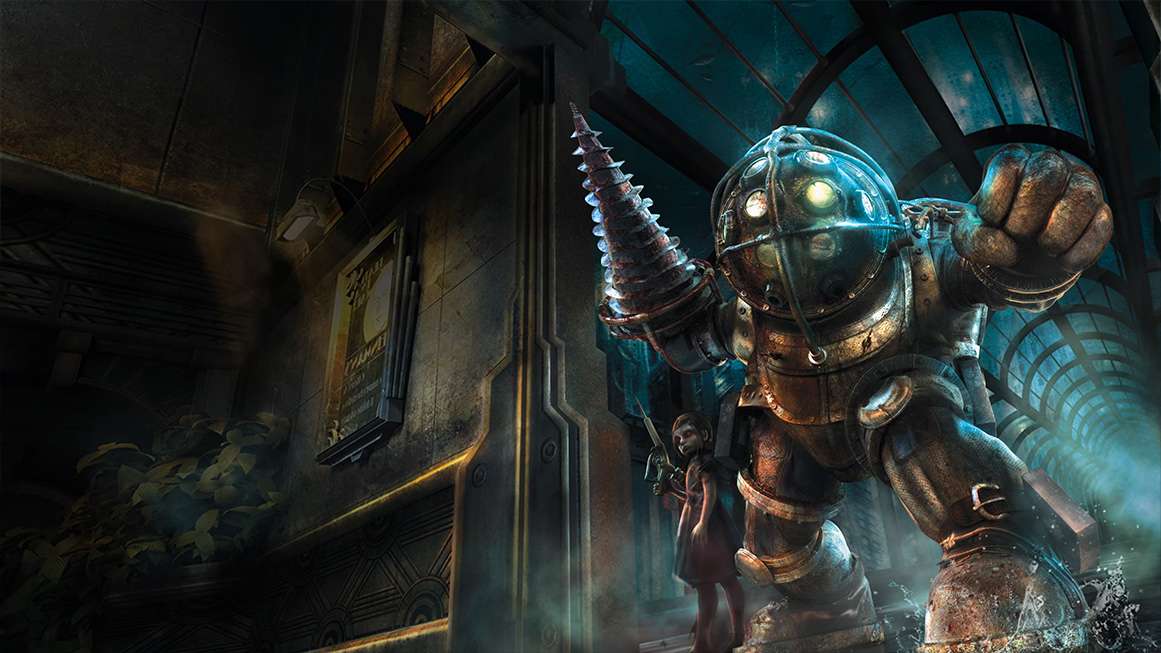
Let's talk a little bit more about BioShock Infinite. There was a sequel in between that you didn't really have much to do with, but BioShock Infinite is your follow-up and it is like the first game. It's set in a beautiful and incredibly engaging world. It's this dark and twisted vision of America. It's a city in the sky rather than underwater, and it's called Columbia—an early-1900s world that is supposed to be the ideal of America at the time. And this is, again, not exactly what you think of when you think of a big-budget commercial game that is an easy sell. How did you envision that world?
I had been reading a lot about the Gilded Age and period of manifest destiny and American exceptionalism. That was a big topic during the Iraq War. That topic of American exceptionalism came up a lot.
And it always struck me as a strange topic. I think America is exceptional because of what we do, not because there's some external factor that has blessed us that way. But there was a big conversation about American exceptionalism, and neoconservatism was a major factor at that time. I think I was writing a little bit out of reaction to that: What does it mean to be American?
And also seeing can America be defined in a very specific way, the sort of deification of the Founders. Personally, I adore the Founders. I think they're incredible people who figured out that separation of powers needed to be a thing, which is I think their most incredible innovation, but—
—and yet you also created a kind of a boss character who is a Founder bot, right?
Yeah, the Motorized Patriots.
And it's one of the most memorable, big fights in the game.
You've got a Benjamin Franklin robot and a George Washington robot.
It's very funny. It's thrilling, but also it's witty.
It was sort of a joke on the deification of any figure. I've talked to people who deify Rand, who say "I only do exactly what she says" and her word is gospel essentially. So you can turn anybody into a god. And I think people do that with the Founders.
The Founders, to be clear, I find to be exceptional, but they can get turned into people they weren't. They can get turned into these godlike figures who had no flaws. But that's what makes them amazing: As flawed, broken human beings, they did have a vision for the rights of man that wasn't happening anywhere else in the world. I also wanted to criticize how that could be calcified into a bunch of received wisdoms like a church.
We were also wondering: What is a BioShock game, exactly? We thought that being based in sort of an alternate history was an important part of it. Eventually you find out that the worlds are quite connected, even though at first you're like: "What the hell is this thing? It has nothing to do with the first game." Different characters, different time period, but also an exaggerated sense of history, a focus on these philosophical debates that happen within America about what is America, who's America for, that I still think resonate today.
Both of these games are about attempts to set up utopian societies that go wrong. They go wrong because they are ideological visions taken to their extreme, and because they are executed by people who are naturally flawed. Is that the through line here? Is that your worldview that you're trying to put in these games?
I don't talk about my politics very much, but certainly the notion of ideological capture, where people stop looking at reality and they keep looking at the text and say, "Well, the ideological text says this, so we have to do this even though the world's falling apart."
Look, people. We're descended from animals. We're not descended from angels. The best philosophies, the best ideologies, take that into account and manage that—that people have incentives and all those other things. But if you start from an ideology and you adhere to the ideology, quite often those rigid ideologies often lead to real disaster.
I know you just said you don't talk about your politics too much, but you've said here that you are at least amenable to capitalism in some form. I think in other interviews you have said that you are some flavor of individualist. How does that inform your artistry?
I think the first thing I do is I say "whatever my political views are, they don't get special treatment here." I'm pretty skeptical of all rigid ideologies and I don't really have one because, look, you use the tool for the job at hand and the job at hand often changes. When people say, "Well, I can't do that because I'm a Democrat," I'm like, "Well, what's the outcome? Does it matter?" Or vice versa. "I'm a Republican. I can't do it." "I'm a Libertarian and I can't do that."
I'm a big fan of taking things as they come and acting appropriately. It was really important to me, in terms of writing the games, that I really didn't want to write Andrew Ryan as a caricature. In fact, Rand's voice is so helpful there because she was real.
This is part of why I wanted to ask you about what you think would happen if the BioShock games were released today, because we now view everything through such a political lens. A game like BioShock Infinite is political art. At the same time, there are people who are viewing these things not as art—just as politics. Is that constraining for video games as an industry?
It seems like you have tried to avoid that, but your last release was in 2014. You have not put something out into the world that we exist in now. How do you see this affecting this kind of art and culture?
There's a moment in Infinite where the revolutionary group, we make clear, has their own moral challenges vs. the oppressor group, which you see in the founders of the city. But the revolution is an extremely bloody and violent revolution, like most revolutions tend to be.
The American Revolution was relatively squeaky clean, but there was still a lot of death and a lot of people cleansed out. You've got the loyalists being chased out of their homes. It was a mess. But most revolutions—I think about the French Revolution and the Haitian Revolution, they really devolved into a bit of a mess.
There were people who were pretty angry at the fact that I portrayed the revolutionary side as also having their own challenges. And that was interesting because we try to be very fair to everybody and we try to explain why they were so angry and why that might spin out of control. The Russian Revolution, Maoist Revolution—these are all not great examples of immediate peace and harmony.
I got a lot of crap about that, because there was a very particular viewpoint that it was racist or something to assume that that group of the underclass or the marginalized group would not stage a purely noble revolution. I got a bit of that. Probably, if it came out in 2020, it would've been a much bigger conversation, and that might've made some people very nervous.
But to me, that's never a disincentive. If you're not going to be brave about these things, well, you really shouldn't be a writer.
This interview has been condensed and edited for style and clarity.
This article originally appeared in print under the headline "Ayn Rand, the Video Game."
