

The GOP Looks Increasingly Like a Home for Elizabeth Warren and Bernie Sanders
Many Republicans are now openly embracing ideas from the progressive playbook. Call them "Depublicans."
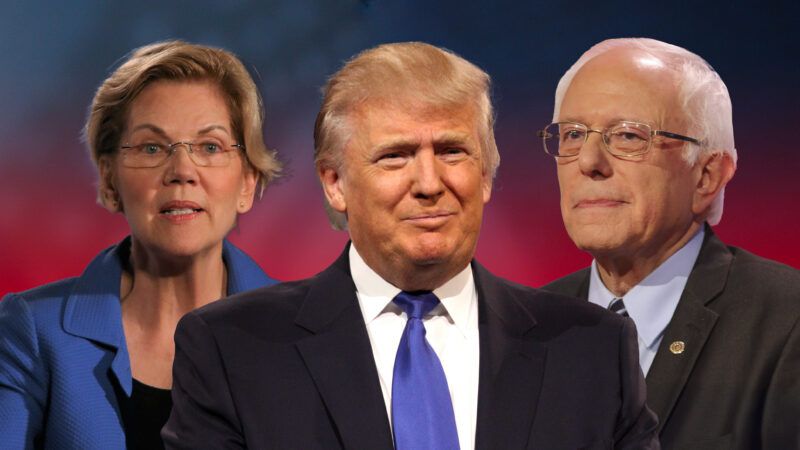
For some years now, conservatives who believe in free markets and limited government have been labeled RINOs—"Republicans in name only"—as GOP liberals or moderates have historically been known. The MAGA movement flings this term as an insult and a signal that respecting the realities of supply and demand instead of endorsing price controls is a character flaw.
But after watching the last few weeks unfold, it's hard not to ask this: If believing in markets makes you a RINO, what exactly do we call Republicans who now openly embrace ideas lifted from the playbooks of Sens. Bernie Sanders (I–Vt.) and Elizabeth Warren (D–Mass.)?
How about "Depublicans"?
The gradual transformation has been taking place since around the beginning of President Donald Trump's first term and is now unmistakable. With a few notable exceptions like taxes, deregulations, and the occasional bombing, those in power seem to behave like Democrats in Republican clothing. They have adopted many of their counterparts' instincts, rhetoric, and policy tools, including industrial policy, trade protectionism, corporate scapegoating, price controls, ownership restrictions, and discretionary federal intervention.
In just the past few weeks, Trump has floated—and senior members of his administration have defended—four policy proposals that would have been loudly denounced as socialist overreach had they come from the progressive wing of the Democratic Party. And for good reason. Progressives champion similar big-government policies.
Start with the proposal to ban institutional investors from buying single-family homes. This is not conservative policy; it's the federal government deciding who should be allowed to buy property based on identity rather than on behavior. It substitutes political discretion for voluntary market exchange and treats ownership itself as suspect.
The proposal rests on the false premise that allowing corporate investors to own and subsequently rent out homes is a major driver of high home prices. The practice is supposedly diverting capital away from construction, limiting the number of homes changing hands and crowding out owner-occupiers.
The data say something much different. Depending on the source, institutional investors own only about 1–2 percent of U.S. single-family homes. Estimates from the American Enterprise Institute and HousingWire show that even at the upper bound, this share is far too small to plausibly explain the 50 percent nationwide increase in home prices since the start of the COVID-19 pandemic.
Then there is Trump's suggestion that Washington control executive compensation at defense and aerospace companies, and even prohibit returning capital to investors through dividends or buybacks. This is not the administration's first move toward taking an active role in private American companies. For all intents and purposes, it has nationalized the steel industry and taken equity stakes in 11 other U.S. companies such as Intel and MP Materials.
Trump is dissatisfied with the defense industry's performance. However, U.S. firms did not become the global leader by patriotic virtue alone; they did it with capital, incentives, and by rising to meet competitive pressure. If we treat them as a public utility, we'll end up with stagnation.
Next comes the idea of ordering Fannie Mae and Freddie Mac to purchase $200 billion in mortgage-backed securities, a kind of housing-specific version of the Federal Reserve's quantitative easing, in an effort to lower mortgage rates. Conservatives spent the last election cycle correctly explaining that subsidizing demand in a supply-constrained housing market only pushes prices higher.
That logic doesn't change when the subsidy runs through government-sponsored enterprises jawboned by Trump. Manipulating mortgage rates without loosening supply is how you inflate bubbles, not how you make homes affordable.
Finally, there's the proposed 10 percent cap on credit card interest rates. Price controls on unsecured credit don't make borrowing cheaper; they make it disappear for anyone deemed risky. When banks cannot price risk to certain borrowers, they stop lending to them. But borrowers don't stop needing credit; they just get pushed into far worse alternatives.
What makes this moment so revealing is that these ideas are not musings or trial balloons. They're echoed and defended by the administration, promoted in the Senate by the vice president, touted by legislators like Sen. Josh Hawley (R–Mo.) and increasingly normalized across the populist right.
Don't be fooled by the replacement of progressive jargon with nationalist rhetoric. This economic crusade will harm the workers and non-rich it is supposed to help. It will raise prices by restricting supply, reduce market access by imposing controls, and replace opportunity with favoritism and discretion. Worse, it will erode the institutional foundations, capital markets, investment incentives, and predictable rules that enable long-run prosperity.
If believing in free markets makes you a RINO, fine. But let's at least be honest: The GOP is not becoming more conservative. It's becoming more comfortable with Democrats' positions such as bans, controls, and government direction of private economic life. Republicans are becoming Depublicans.
COPYRIGHT 2026 CREATORS.COM




