
Mike Johnson Says He Has 'No Intention' of Letting Congress Vote on Trump's Tariffs
A House rule prohibiting tariff resolutions from coming to the floor will expire at the end of the month and is unlikely to be renewed.
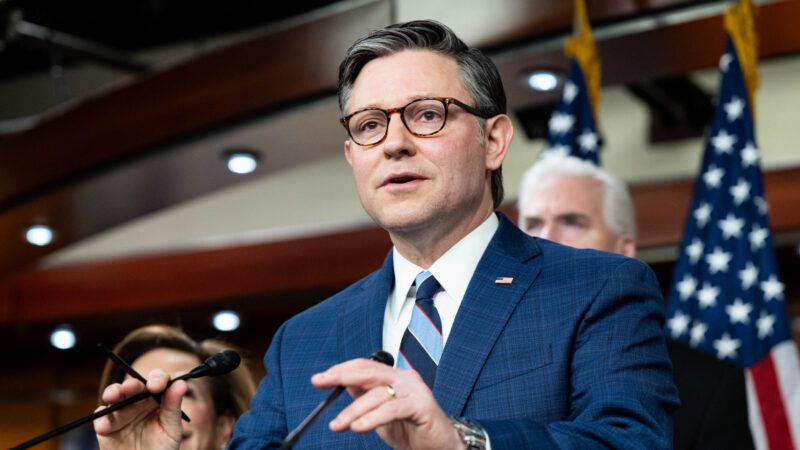
Even as one significant hurdle to a congressional vote on President Donald Trump's tariffs is set to expire in the coming days, another major obstacle remains in place: Speaker of the House Mike Johnson (R–La.).
Since early last year, the House has operated under a self-imposed ban that prevents members from requesting a vote that could cancel the various tariffs Trump has imposed via the International Emergency Economic Powers Act (IEEPA). That ban, however, comes with an expiration date of January 31 (it was originally March 31, but Congress voted in September to shorten the timeframe).
Asked on Wednesday if he would support extending that provision in the House rules, Johnson told reporters that Republican leaders were still in the process of "determining" that. Reporting by Politico's Meredith Lee Hill indicates that there is not enough support in the House Rules Committee (or in the chamber more generally) to renew that provision.
"We've already made it clear where we stand," Rep. Don Bacon (R–Neb.) told Politico. "The rule won't pass." Rep. Tom McClintock (R–Calif.) also recently told Politico that he would oppose any effort to prevent tariff votes.
When the House's rule blocking tariff resolutions was last brought up for a vote, in September, three Republicans voted against it: Reps. Kevin Kiley (R–Calif.), Thomas Massie (R–Ky.), and Victoria Spartz (R–Ind.).
In a comment to Reason on Wednesday, Massie said he was unsure whether the Rules Committee would hold a vote on "language to block a tariff vote," but added that he informed Republican leaders of his intention to "vote no again on any resolution that included that troublesome language."
If you assume from their public comments that Bacon and McClintock are also "no" votes, that's enough to carry the day, given Johnson's slim majority.
Still, Johnson left no doubt on Wednesday about where he stands.
"I have no intention of getting in the way of President Trump and his administration" on the tariff question, Johnson said Wednesday. "He has used the tariff power that he has under Article II very effectively. He has not exceeded his authority. There is no reason, in my view, for the Article I branch to intervene."
That second bit requires a little fact-checking. Despite what Johnson says, there is no Article II tariff authority—the U.S. Constitution vests all power over trade, tariffs, and taxes with Congress in Article I. The fact that Congress has delegated wide amounts of tariff power to the executive branch does not change that.
Constitutional inaccuracies aside, Johnson's remarks are telling in two other ways. First, he's signaling his intention to oppose any efforts to bring tariff resolutions to the House floor, even in the absence of an actual House "rule" prohibiting such a thing.
Secondly, Johnson is assuming that the rest of Congress shares his passive, supine approach to Trump's tariffs. Johnson might sincerely believe there is "no reason" to intervene, but at least some members of Congress disagree—a bipartisan group of lawmakers has introduced multiple resolutions to block Trump's tariffs and restrict his IEEPA powers. Three such resolutions have already been passed by the Senate.
The only way to determine whether "the Article I branch" should intervene is to hold a vote in which members can say if they want to intervene.
That is, of course, the very thing Republican leaders have been prohibiting for months, and the thing Johnson is now saying he does not want to do, even after the ban expires.
The expiration of that ban is the first step toward Congress reasserting its proper powers over tariffs, and the role granted to it by the IEEPA statute, which plainly authorizes congressional power to overturn a president's emergency declaration and any actions—like Trump's tariffs—that spring from it.
Once that hurdle is out of the way, we might finally get a vote that actually matters on the question of Trump's tariff powers, whether Johnson likes it or not.
