
As ICE Cracks Down Harder, Support for Abolishing ICE Surges
A plurality of Americans now say they'd like to end the agency.
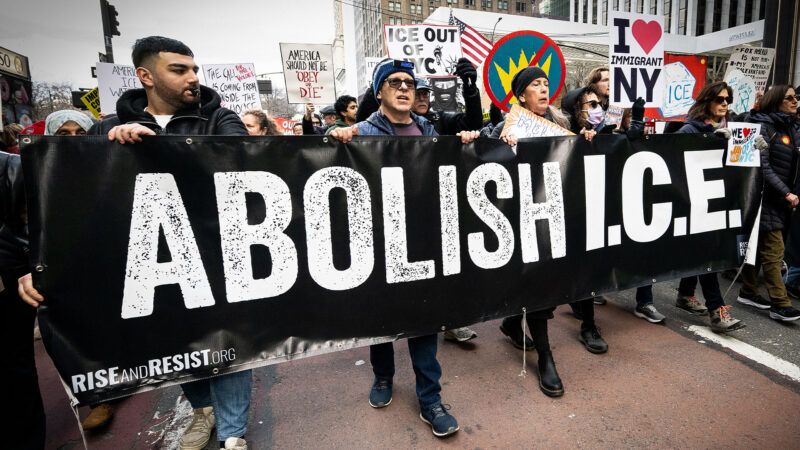
Donald Trump was reelected to the presidency in 2024 after pledging to carry out the "largest deportation operation in American history." In the first year of his second term, he followed through on his promise, weaponizing the agencies of the U.S. Department of Homeland Security (DHS) and deploying thousands of federal troops into major U.S. cities like an occupying army.
Earlier this month, the death of Renee Good at the hands of Immigration and Customs Enforcement (ICE) officer Jonathan Ross brought overly aggressive federal law enforcement into public view. As a result, more Americans than ever now think we should get rid of it.
"More Americans now support the abolishment of ICE, in a major change since July and in Donald Trump's first presidency," Forbes' Mike Stunson wrote last week, "as the fatal shooting of Renee Good by a federal officer has led to a wave of backlash against the agency."
Stunson cited a January 2026 poll conducted by The Economist and YouGov, which found that 46 percent of respondents support abolishing ICE, with 43 percent opposed. The same poll found 50 percent felt Good's shooting was "not justified," while only 30 percent said it was justified.
A separate poll by Civiqs found 43 percent of respondents support ending ICE, with 49 percent opposed. Notably, though, this represents a dramatic shift since only a few months ago. In September 2024, only 19 percent supported, and 66 percent opposed, abolishing the agency.
It was also the highest number in favor of abolition, and the lowest number against, since Civiqs began asking the question in July 2018, when the #AbolishICE movement began in earnest. (At that time, respondents favored keeping the agency intact by a 2–to–1 margin.)
And an Associated Press/NORC poll shows 61 percent of Americans now oppose Trump's handling of immigration; as recently as March 2025, respondents were evenly split.
The reason for the shift is clear: Americans are suddenly confronted with the reality of what ICE is doing, and they don't like what they see.
"Trump has deployed 3,000 federal officers and agents to Minneapolis this month, the largest operation in DHS history," Nick Miroff wrote last week in The Atlantic. "Many of the ICE officers and Border Patrol agents are outfitted in tactical gear and wear body armor and masks, and they're using the technological tools that the department acquired to protect the country's borders: surveillance drones, facial-recognition apps, phone-cracking software. Powered by billions of dollars in new funding, they are making immigration arrests and grabbing protesters who try to stop them."
In August 2025, ICE announced a major recruitment push, offering perks like a $90,000 salary and a signing bonus of as much as $50,000. DHS recently announced that in just four months, ICE more than doubled its ranks, from 10,000 to 22,000.
Those numbers may not be accurate: NOTUS' Jackie Llanos writes that according to the government's official employment statistics, since Trump took office in January 2025, ICE "has hired 7,114 employees" but 1,746 have left in the same period, "placing the net growth of employees at 5,368."
Still, a 50 percent increase in one year is substantial. And such a quick expansion doesn't come without tradeoffs: "ICE reduced training requirements to meet hiring targets," Military.com reports, "though the agency has not been transparent about the criteria used to determine which recruits qualified for abbreviated training pipelines or how those changes were evaluated internally."
For example, NBC News' Julia Ainsley reports that due to a technical glitch, about 200 recruits with no law enforcement experience were placed in a fast-tracked training process for experienced officers.
The results are plain to see: ICE officers assaulting U.S. citizens, smashing windows and dragging them from their cars, going door-to-door without a warrant or even reasonable suspicion. In October, ProPublica reported ICE had arrested at least 170 Americans—in many cases using considerable force—including some who were detained for multiple days without being allowed to contact their families or an attorney.
Ross was apparently even recording Good with his cellphone when he pulled his weapon and shot her. Soon after her death, media outlets released the footage; the shooting is not depicted, but afterward, someone can be heard saying, "Fucking bitch."
Social media is full of videos of ICE raids gone wrong, but the government has also saturated the internet with footage of its own.
"During President Donald Trump's second term, ICE's public affairs arm has rapidly transformed into an influencer-style media machine, churning out flashy videos of tactical operations and immigration raids," The Washington Post reported last month. Citing internal chat logs, the Post added that this team "coordinate[s] with the White House" to generate "brash content showing immigrants being chased, grabbed and detained" with "video edits that might help legitimize the administration's aggressive stance."
"In President Trump's second term, content is governing and governing is content," added NPR.
This may explain why Ross was filming Good when he drew his gun and shot her: to create content for social media.
And much of that content is distasteful: Last month, on its official X account, Trump's DHS "publicly announce[d] its dream to somehow eliminate 100 million people, the majority of whom would need to be citizens to hit that number, whose ancestry is seen as 'third world,'" writes Reason's Brian Doherty.
And in recent months, the DHS and ICE have posted recruitment ads with white nationalist imagery—including an Instagram post two days after Good's death that used a song popular with neo-Nazis.
It's clear the more that Americans are exposed to ICE and its methods and tactics, the less they think the agency should continue to exist. And this is not an extreme position: Both ICE and the DHS are quite new, established in the early 2000s.
And it's not like either was without controversy, even in the aftermath of 9/11. "There were fears at the time of DHS's founding, including on the political right, that the government was creating an authoritarian monster," The Atlantic's Miroff added. "The United States had never had the kind of all-encompassing domestic-security apparatus common in autocracies, whose interior departments function as political police. DHS skeptics worried that civil liberties would be vulnerable to abuse if the government began assembling national databases and an expanded federal police force."
And yet, that's exactly what happened. "ICE has routinely shown itself to be an overreaching and unaccountable agency," Fiona Harrigan wrote in the December 2024 issue of Reason. "Georgetown University's Center on Privacy and Technology found that ICE has scanned the driver's license photos of one in three American adults and could access the driver's license data of three in four American adults."
"ICE's current powers and central deportation mission are neither appropriately sized nor easily reformed," Harrigan added. "It would be much better for the government to extend an olive branch to nonviolent undocumented immigrants, reassign ICE's useful functions elsewhere, and let the agency go once and for all."
"Leaving immigration restrictions more to the states would bring us closer to the Constitution's original meaning," agrees George Mason University law professor Ilya Somin. "We may not be able to fully restore the original meaning of the Constitution on this score. But abolishing ICE and shifting more law enforcement resources to state and local governments would bring us closer to it. It would also simultaneously curtail ICE abuses and reduce crime."
The U.S. went nearly its entire existence without ICE; it could do so again. And the more that Americans become familiar with the agency and see what it does, the more they seem to agree.
