
'Pregnant? Don't Want To Be?' Ads at South Dakota Gas Stations Spark First Amendment Battle
Mayday.Health ads that direct people to an informational website about abortion access are deceptive advertising and must be banned, the state argues. That’s unconstitutional, counters Mayday.
In the pre-Roe days, nearly 20 states had some sort of law against abortion advertising or publishing information about abortion. In 1975, the U.S. Supreme Court said these were unconstitutional.
Now First Amendment battles over abortion are back. In some states, authorities hostile to both abortion and free speech cite the overturning of Roe as justification for nouveau censorship schemes. If abortion is illegal in a certain locale, they argue, then promoting it there—even if the acts in question would take place out of state—should be illegal too.
And in South Dakota, they've gotten creative: They're claiming that informational abortion ads constitute deceptive advertising.
The matter is now headed to both state and federal court.
You are reading Sex & Tech, from Elizabeth Nolan Brown. Get more of Elizabeth's sex, tech, bodily autonomy, law, and online culture coverage.
The case stems from gas station ads purchased by Mayday.Health, which bills itself as "a reproductive health education nonprofit." Per the Mayday website, its mission "is to share information about abortion pills, birth control, and gender-affirming care in any state."
The group does not sell or prescribe abortion pills itself, nor is it affiliated with any abortion providers or clinics. "We just want people to know their options," it says. To that end, the group provides a wealth of information about groups that can provide everything from "inclusive therapy" to telehealth abortion pill prescriptions.
"South Dakota Attorney General Marty Jackley has sent a letter to Mayday Health ordering the company to immediately cease and desist the deceptive advertising of the sale of abortion pills in South Dakota and said the state may bring a lawsuit against the company if it does not comply," Jackley's office announced on December 10. The investigation into Mayday ads was launched at the request of South Dakota Gov. Larry Rhoden.
While abortion is generally banned in South Dakota, as is administering or procuring abortion-inducing drugs, Mayday is clearly not engaged in either endeavor. It's a website. An information clearinghouse. That's all.
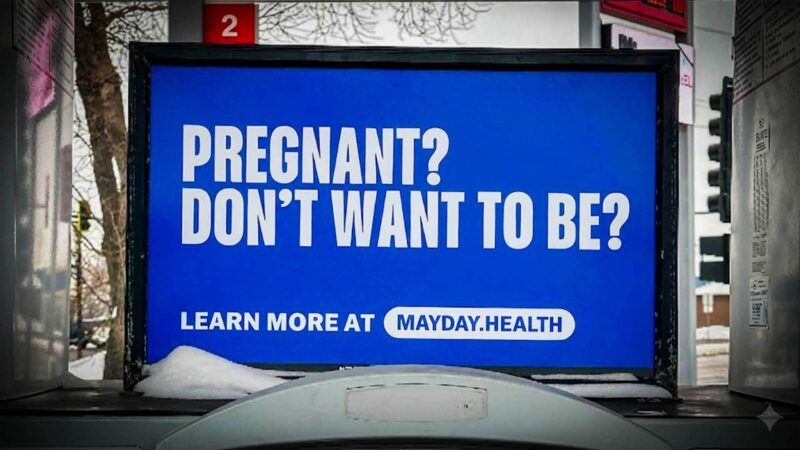
Mayday's gas station ads simply say: "Pregnant? Don't want to be? Learn more at Mayday.Health."
Jackley argues that because these ads don't clearly "state the prohibitions listed in state law," they are somehow deceptive. But nowhere do the ads imply that abortion is legal in South Dakota. They simply direct people to a website where they can learn more about abortion access, including options that would involve traveling out of South Dakota to terminate a pregnancy (something the state cannot ban).
Unsurprisingly, Mayday refused to remove the ads from South Dakota gas stations.
So, two days before Christmas, Jackley's office announced that it had filed a lawsuit in South Dakota's Hughes County Circuit Court requesting a preliminary or permanent injunction against Mayday and another company, Momentara, preventing them "from engaging in the deceptive advertising of abortion-inducing pills and abortion services in this state," per the state's motion. The motion says that Momentara facilitated Mayday's "deceptive abortion advertisements."
The main gist of the complaint is that Mayday's website tells people how and where to travel out of state for an abortion procedure or how to find telehealth doctors out of state who will prescribe them abortion pills.
It also objects to the Mayday website's answer to the question of whether someone will be punished for taking abortion pills: "Research shows that hundreds of thousands of people have received and used pills by mail over the past few years with no legal problems." South Dakota suggests the company should instead advise consumers "that it is illegal to mail abortion-inducing drugs into the state of South Dakota." It also suggests that Mayday should have an extensive section on abortion-pill side effects.
But Mayday's answer is not incorrect, and the company is under no obligation to say exactly what the state of South Dakota wishes it would say. In fact, a stricter warning could itself be deceptive, since it is not a crime for a pregnant woman to take abortion pills in South Dakota.
A preliminary hearing on Jackley's motion is scheduled for Friday, January 16, at South Dakota's Hughes County Courthouse.
This isn't the only legal action involving Mayday's South Dakota ads. Mayday has also sued Jackley, in federal court.
"This action seeks to prevent Defendant South Dakota Attorney General Marty J. Jackley from punishing Plaintiff Mayday Health for publishing truthful information about reproductive healthcare," states Mayday's complaint. "The First Amendment prohibits
the Attorney General from retaliating against Mayday and restraining its speech because of hostility toward Mayday, the information Mayday publishes, and the beliefs that impel Mayday to publish it."
The American Civil Liberties Union (ACLU) seems to agree. "Despite the state's near-total ban on abortion, the governor can't prevent information about abortion from being shared in South Dakota," it posted in December, when Jackley first sought to stop Mayday's advertising. "The United States Supreme Court considers speech about abortion protected speech under the First Amendment and has reaffirmed that position multiple times since Bigelow v. Virginia in 1975."
In related news, the state Supreme Court in Wyoming—home of "the country's first explicit ban on abortion pills," per the Associated Press—has struck down the state's abortion pill ban and another state law banning abortions. "Wyoming is one of the most conservative states, but the 4–1 ruling from justices all appointed by Republican governors was unsurprising in that it upheld every previous lower court ruling that the abortion bans violated the state constitution," AP reports.
The plaintiffs in the Wyoming case argued that a 2012 constitutional amendment guaranteeing people the right to make their own medical decisions protected a woman's right to have an abortion. The amendment didn't specifically mention abortion, but it didn't exclude abortion either, and the justices opined that it wasn't for them to "add words" to the state constitution.
More Sex & Tech News
Several states are attempting to tax porn out of business. Allowing the government to heavily tax a specific category of speech — here, sex — is just another form of censorship. "Free" speech means freedom of speech, yes — but it also means the government can't charge you to do it. .
— Mike Stabile (@mikestabile.bsky.social) 2026-01-12T01:05:53.937Z
Updates on the Grok nudify controversy, in which xAI's chatbot has been stripping photos of people—mostly women, sometimes girls—without the consent of those pictured: Grok claimed last week to have limited image generation and editing, overall, to paying subscribers. But "as of Friday morning, image generation was still available to unpaid users through Grok's standalone website by simply confirming their year of birth when prompted," Forbes writer Martina Di Licosa reported last week.
Meanwhile, several Democratic senators have been calling on Apple and Google to yank X and Grok from app stores. Even if image generation is limited to paying subscribers, "all X's changes do is make some of its users pay for the privilege of producing horrific images on the X app, while Musk profits from the abuse of children," Sen. Ron Wyden (D–Ore.) told NBC.
A pilot program in Utah lets an AI system renew patient prescriptions. "The state sees automating routine prescription renewals as a way to ease pressure on providers while lowering costs for patients," Politico reports.
"How millennials fell out of love with the internet": Here's a Vox conversation notable for its nuance on what's wrong with today's internet. For instance, on algorithmic feeds, which pundits proclaim that "everyone" dislikes, Max Read points out that "when [Facebook staff] interview people, people will say they felt like their time was better spent with the algorithmic, FYP-type feeds than with the way Facebook was 10 years ago." Also:
Millennials like us, we were the protagonists of the internet for a really long time, because we were the people who grew up on it. We were the people who in our office knew the most about it. We were the people who created most of the content first on most of the social networks.
And we're not the protagonists anymore. Some of that is aging out. Some of that is, there are people who are even more raised by the internet than we were, who have been online for an even higher percentage of their lives.
"Saving America by Saving the Family": In a new report, the Heritage Foundation encourages the Trump administration to offer "massive tax credits for families with more children while capping alimony payments, enacting strict work requirements on social benefit programs, discouraging online dating, creating marriage 'bootcamp' classes and more," according to The Washington Post. And, oh boy, the "and more":
The report suggests public-private partnerships to honor and provide monetary awards for every decade a couple remains married. It calls for a 16-year-old age limit on social media and certain AI chatbots, and further age restrictions on access to pornography, and it argues that "climate change alarmism" demoralizes young people and dissuades them from having children….
The Heritage report also encourages local governments to institute a 'uniform day of rest' to limit commercial activity to 'set aside time for religious observance, family gatherings, outdoors activities, and rest.'
Gone were several ideas mentioned "in the spirit of furthering debate" in a previous draft, including banning pornography entirely and legal punishments for adulterers.
The eternal mixtape is now possible: Scientists have reportedly created a cassette tape that could hold every song ever recorded.
