
No Other Choice Is a Dark Satire of Capitalism and Masculinity
Is the problem big corporations? Or the modern man?
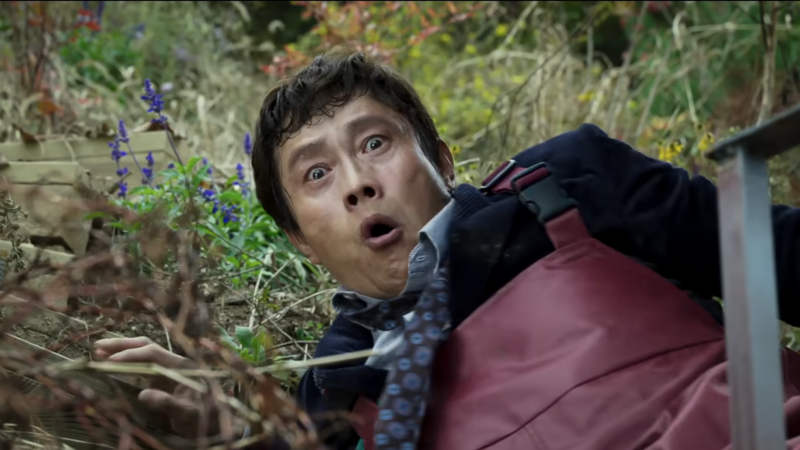
There's not much in the way of subtlety when it comes to the big themes of Park Chan-wook's No Other Choice. It's a movie about the soulless, zero-sum misery of late capitalism—a sharp, bleak, brutal, and surprisingly funny retort to the idea that corporate power leaves anyone with anything resembling real choice. I'm a libertarian who works for Reason. I have a generally sunny disposition towards both capitalism and corporations, which aren't perfect but have, on the whole, made societies richer and individual life more enjoyable. And yet I rather enjoyed this movie, not because I agreed with its critique of markets, but because it's the sort of ambitious, personal, high-wire film that can only be made in a world where real choice exists. And beyond the surface critique of corporate inhumanity, there's a deeper character study of modern masculinity to be found.
The setup mixes dark comedy with thriller noir in the way of the Coen brothers or A Simple Plan-era Sam Raimi. Yoo Man-su, a middle-aged man with a beautiful family and a comfy dream home, suddenly finds himself the victim of layoffs after an American company buys his specialty paper factory. He protests to one of the new owners, but is dismissed and told that there was "no other choice." It's one of the very few lines in the film spoken in English, and clearly meant as an indictment of American capitalism.
He sets out to find new work, but ends up lifting boxes as he realizes that most other specialty paper companies are downsizing too. All, that is, except one, which has exactly one senior-level job that he would be qualified for. The problem is that he's not the only one trying to score that position; there are a small number of other middle-aged paper factory managers who have similar qualifications. So he decides to kill his rivals, eliminating the competition. He feels he has no other choice.
It's an absurd setup, but Chan-wook sells it by leaning into comic hyperbole and exaggerated metaphor. It's a murder fable for our times, meant to be taken seriously but not literally. You're not expected to engage with the movie or its story on strictly realist terms; this is an elaborate exercise in narrative symbolism.
Buried in the movie is something darker, stranger, less overtly political, but no less incendiary. As Man-su sets out on his murder spree, he meets the other paper men he intends to kill—and he discovers they all have a lot in common. Man-su is a recovering alcoholic, and his first intended victim is a drunk who prides himself on analog living, holing up in a study with an audiophile sound system and too much whisky. Man-su is a great admirer of well-made objects, and at the start of the film, he gives his wife a pair of fancy high heels. The second man on his list has taken a job as a retail shoe salesman; he's also an engineer who prides himself on fix-it ability. In the opening scene, Man-su grills an eel delivered to him by his company, before he loses his job. The final target is not only a drinker, but a lover of barbecue who dreams of grilling every night at his swank new island hideaway. They are competitors, yes, but they are also a brotherhood, men given purpose by a specific line of work.
All of the men, meanwhile, have complicated relationships with women: divorce, distance, jealousy, and anger. This isn't a crisis of capitalism so much as a crisis of masculinity. It's a farce about what ails the modern man, what happens when he's left without work, without self, without purpose. It's a movie version of the memes: Men would rather kill their workforce peers than go to therapy. Is the cure for male loneliness murdering the competition?
What Man-su wants is more than just stability. He wants camaraderie, community, collegiality. When his plant downsizes, he initially protests that it isn't right, that the job is really about the other guys he works with. Yet in the movie's ironic metaphorical conceit, he goes on to pursue what amounts to a downsizing effort himself, culling the workforce to make it leaner. Did he perhaps have other choices, but refused them because of his masculine ego? The movie at least allows the possibility for those who are paying attention.
Chan-wook's most famous work is the twisted, tragic 2003 thriller Oldboy, a movie built on a series of bravura set piece shots. No Other Choice is somewhat more restrained, but its elegant formalism sometimes gives way to his old, stylish bravado. A key scene involves the guzzling of an Irish car bomb—a pint of beer with a shot of whisky in it—shot from an inside-the-glass perspective that makes the simple act of taking a drink seem like the most momentous thing in the world. Even if you don't buy its themes, it's a truly stunning movie just on a visual level.
And the fact that you can see it widely in American theaters is a triumph of global distribution. I'm old enough to remember when it was nearly impossible to see South Korean cinema in the U.S. outside of a few major cities. Yet over more than 20 years, Chan-wook has succeeded as a popular artist in the international movie marketplace. That's the real logic of contemporary capitalism: It gives movie viewers, movie makers—along with many other people—more choices. Thank goodness.
