

No Other Choice Is a Dark Satire of Capitalism and Masculinity
Is the problem big corporations? Or the modern man?
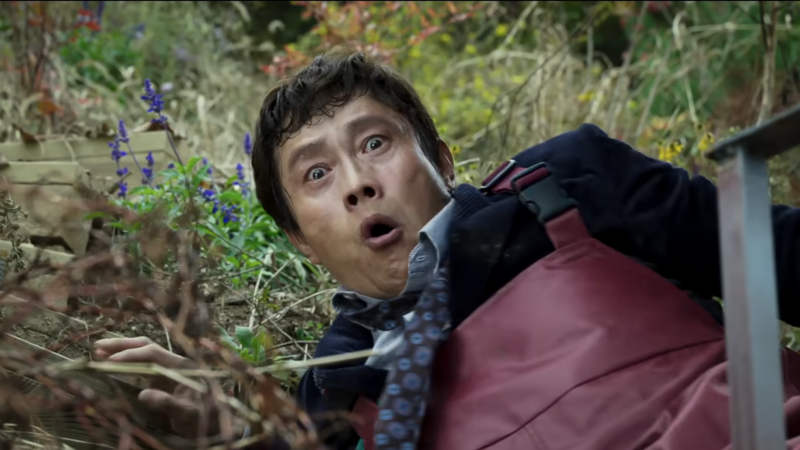
There's not much in the way of subtlety when it comes to the big themes of Park Chan-wook's No Other Choice. It's a movie about the soulless, zero-sum misery of late capitalism—a sharp, bleak, brutal, and surprisingly funny retort to the idea that corporate power leaves anyone with anything resembling real choice. I'm a libertarian who works for Reason. I have a generally sunny disposition towards both capitalism and corporations, which aren't perfect but have, on the whole, made societies richer and individual life more enjoyable. And yet I rather enjoyed this movie, not because I agreed with its critique of markets, but because it's the sort of ambitious, personal, high-wire film that can only be made in a world where real choice exists. And beyond the surface critique of corporate inhumanity, there's a deeper character study of modern masculinity to be found.
The setup mixes dark comedy with thriller noir in the way of the Coen brothers or A Simple Plan-era Sam Raimi. Yoo Man-su, a middle-aged man with a beautiful family and a comfy dream home, suddenly finds himself the victim of layoffs after an American company buys his specialty paper factory. He protests to one of the new owners, but is dismissed and told that there was "no other choice." It's one of the very few lines in the film spoken in English, and clearly meant as an indictment of American capitalism.
He sets out to find new work, but ends up lifting boxes as he realizes that most other specialty paper companies are downsizing too. All, that is, except one, which has exactly one senior-level job that he would be qualified for. The problem is that he's not the only one trying to score that position; there are a small number of other middle-aged paper factory managers who have similar qualifications. So he decides to kill his rivals, eliminating the competition. He feels he has no other choice.
It's an absurd setup, but Chan-wook sells it by leaning into comic hyperbole and exaggerated metaphor. It's a murder fable for our times, meant to be taken seriously but not literally. You're not expected to engage with the movie or its story on strictly realist terms; this is an elaborate exercise in narrative symbolism.
Buried in the movie is something darker, stranger, less overtly political, but no less incendiary. As Man-su sets out on his murder spree, he meets the other paper men he intends to kill—and he discovers they all have a lot in common. Man-su is a recovering alcoholic, and his first intended victim is a drunk who prides himself on analog living, holing up in a study with an audiophile sound system and too much whisky. Man-su is a great admirer of well-made objects, and at the start of the film, he gives his wife a pair of fancy high heels. The second man on his list has taken a job as a retail shoe salesman; he's also an engineer who prides himself on fix-it ability. In the opening scene, Man-su grills an eel delivered to him by his company, before he loses his job. The final target is not only a drinker, but a lover of barbecue who dreams of grilling every night at his swank new island hideaway. They are competitors, yes, but they are also a brotherhood, men given purpose by a specific line of work.
All of the men, meanwhile, have complicated relationships with women: divorce, distance, jealousy, and anger. This isn't a crisis of capitalism so much as a crisis of masculinity. It's a farce about what ails the modern man, what happens when he's left without work, without self, without purpose. It's a movie version of the memes: Men would rather kill their workforce peers than go to therapy. Is the cure for male loneliness murdering the competition?
What Man-su wants is more than just stability. He wants camaraderie, community, collegiality. When his plant downsizes, he initially protests that it isn't right, that the job is really about the other guys he works with. Yet in the movie's ironic metaphorical conceit, he goes on to pursue what amounts to a downsizing effort himself, culling the workforce to make it leaner. Did he perhaps have other choices, but refused them because of his masculine ego? The movie at least allows the possibility for those who are paying attention.
Chan-wook's most famous work is the twisted, tragic 2003 thriller Oldboy, a movie built on a series of bravura set piece shots. No Other Choice is somewhat more restrained, but its elegant formalism sometimes gives way to his old, stylish bravado. A key scene involves the guzzling of an Irish car bomb—a pint of beer with a shot of whisky in it—shot from an inside-the-glass perspective that makes the simple act of taking a drink seem like the most momentous thing in the world. Even if you don't buy its themes, it's a truly stunning movie just on a visual level.
And the fact that you can see it widely in American theaters is a triumph of global distribution. I'm old enough to remember when it was nearly impossible to see South Korean cinema in the U.S. outside of a few major cities. Yet over more than 20 years, Chan-wook has succeeded as a popular artist in the international movie marketplace. That's the real logic of contemporary capitalism: It gives movie viewers, movie makers—along with many other people—more choices. Thank goodness.

Editor's Note: As of February 29, 2024, commenting privileges on reason.com posts are limited to Reason Plus subscribers. Past commenters are grandfathered in for a temporary period. Subscribe here to preserve your ability to comment. Your Reason Plus subscription also gives you an ad-free version of reason.com, along with full access to the digital edition and archives of Reason magazine. We request that comments be civil and on-topic. We do not moderate or assume any responsibility for comments, which are owned by the readers who post them. Comments do not represent the views of reason.com or Reason Foundation. We reserve the right to delete any comment and ban commenters for any reason at any time. Comments may only be edited within 5 minutes of posting. Report abuses.
Please to post comments
Is the problem big corporations? Or the modern man?
No grasshopper, it is not.
It must be either Trump, or those damn leftists, right?
"If the problem isn't with corporations, then it must be modern men." is a pretty AWFL take/ideology.
I dunno, Peter, I'm surprised you liked this movie, considering that if it weren't an immigrant, it might have voted for Trump...
satire on masculinity & capitalism oh yay just what everybody wants
edit: >>an Irish car bomb—a pint of beer with a shot of whisky in it
Boilermaker. that's called a Boilermaker
Does he drop the shotglass in the pint in the movie? Otherwise yeah, it's a boilermaker.
Edit: Casual racism day is when you're allowed to call a drink made with whiskey that causes an 'explosion of carbonation' an "Irish car bomb" relating to Irish terrorism of the 'troubles' era.
Imagine some Arab-influenced food/drink product that had some gimmicky effect that everyone called the 9/11.
I've never heard the drink called a car bomb before but we're Irish back to the 1500s fighting John Bull so I don't mind lol
It's called the bacon wrapped hotdog
Buddhist Monk - pour one shot of everclear in a cup of green tea and set it on fire.
Happy casual racism day! Cheers everyone!
This is what happens when kids “edit” this rag
An Irish car bomb, Irish slammer, Irish bomb shot, or Dublin drop is a cocktail, similar to a boilermaker, made by dropping a bomb shot of Irish cream and Irish whiskey into a glass of Irish stout.
It absolutely is a boilermaker! And the "kill all your rivals" harks back to Kind Hearts and Coronets, where some 8 or so Alec Guinnesses are dispatched in various ways.
And the fact that you can see it widely in American theaters is a triumph of global distribution.
How was I seeing all those foreign films in the 1990s, Pete? I mean I guess it's possible this is just a passing comment on global distribution which has been a thing in the movie industry for literally decades, but it sure feels like you're suggesting this is a recent phenomenon...
The Modello commercials on TV today pointedly make use of Ennio Morricone's Ecstacy of Gold made famous by Sergio Leone's 1966 'spaghetti western', The Good, the Bad and the Ugly starring Clint Eastwood.
The internet has been around for 30 yrs. now and my kids know the composer of an Italian Western filmed 30 yrs. before I was born. I can't wait until the globalism fetish finally starts making people look like the historically-and-technologically illiterate backwoods morons that they are.
In fact, I'd seriously have to question anyone's opinion on the "triumph of global distribution" who hasn't spent at least 30 min. scrubbing Mandarin, Hindi, and Tagalog subtitles from at least 1-2 of their films before watching them.
"It's one of the very few lines in the film spoken in English, and clearly meant as an indictment of American capitalism. "
This is pretty much the problem with all cinema these days, and largely the reason why the art has been relegated to 13 year olds and boomers whose minds were burnt out on acid in the 60s.
These movies are all great, just so long as you accept absurd premises that work as long as you are willing to turn off any logic center in your brain.
And this would be fine, except for the fact that kids (and drug-addled boomers) then venture forth into the world under the mistaken impression that these movies have uncovered some deeper truth. The only truth they reveal is that if god had the intelligence of your average lefty screenplay-writer, it would make for a horrible life. Because all the drama and misery only works if the creator is willing to create caricatures for villains and the most shallow and unworkable mechanics for life.
Every "critique" of capitalism I have seen in the past few decades has been as unrealistic and laughable as Bruce Willis or Ahhhnold outrunning a supersonic detonation or hiding from bullets under an inch of water.
"The problem is that he's not the only one trying to score that position; there are a small number of other middle-aged paper factory managers who have similar qualifications. So he decides to kill his rivals, eliminating the competition. He feels he has no other choice."
So the main character is displaced by global competition. Did he not know that he could learn to code?
"Men would rather kill their workforce peers than go to therapy."
How exactly would therapy help in the movie's situation? Is he mentally unstable or making a rational, if amorally utilitarian choice of actions to solve his problem?
All of the men, meanwhile, have complicated relationships with women: divorce, distance, jealousy, and anger. This isn't a crisis of capitalism so much as a crisis of masculinity.
I'm not saying there are no female coders. I'm just saying that the majority of people I see lamenting "Do I have to write down detailed instructions for you?" are women and the majority of people I see being scolded for not following vague, unwritten instructions are men.
How exactly would therapy help in the movie's situation?
There's a Bill Burr sketch where he backhandedly(? Hard to tell with him any more) exposes this... wishcasting. He talks about how he's working through his feelings, his wife asks him if he's ok and, when he says he's sad, she spins on her heel and exits the room. "I didn't know you could do that?!"
"No Other Choice is somewhat more restrained"
A serial-killer movie is more restrained that the director's previous work?
I only hear socialists using the term late capitalism. Must be going to too many Jacobin cocktail parties.
Everything that gets blamed for being caused by late capitalism is always some combination of fascist and socialist policies.
It's wishful doublethink. They mean "late" as in "deceased," but with Prohibitionist Blond Hitler cast as a free-trading classical Liberal, they might be right. Suderman also plugged the Trumpanzee flick "Beekeeper" as a good buzz, so... caveat emptor.
WTF is “late” capitalism?
Is it when you employ too many Millenials, single moms, and minorities?
How is it different than late Stage capitalism?
Why would any self-respecting supposed Libertarian ever use either term?
It is capitalism that has caught a terminal case of Marxism - my personal definition.
Late capitalism is when you can't scare up the money in time so you just get a government-funded abortion.
"No Other Choice Is a Dark Satire of Capitalism and Masculinity"
There are no words to describe how much I'm going to miss this one.
Did not read the article nor will I waste any time or money watching the movie. Based on the title of the article and the movie I am confident both are a bunch of commie gobledygook
It's not even original. It's like voting for subsidized looters in Australia. They don't frogmarch the proles to the polls using jointed truncheons. It's more like Orwell's description: "The horrible thing about the Two Minutes Hate was not that one was obliged to act a part, but, on the contrary, that it was impossible to avoid joining in."
…and his first intended victim is a drunk who prides himself on analog living, holing up in a study with an audiophile sound system and too much whisky
I think I’ve finally found my life-mentor
Probably not much of a career path or growth potential in going around murdering whiskey-drinking audiophiles.
Will the socialist/collectivist give capitalism credit for anything? No!
A free economic activity is ignored. Life, liberty, property are rights that are a package deal, IT'S ALL OR NONE.
The capitalist compromises, apologizes for being successful, as if satisfying customers is a sin. The businessperson is patronized, empowered, exploited by workers who want power, but don't have the ability or work ethic. And the company owner doesn't see it,
doesn't defend the value created. Why? Perhaps it's the programing from kindergarten-college that preaches self-sacrifice to the crowd. The collective is sacred, the individual exists for it. The consensus defines truth, justice, reality. The authorities use deadly force to serve "the common good", NOT the individual. Individuals must submit or be considered a "public enemy". How does any business survive that? By joining the govt. By letting it take ultimate control, while the corp manages, takes the blame for public distrust.


