
Why Insulting Brigitte Macron Online Can Mean Prison Time in France
Ten Frenchmen were given fines, jail time, and social media bans for accusing their first lady of being a pedophilic gay man.
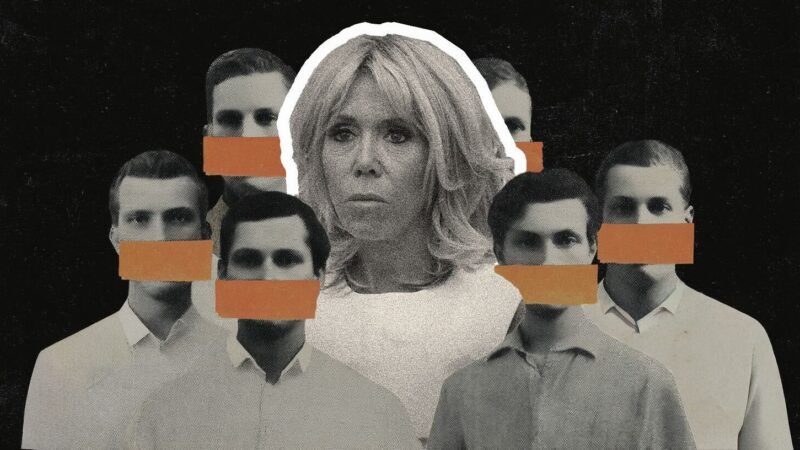
In the United States, poking fun at politicians online is a birthright. In France, it could land you in jail.
On Monday, a French court found 10 people guilty of cyberbullying France's first lady, Brigitte Macron. The defendants' "crime" was falsely claiming on X that the first lady was born male and characterizing her relationship with French President Emmanuel Macron as pedophilic. (The French president met his wife when he was about 16 years old and she was a 39-year-old drama teacher at his high school.)
Defendants denied the charges against them by "saying their posts were either meant in jest or constituted legitimate debate," reports The New York Times. Unfortunately for them, this argument rang hollow for the court, which handed out a variety of punishments. These included compulsory cyberbullying awareness training, eight suspended prison sentences, one six-month sentence to be served from home, and a six-month social media ban for five of the defendants. The defendants were also fined 600 euros (roughly $700) each and were ordered "to contribute to a total of 10,000 euros—about $12,000—in compensation" to the first lady, reports the Times.
While the thought of someone facing fines and jail time for a social media post may seem strange to Americans (although it does sometimes happen), French constitutional law is much more permissive of speech restrictions than its American counterpart.
The French Constitution holds that "any citizen may therefore speak, write and publish freely." However, unlike the First Amendment to the U.S. Constitution, it immediately caveats this right by excluding "what is tantamount to the abuse of this liberty in the cases determined by Law."
This carveout has allowed the French government to outlaw speech acts like bullying, which it defines as "the act of bullying a person through repeated comments or behavior whose purpose or effect is to degrade their quality of life, leading to an alteration in their physical or mental well-being." Cyberbullying is defined as bullying through an electronic medium. Both are punishable by up to two years' imprisonment and a fine of 30,000 euros (nearly $35,000).
Based on the punishment they could have received, the defendants in the Macron case got off practically scot-free. But that doesn't mean that we should praise the French court for its graciousness. Comparing French and American law reveals just how unlucky the French are when it comes to their free speech rights.
Ari Cohn, a lawyer with the Foundation for Individual Rights and Expression, tells Reason that, while there are laws in the U.S. against cyber harassment, they have been interpreted narrowly by courts to comply with the First Amendment.
In People v. Relerford (2018), the Illinois Supreme Court struck down the portion of the state's cyberstalking statute that criminalized nonconsensual communications that would cause a reasonable person to suffer emotional distress because "it was not limited to unprotected threats or other criminal conduct, but instead criminalized entirely protected speech that merely deeply offended or upset others," explains Cohn. Similarly, the 3rd Circuit Court of Appeals upheld federal cyberstalking law in United States v. Yung (2022) by interpreting "'harass' to mean 'a course of conduct designed to distress the victim by threatening, intimidating, or the like,'" according to Cohn.
If the Macron case had occurred in the U.S., the first lady likely wouldn't have even had enough legal standing to have her complaint heard by a jury. But the case didn't happen in the U.S., it happened in France, where the country's illiberal speech laws led to prison sentences for insulting the president's wife, a fact that Cohn calls "breathtaking lunacy."
