
A Recent Book Shows Why Invading Greenland Would Be a Dumb Idea
Polar War demonstrates how difficult it is for armies to operate in the high north—and just how far America is behind Europe in Arctic warfare.
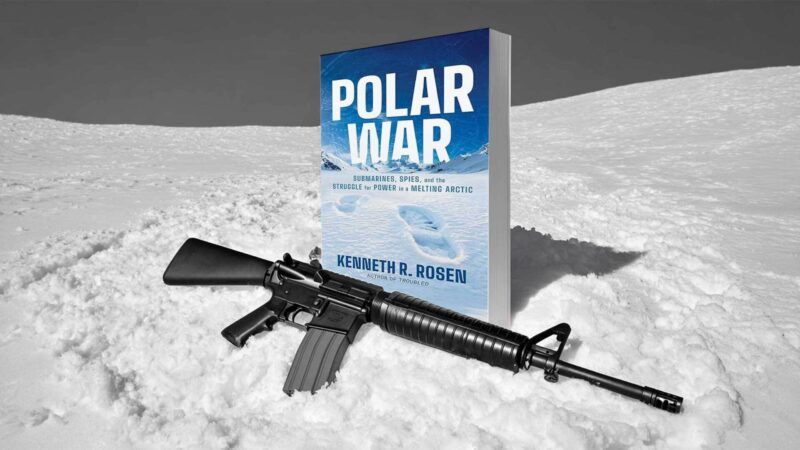
Polar War: Submarines, Spies, and the Struggle for Power in a Melting Arctic, by Kenneth R. Rosen, Simon & Schuster, 320 pages, $29
When he first started talking about it, President Donald Trump's desire to take over Greenland sounded like a joke. Now European leaders are taking the possibility of a hostile takeover—and possibly even a war for the Danish Arctic island—as a deadly serious threat. After Trump's diet regime change operation in Venezuela, he immediately set his sights on Greenland, with the implication that it would be an armed conquest rather than a voluntary purchase.
"Nobody's going to fight the United States militarily over the future of Greenland," White House Deputy Chief of Staff Stephen Miller told CNN, bragging about a world "governed by strength, that is governed by force, that is governed by power." Danish Prime Minister Mette Frederiksen said that a U.S. attack on any part of Denmark would end "everything" that has to do with "post-World War II security."
What would a battle in the Arctic actually look like? Polar War, a book published by Kenneth Rosen amid the latest threats, aims to answer that very question. Rosen sails along with Norwegian and American coast guard patrols in the Arctic, watches prospective Swedish ski troopers at their boot camp, flies to the village in northern Greenland where the U.S. military is based, and hitches a ride on a supply run to the Russian outpost in Svalbard, a strange neutral zone in the Barents Sea.
The book is at least partly a pitch for more Western military spending. "Russia and China and their allies knew exactly what they wanted," Rosen argues, but the United States had "no road map" to compete. The problem is his double standard: While Rosen sees the gap between planning and execution on the Western side up close—and gets to hear typical complaints from officials that their programs are underfunded—he takes it for granted from a distance that Russian shows of force or Chinese business plans reflect these countries' real polar capabilities.
Rosen's comparisons within the Western bloc have inadvertently turned out to be the most useful part of his book, given the tensions over Greenland. Observing U.S. and European operations in the far north, he finds that Nordic troops are much more agile and well-prepared for high latitudes than their American counterparts.
In fact, Rosen gets to compare these forces side-by-side when he follows a Norwegian ship on the way to a planned rendezvous with the USCGS Healy, the U.S. Coast Guard's only Arctic-specific icebreaker. When the two ships meet, they are suddenly buzzed by a Russian helicopter. The Americans are "visibly unnerved," Rosen notes. The Norwegians, on the other hand, dryly comment about how they do the same to Russians all the time.
An important lesson is that experience, rather than flashy equipment, makes or breaks a polar army. The cold quickly kills people and destroys machines. Snow does not behave like sand when building fortifications. Cross-country skis are faster than snowshoes. Sunburn is a surprisingly common problem despite the cold. Hooks and ropes have to be carefully maintained. Wind and weather at sea can change unpredictably. Even routine, peacetime shipboardings can be deadly.
The book argues that Europe's comparative advantage in the Arctic can make NATO worthwhile for the U.S., by reducing the need for an American military buildup up there. What neither Rosen nor almost anyone else imagined was that the Arctic would trigger a zero-sum competition between America and Europe, with a real possibility of Americans facing off against their more experienced European counterparts.
Missing from most of the mainstream conversation—but present in Rosen's book—is the question of what Greenlanders themselves want. Most people in Greenland are Inuit, members of the same culture that much of northern Canada and coastal Alaska belong to. For centuries, they chafed under Danish colonial rule. Now they enjoy considerable self-rule within Denmark and are deciding whether to pursue independence.
Polls show that most Greenlanders support independence in theory but don't necessarily want to break away at the moment. The fact that Danish taxpayers pay for half of the Greenlandic government budget is an obvious, widely known barrier to independence. So is the potential loss of the mobility and export markets that European Union membership provides. Many Greenlanders whom Rosen meets have family or work ties to mainland Europe. Even if they resent being ruled by and dependent on faraway foreigners, they have a lot to lose from cutting the relationship in haste.
What Greenlanders definitely do not want is to have this relationship renegotiated at gunpoint. They are, as Rosen puts it, "open for business but not for sale." Ironically, Trump's threats threw icy water on Greenlandic nationalists' otherwise warm view of America; many had hoped that American tourism and mining investment could replace Danish subsidies.
With climate change opening up the Arctic, it may be prudent for America to pay more attention to its northern frontier. And that may mean preparing for the intense difficulties of fighting in the Arctic. But those difficulties show why actively seeking out such a fight is so deranged.
