
Regime Changed?
Plus: the illegality of the Maduro raid, the wide open question of what happens next, and more
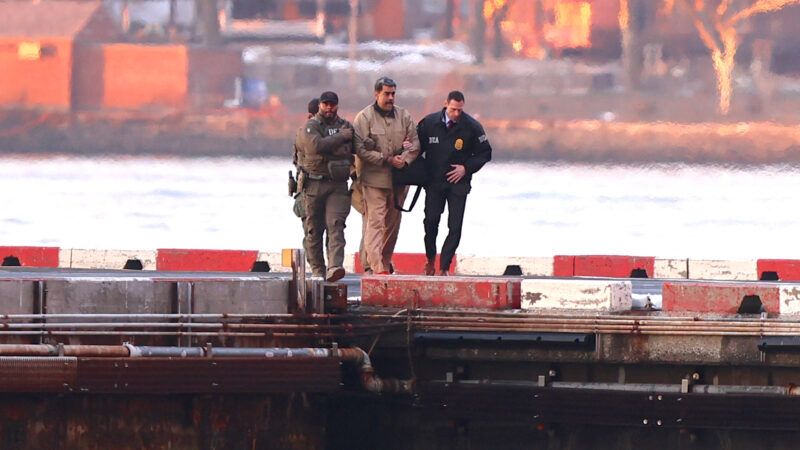
Maduro captured: In a raid early Saturday morning on a military residential complex in the Venezuelan capital of Caracas, U.S. military forces captured the country's president, Nicolas Maduro, and his wife, Cilia Flores. The two will stand trial in New York City for a long list of drug-trafficking-related charges.
The Reason Roundup Newsletter by Liz Wolfe Liz and Reason help you make sense of the day's news every morning.
Maduro is being held in the Metropolitan Detention Center, a federal jail in Brooklyn. He and his wife are expected to be arraigned in federal court today. Delcy Rodríguez, a vice president under Maduro, has been sworn in as the interim leader.
Maduro is a bad man and a worse singer whose dictatorial regime impoverished Venezuela and maintained itself through a mix of corruption, repression, and stolen elections. His ouster nevertheless raises a number of serious questions, including what legal power President Donald Trump had to unilaterally depose him—and just how involved the United States will be in running the country now.
The illegality of the Maduro raid: The U.S. Constitution gives Congress the power to declare war. Bombing a foreign country's capital and arresting its president are plainly acts of war that received no authorization from Congress. The Trump administration clearly seems to have violated the Constitution.
Trump himself has largely not bothered to offer any legal justification for ousting Maduro. Vice President J.D. Vance has argued on social media that since Maduro had been charged with federal crimes, the U.S. was well within its rights to go arrest him.
"You don't get to avoid justice for drug trafficking in the United States because you live in a palace in Caracas," he wrote.
And PSA for everyone saying this was "illegal":
Maduro has multiple indictments in the United States for narcoterrorism. You don't get to avoid justice for drug trafficking in the United States because you live in a palace in Caracas.
— JD Vance (@JDVance) January 3, 2026
That's not convincing. If Vance were correct, all any president would need to do to start a war is have his Justice Department file charges against a foreign leader. That's hardly compatible with Congress controlling the power to initiate hostilities.
The most direct historical parallel to the Maduro operation would be the U.S. ouster of Panamanian leader Manuel Noriega in 1989 after he stole an election and was indicted on drug smuggling charges.
But as Ilya Somin points out, there are some important legal differences. Panamanian forces had killed a U.S. Marine in the Panama Canal Zone and captured other U.S. citizens. Also, the Panamanian government declared war on the United States.
Over the weekend, Reason's Eric Boehm wrote a more comprehensive explanation of why the Trump administration's ouster of Maduo was illegal, which everyone should read.
Arguing against the president's power to bomb other countries without any congressional input might feel quaint, given how often they've done it in the past few decades without consequence.
As Harvard law professor Jack Goldsmith succinctly put it on his Substack over the weekend, "Congress has given the president a gargantuan global military force with few constraints and is AWOL in overseeing what the president does with it. Courts won't get involved in reviewing unilateral presidential uses of force."
Even so, there's a reason the Constitution gave Congress, not the president, the power to declare war in the first place. Entering a military conflict is a grave decision. Any decision to go to war should be preceded by debate among elected officials about what our war aims are, and how much blood and treasure we're willing to spend to accomplish them.
None of that happened here, leaving everyone guessing what exactly comes next for U.S. involvement in Venezuela.
What next?: During his initial Saturday press conference announcing the Maduro raid, Trump seemed to say that the U.S. was at the beginning of a comprehensive regime-change mission that would require heavy American involvement.
"We are going to run the country until such time as we can do a safe, proper and judicious transition," said the president. "We want peace, liberty and justice for the great people of Venezuela."
But as the weekend progressed, Trump and Secretary of State Marco Rubio attempted to downplay U.S. involvement and seemed to swear off any explicit goal of regime change.
"There's not a war. We are at war against drug trafficking organizations—not a war against Venezuela," said Rubio in one media appearance. When asked about Trump's claim that we'd be running Venezuela, Rubio said that we were merely "running policy—the policy with regards to this."
Likewise, on Sunday night Trump said his administration was talking to Rodríguez, the newly sworn-in interim president. Asked by reporters what he'd want from Rodríguez, Trump said: "We need total access. We need access to the oil and to other things in their country that allow us to rebuild their country."
At the same time, he's said that if Rodríguez doesn't comply with U.S. demands, "she is going to pay a very big price, probably bigger than Maduro."
The president has also said that María Corina Machado, the leader of Venezuela's democratic opposition and recent recipient of the Nobel Peace Prize, lacked the "respect" needed to govern the country.
Rodríguez herself denounced U.S. intervention immediately after being sworn in and insisted Maduro was still the rightful president of Venezuela. Over the weekend, however, she's also said she's offered "to collaborate" with the Trump administration.
There's certainly an upside, relatively speaking, to cutting a deal for Venezuelan oil and calling it a day. That path carries a lot less risk that the U.S. will get embroiled in another protracted foreign conflict. Democratic transitions are hard, and the U.S. does not have a particularly good track record of interventions in Latin America.
But ousting a dictator just so you can coerce the next one into coughing up some natural resources is not an honorable thing to do. Removing Maduro hardly seems worth the effort in that context, particularly given the illegal means by which it was carried out.
One hopes for a day when America's foreign policy isn't a choice between using the military to remake the world in our image or being a transactional bully. That day is not today.
Scenes From D.C.: A small group of protestors organized by the far-left Party of Socialism and Liberation (PSL) gathered outside the White House to protest Maduro's ouster. PSL is a mainstay of Lafayette Square protests, even if it is less than influential in the wider world of American politics. I'm always impressed by their ability to print topical signs for every occasion.
QUICK HITS
- The Wall Street Journal has a piece on how Trump was won over to ousting Maduro.
- Is Trump uninterested in helping Machado because he thinks she stole his Nobel Peace Prize?
"Two people close to the WH said the president's lack of interest in boosting Machado…stemmed from her decision to accept the Nobel Peace Prize, an award the president has openly coveted.
"If she had turned it down and said, 'I can't accept it because it's Donald Trump's,'…
— Vera Bergengruen (@VeraMBergen) January 5, 2026
- Congressional Democrats criticize the Maduro raid as illegal and unjustified.
- Europe is monitoring the situation.
Following very closely the situation in Venezuela. We stand by the people of Venezuela and support a peaceful and democratic transition. Any solution must respect international law and the UN Charter.
With HRVP @kajakallas and in coordination with EU Member States, we are…
— Ursula von der Leyen (@vonderleyen) January 3, 2026
- That dancing was really a bad idea in retrospect:
*Maduro's constant dancing became the last straw for Trump, he pressed the button
*White House settled on Delcy as an acceptable candidate. Her ability to edge up oil output under sanctions impressed some Trump officials
*Machado was never a frontrunnerhttps://t.co/DvhHvYVjR1
— Anatoly Kurmanaev (@AKurmanaev) January 4, 2026
