

Reason.com - Free Minds and Free Markets
Reason logo Reason logo
  • Latest
  • Magazine
    • Current Issue
    • Archives
    • Subscribe
    • Crossword
  • Video
    • Reason TV
    • The Reason Roundtable
    • Free Media
    • The Reason Interview
  • Podcasts
    • All Shows
    • The Reason Roundtable
    • The Reason Interview With Nick Gillespie
    • Freed Up
    • The Soho Forum Debates
  • Volokh
  • Newsletters
  • Donate
    • Donate Online
    • Ways To Give To Reason Foundation
    • Torchbearer Society
    • Planned Giving
  • Subscribe
    • Reason Plus Subscription
    • Gift Subscriptions
    • Print Subscription
    • Subscriber Support

Login Form

Create new account
Forgot password

Housing Policy

Would Star Trek's Transporter Destroy Cities or Save Them?

What a speculative technology can tell us about the demands for urban density and sprawl
Christian Britschgi | 12.23.2025 1:40 PM

Share on FacebookShare on XShare on RedditShare by emailPrint friendly versionCopy page URL Add Reason to Google
Media Contact & Reprint Requests
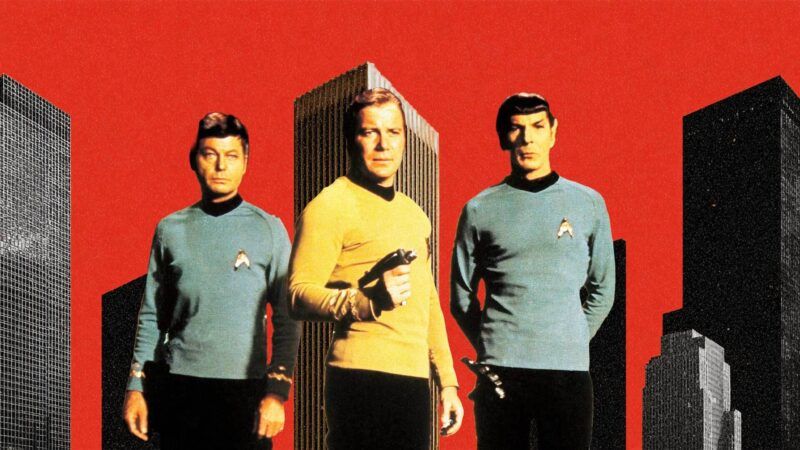
An illustration of Star Trek characters standing in front of tall buildings | Illustration: Eddie Marshall | PARAMOUNT TV | Album | Newscom | Midjourney
(Illustration: Eddie Marshall | PARAMOUNT TV | Album | Newscom | Midjourney)

Happy Tuesday, and welcome to another edition of Rent Free.

Given the holiday slowdown in the news and general merriment that comes with the Christmas season, I'm hoping readers might indulge me in writing this week's newsletter on something a little more fun and speculative.

That would be the urban form of the Star Trek universe.

Every once in and while on social media, a person will post a screenshot of the San Francisco Bay Area of the 23rd or 24th century, as imagined by the various Star Trek movies and TV shows.

Lo and behold, it's massively more built up in the future than it is today.

the world of star trek is only prosperous because of their willingness to boldly develop at high densities where no was allowed to before pic.twitter.com/cPuAKFOEpL

— Matthew Zeitlin (@MattZeitlin) December 1, 2020


Since the Venn diagram overlap between Star Trek fans and YIMBYs ("yes in my backyard") is close to a flat circle, this is always presented as a positive thing.

Star Trek generally presents a positive, progressive vision of the future. A bunch of skyscrapers towering over Marin County—currently a low-density, tightly zoned hotbed of NIMBYism ("not in my backyard")—is just more evidence that the good guys won.

While I certainly like the idea that a YIMBY victory in Marin County is Star Trek canon, I have to confess that I do wonder just how realistic it is.

Rent Free Newsletter by Christian Britschgi. Get more of Christian's urban regulation, development, and zoning coverage.

This field is for validation purposes and should be left unchanged.

Specifically, in a universe where physical travel is instantaneous and production of most household goods can happen within the home, would people still even want to live next to each other?

It might seem silly to spend a whole newsletter puzzling about the impact of a fictitious technology on far-future cities. Then again, a major purpose of science fiction, beyond pure entertainment, is precisely to examine these questions.

Whether it's the rise of remote work, the advent of driverless cars, or ubiquitous drone deliveries, cities in the mid–21st century are likely to experience a lot of technology-driven changes.

Serious thinkers and researchers are already hard at work trying to puzzle out what all this means for urban economies and the built environment. I can't hope to replicate those efforts.

But I do think that looking at how we might live in a world where there's a replicated chicken in every pot, and a transporter in every garage, could tell us a lot about where cities are headed as we barrel into these next decades.

So, engage.

A Final Urban Frontier

It's beyond conventional in science fiction for cities to be depicted as ultra-dense conglomerations of buildings and people.

Whether it's Star Wars or Blade Runner, everyone is packed in together. The only major difference is whether this urban form is depicted as a gleaming utopia or an environmentally ruined hellscape. Sunny, positive Star Trek is definitely in the former category.

Yet there's good reason to think that cities of even modern American densities would not exist in the Star Trek universe, thanks to the famous transporter.

Anyone who's seen the various TV shows or movies will know that people in Star Trek generally get around primarily by using the transporter to beam instantaneously from one point to another. Even if you've never seen a second of Star Trek, you still will probably know the phrase "Beam me up, Scotty"—effectively the 23rd century equivalent of calling an Uber.

One would expect this technology to completely revolutionize the built environment.

Unless a dictatorial government is calling the shots, there's arguably nothing more consequential for what form cities take than the dominant transportation technology people use.

The past century or so of urban development has taught us that the faster the dominant transportation technology is, the more likely cities are to sprawl.

Readers might be familiar with Marchetti's constant, which states that people are usually only willing to commute 30 minutes one way between work and home.

In the days when most people were limited to walking or riding, this meant that cities were usually really small, cramped places.

The first early urban rail systems allowed people to live further from city centers, where land was cheap, and they could afford more private space. Cars supercharged the expansion of urban areas. By enabling not just faster travel but point-to-point travel, they also coaxed a lot of jobs out of city centers.

There's a very active debate about just how much post-war urban sprawl, and the consequent population declines of city centers, was the result of government interventions like federal highway funding, "urban renewal," single-family zoning, mortgage subsidies, and whatever else.

The fact that the center of an urban area still provided access to the most jobs and locations within a given travel time meant that there was still demand for high densities downtown.

Nevertheless, faster, point-to-point transportation still favored sprawl. Absent any government interventions, the car was going to ensure that urban areas grew outward a lot.

In Search of Sprawl

At first blush, one would assume that the effect of the Star Trek transporter on the urban form would basically be the effect of the car to the nth degree.

A technology that provides not just rapid but instantaneous travel would seem to be the Platonic ideal of a sprawl-spurring technology.

According to Star Trek technical manuals prepared for the original show, transporters had a range of 40,000 kilometers. That's roughly the circumference of the Earth.

That means someone with a transporter in their home would presumably be able to commute anywhere on the surface of the Earth in seconds.

Today, the tradeoff of urban life is that one has more proximity to jobs, people, and amenities at the expense of less private space. Lots of people living next to each other drives up land prices. Higher-density development also costs more to construct.

Even without zoning and all the other red tape raising the expense of urban development, the cost of occupying a square foot in a dense city center is just going to cost more.

With a transporter, however, one could seemingly eliminate the tradeoff between private space and access to amenities and jobs.

Being able to beam from your living room to any other location on the planet could enable you to live on a remote island or in the middle of the desert and still make it in to work on time, or visit friends or family at your leisure.

If that's the case, why wouldn't everyone choose to buy a bunch of cheap land in the middle of nowhere, put up a castle on it, and call it a day?

We've seen much lower-tech versions of this exact thing. During the 20th century, wave after wave of urbanites have decamped for suburban and exurban areas, where land and housing are cheaper.

During the pandemic, we saw the rise of "Zoom towns" where newly remote workers transported their city jobs and city incomes to smaller communities, where housing is less expensive.

Add in Star Trek's replicator—which can make almost any household good right there in your home—and one wouldn't even need a corner store to shop at.

Does that mean that Gene Roddenberry's imagined utopia would be a sprawling suburban utopia too? In his universe, would skyscrapers be as obsolete as money?

Maybe, but maybe not.

The Next Generation of Density 

If you've watched as much Star Trek: The Next Generation as I have, you'll notice that the characters spend a lot of their time traveling across star systems to attend diplomatic summits, professional conferences, and other missions that really could have been an email (or communicator conversation).

Even on the Enterprise itself, where one would assume the goal is to use square footage as efficiently as possible, ample amounts of space are devoted to conference rooms, theaters, and even a bar that isn't strictly necessary.

Clearly people in the Star Trek universe value face-to-face interactions. That's cause to believe they would value urban density as well, even if transporters make it theoretically obsolete.

It's a quirk of our modern economy that plenty of jobs that could be done remotely benefit the most from having people in the same room and the same city together.

As Harvard urban economist Edward Glaeser wrote in a March 2020 working paper, "urban density abets knowledge accumulation and creativity. Dense environments facilitate random personal interactions that can create serendipitous flows of knowledge and collaborative creativity."

Most jobs in the finance, tech, and publishing industries could all be done from the comfort of one's home. These industries are nevertheless highly concentrated in America's densest, most expensive cities.

Indeed, growth in these industries is a major driver of the revivals of urban populations in the mid and late 2010s.

Workers and firms wouldn't be paying a premium to live in the big city if it didn't benefit them somehow. A la Glaeser, they think that physical proximity boosts productivity and makes professional collaboration easier.

The pandemic proved that many jobs could be done remotely. Companies' return-to-office drives over the past several years show that employers think in-person work gets more done.

Zoom towns might have boomed during the pandemic. But big cities that people fled during COVID are starting to fill back up again as well.

If the so-called "death of distance" created by today's communication technology hasn't caused a death of density, one could assume that Star Trek's transporter wouldn't either.

People would still demand office space, coffee shops, bars, and other third places.

With this technology, these wouldn't necessarily all need to be right next to each other. But we could assume that walkability and pleasant streetscapes would still be prized in the far future, too.

It's still nice to walk to the café, even if you don't strictly have to.

Far from making density obsolete, transporter technology might make it a lot more viable.

Cars drive sprawl because they can travel point-to-point farther and faster. They also drive sprawl because their speed necessitates a lot of space. They also need to be stored wherever they end up, necessitating lots and lots of parking spaces.

The Parking Reform Network estimates that parking spaces take up as much as a quarter to a third of all surface land in many American cities' downtowns.

The upshot is that the more space that's devoted to roadways and parking, the further apart the destinations people are driving to must be. There's a tradeoff between easy car travel in urban areas and dense walkable streetscapes.

While NIMBY complaints about parking and traffic are often overdone, it is true that when most people drive, new businesses and apartments mean more car traffic on a fixed supply of roads.

With transporter technology, one could completely eliminate this tradeoff between fast travel and desirable destinations. One of the primary externalities of density (traffic) would be gone.

Today's clogged streets could be converted to pedestrian malls. Parking lots could be redeveloped into usable businesses and offices without any loss of mobility. Dense areas could become denser, and a lot nicer too.

The Best of Both Worlds

When researchers model the effects of driverless cars on urban density, they find mixed results. The easier commutes created by autonomous vehicles encourage a lot of sprawl. By reducing demand for parking, they would also drive a lot of infill development.

One would imagine Star Trek's transporter technology would likewise hypercharge (warp-drive?) both urban sprawl and urban density, while making both much more livable.

When commuting anywhere is as easy as stepping out your front door, most people would opt to live in remote areas where space, quiet, and privacy are abundant, but rural isolation is a thing of the past.

Without the need for busy arterials and highways, this sprawl would be a lot more pleasant than today's greenfield development.

When they do step out their front door, odds are the destination will be a dense, dynamic urban area freed from through traffic and parking lots.

In this incredibly speculative analysis, one would assume that residential density would decline substantially, but commercial densities in downtowns would explode.

It's canon in Star Trek that Marin County becomes the center for a lot of Federation and Starfleet facilities. That would realistically explain the densities we see there in the shows and movies.

At its best and most wholesome, Star Trek is about people of different backgrounds using technology to solve hard problems. From what we know of the built environment of future Earth, it appears they've done just that for today's urban problems.

Extreme sprawl and density co-exist without the tradeoffs necessitated by today's technology. All things considered, it's not an incredibly plausible vision of the future. But it is one to strive for nonetheless.

Rent Free is a weekly newsletter from Christian Britschgi on urbanism and the fight for less regulation, more housing, more property rights, and more freedom in America's cities.

This field is for validation purposes and should be left unchanged.

NEXT: Trump's Economic Adviser Says Tariff Refunds Would Be 'Very Complicated' and Unlikely

Christian Britschgi is a reporter at Reason.

Housing PolicyScience FictionZoningDriverless CarsTransportation PolicyTelevision
Share on FacebookShare on XShare on RedditShare by emailPrint friendly versionCopy page URL Add Reason to Google
Media Contact & Reprint Requests

Hide Comments (59)

Editor's Note: As of February 29, 2024, commenting privileges on reason.com posts are limited to Reason Plus subscribers. Past commenters are grandfathered in for a temporary period. Subscribe here to preserve your ability to comment. Your Reason Plus subscription also gives you an ad-free version of reason.com, along with full access to the digital edition and archives of Reason magazine. We request that comments be civil and on-topic. We do not moderate or assume any responsibility for comments, which are owned by the readers who post them. Comments do not represent the views of reason.com or Reason Foundation. We reserve the right to delete any comment and ban commenters for any reason at any time. Comments may only be edited within 5 minutes of posting. Report abuses.

  1. Sometimes a Great Notion   2 months ago

    Given the holiday slowdown in the news

    Who is John Galt Jeffrey Epstein?

    1. Gaear Grimsrud   2 months ago

      That was my reaction to this article that I didn't read. Why is Reason so desperate to distract us from the Epstein files? What are they afraid of? Was Daddy Koch on Lolita island?

      1. SCOTUS gave JeffSarc a big sad   2 months ago

        At this point, I just assume most hardcore leftists like to fuck children. I end up being correct with surprising frequency.

        1. GOD OF PENGUIN ISLAND   2 months ago

          After Rittenhouse shot 3 of them, and 2 of them were pedos, assuming otherwise would be stupid.

          And that's before we even start on the leftists here in the comment section.

          1. SCOTUS gave JeffSarc a big sad   2 months ago

            Jeffy and Shrike are obvious pedophiles, and I have credible suspicions about some of the others too.

            1. Bruce D   2 months ago

              You guys got pedos on the brain. Hmmm...a bit of projection?

  2. Fist of Etiquette   2 months ago

    NERD

  3. mad.casual   2 months ago

    Ctrl+f 'theseus': 0 reults.

    D-

    If a transporter can take the entirety of a human's existence (as attached to their biology) and condense it down into the space of a stream of photons, then even a fairly small apartment, or even a human body itself becomes a vacuous cosmos comparatively.

    1. mad.casual   2 months ago

      Clarke's Third Law: Any sufficiently advanced technology is indistinguishable from magic.

      Corollary to Clarke's Third Law: Any sufficiently advanced science fiction, propagated long enough, becomes indistinguishable from bullshit.

    2. SCOTUS gave JeffSarc a big sad   2 months ago

      The capacity to store transporter patterns like that would be a great way to deal with illegals, and our democrat problem. Either that, or Phantom Zone projectors.

      I wonder how much storage Pedo Jeffy’s transporter pattern would require?

  4. Horatio Cornblower   2 months ago

    First, I would never consent to be transported. I do believe that would be the death of my consciousness and the beginning of a different, yet identical Horatio.

    Second, I would definitely choose to live out in the boonies, where the closest human is hundreds of miles away.

    1. EdG   2 months ago

      Math: 8 billion humans occupying 58 million square miles of surface land equals 139 persons per square mile. And that's not even accounting for unbuildable/unlivable land.

      1. D-Pizzle   2 months ago

        "And that's not even accounting for unbuildable/unlivable land."

        No need to bring California into the discussion.

      2. GOD OF PENGUIN ISLAND   2 months ago

        Macau has a population of 60,000 ppsm.

      3. Horatio Cornblower   2 months ago

        Your inference is that every person wants to live like I do. I'd bet a good number prefer to live in metropolises.

        To each their own.

        1. EISTAU Gree-Vance   2 months ago

          “To each their own.”

          No, no, no! How dare you trivialize this important culture war issue!!? Living in large urban areas and riding mass transit is how we determine who is a good person and who is bad! The decision on where to live or how to commute defines a persons moral worth!

          I learned that here. See chemjeff for more details.

  5. Fist of Etiquette   2 months ago

    I don't think we currently have the capacity to understand what happens to humanity in a post-scarcity world, other than giving everyone the leisure to invent v to bitch about on Space Twitter.

    Even in a successful socialist utopia like the Star Treks, transporter use will be limited to the military (quasi or otherwise) and the elites. That would be fine by me. Every time you use it, you would be killing yourself in lieu of an exact copy replacing you some distance away. Future me will stay a pure blood, thank you very much. I won't live in a city, though. I will invent the Star Wars hologram phone for space meetings, except mine won't be all glitchy.

    1. mad.casual   2 months ago

      I know in true Gen X-meta fashion this probably says as much about me as it necessarily does about the show or society; but it seems very likely that endlessly replicating red shirts to die in dramatic, if not comedic, fashion would be a popular past time in any real-world instantiation of Star Trek.

    2. EdG   2 months ago

      Why do you assume transporters are replicators? It's possible that future technology uses quantum tunneling or another method to transport and then reassemble your original pure blood at a different location instead of the 1950s/60s idea of creating an exact copy.

      1. Horatio Cornblower   2 months ago

        Interesting, but I still wouldn't trust it. Best left to cargo.

    3. Azathoth!!   2 months ago

      Star Trek isn't a socialist utopia.

      Hell, the series that spawned that ridiculous idea starts with an episode wherein characters bargain and realize that the prices of items do not correspond with the value being recieved.

      These people understand capital and it's functions.

      And use them.

      The Promenade on DS9 is a mall where things are bought and sold. Quark runs a casino.

      People without money don't gamble.

      Picard was killed over a bet. People who are playing for funsies don't kill over cash.

      And yes, the transporter rips you apart and makes a copy that is not you.

      1. Fist of Etiquette   2 months ago

        I accept your apology.

    4. Bruce D   2 months ago

      Every time you use it, you would be killing yourself in lieu of an exact copy replacing you some distance away.

      Very good point.

  6. Stupid Government Tricks   2 months ago

    Congrats for a good article. It's something I often wondered about, and not just from orbit to planet. The Enterprise is not exactly a compact design. Why does it have some many corridors -- why not just teleport from one end to the other?

    And what's with Scotty or some flunky manually manipulating the control board? Elevator boys had already mostly disappeared by the 1960s, yet there's Scotty, relegated to transporter boy, manually controlling the teleporters.

    On the other hand, poking holes in science fiction is one of the easiest things possible. I seldom cared about science fiction holes in good stories.

    1. mad.casual   2 months ago

      On the other hand, poking holes in science fiction is one of the easiest things possible. I seldom cared about science fiction holes in good stories.

      This isn't just science fiction. The idea is to tell a story good enough (or in some cases an OK story stylistically enough) that the holes don't really matter.

      1. Don't look at me! ( Is the war over yet?)   2 months ago

        Like Star Wars!

      2. Stupid Government Tricks   2 months ago

        Science fiction is the easiest to poke holes in, therefore the best example.

        1. mad.casual   2 months ago

          Most of the holes I find in fiction are far more personal, contextual, or just existential; veracity vs. verisimilitude. People blatantly stating their motives and then acting in opposition to those motives, repeatedly, to the point that there's no reason to continue following their idiotic self-narratives. Outside the story, lots of directors, have a real problem with continuity and object permanence. I don't have to know how phasers work to see that the beam isn't going in the direction the weapon is pointed.

          Science fiction is just the most relevant to the article.

      3. Bruce D   2 months ago

        Sound or visible light beams in vacuum of space.

    2. Incunabulum   2 months ago

      Its about limits on the technology as-written.

      In the TOS the limits of the transporter prevented 'site-to-site' teleportation. You had to start or end on a transporter pad

      This was dropped in later series.

  7. Idaho-Bob   2 months ago

    Has anyone has read the short story The Jaunt by Stephen King? In the story, the teleportation invention originally focused on goods, not people. Teleportation eliminated logistics entirely. The price of gas plummeted. No cargo ships on the ocean, no trucks on the highways, and no cargo planes. The Jaunt gives a "historical" account of the teleportation technology that has always interested me.

    1. Don't look at me! ( Is the war over yet?)   2 months ago

      But the machines ran on electricity and the price went through the roof!

  8. MWAocdoc   2 months ago

    "Then again, a major purpose of science fiction, beyond pure entertainment, is precisely to examine these questions."

    More importantly the major purpose of science fiction is to ILLUSTRATE possible futures. Imagination as a tool of examination is fraught with peril. When a reader or viewer asks, "What would such a future look like?" a great sci-fi writer can help them figure out whether it might be good or bad, and how or why. Rigorous analyis is unlikely in such works, but comparing dystopian outcomes with eutopian ones can and sometimes does go beyond "pure" entertainment.

  9. Azathoth!!   2 months ago

    If the so-called "death of distance" created by today's communication technology hasn't caused a death of density, one could assume that Star Trek's transporter wouldn't either.

    People are being forced back by jobs killing remote work.

    It is one of the biggest problems in modern hiring. People want to work from home because now they know it's possible.

    And companies, and the left, wants enforced social density so that people are more easily controlled.

    1. Don't look at me! ( Is the war over yet?)   2 months ago

      And companies, and the left, want actual production enforced social density so that people are more easily controlled.

    2. SCOTUS gave JeffSarc a big sad   2 months ago

      It works for some jobs, and some people. But a lot of people sat back and got paid for doing jack.

      1. mad.casual   2 months ago

        Yeah, nobody ever thought remote work wasn't a thing. Tim Ferris published The 4-Hour Work Week in 2007. The difference is, people used to rightly recognize that when you were somewhere else when needed on the job or a problem needed your immediate and specific attention, you were increasingly "phoning it in" and/or absentee.

        There were all kinds of part-time, as-needed, and virtual jobs before "remote" and "gig" work. COVID was just a push towards it.

  10. Earth-based Human Skeptic   2 months ago

    'Specifically, in a universe where physical travel is instantaneous and production of most household goods can happen within the home, would people still even want to live next to each other?'

    At least the women would. Both real women and manufactured women.

  11. Earth-based Human Skeptic   2 months ago

    Yeah, but what happens when people start claiming that wide-spread transporter use causes global shrinking? Or maybe orbital wobble or nebula dimming? Who is going to pay reparations?

    1. Stupid Government Tricks   2 months ago

      Now there's an idea! Everyone transport to one side of the Earth, then 15° further, and keep on doing that until the Earth speeds up or slows down.

    2. SCOTUS gave JeffSarc a big sad   2 months ago

      We should offer to be a up all the eco warriors to ‘save’ them. Then just leave them in the transporter’s pattern buffer, forever.

      1. Bruce D   2 months ago

        I think "be a up" = "beam up"

  12. MollyGodiva   2 months ago

    There is no indication that every house, or even most houses have their own transporters. We have seen many residences, but none (or very few) with their own transporters. In DS9: "Explorers" Sisko said that he used up all of his academy transporter credits beaming home for dinner. We also have many exterior shots of Earth, and there are shuttles everywhere, which means that many people get around the old fashioned way. We even see people arrive on Federation ships by shuttle.

    1. SCOTUS gave JeffSarc a big sad   2 months ago

      Very true, in most cases, only Starfleet, other Federation organizations, and some private corporate entities had their own transporters.

      1. Brett Bellmore   2 months ago

        Apparently transporters were VERY energy expensive, to the point that they would only be used where there was no good alternative.

        Most of Star Trek takes place on starships and space stations with energy to burn and facing serious logistics problems. If you're on a planet, even if you could generate the necessary power for everybody to use transporters instead of walking, you wouldn't dare: The waste heat would ruin the climate!

        You might suspect the expensive thing isn't the power as such, but instead buying the waste heat allowance.

  13. GOD OF PENGUIN ISLAND   2 months ago

    The libertarian issue of our time.

    1. Horatio Cornblower   2 months ago

      Goddamn right

  14. rxc   2 months ago

    Why do the people need to live on the surface of the earth? They could live in space stations in orbit or on the moon or on any other planet. They would not have to worry about supplies, because transporters are inherently deconstructors/replicators, so everything could be scanned where it is conceived, and replicated where it is wanted.

    The biggest problem i see is crazies sending bombs/other destructive devices to people/organizations they do not like. But if it is a StarTrek utopia, then there are no crazies, other than geniuses like Kahn, who see to exist in every form of the universe...

    1. Mickey Rat   2 months ago

      They do not need to live on Earth, but Earth and any other habitable planet would be prime real estate.

      1. Incunabulum   2 months ago

        Why though?

        You could build a space habitat that was a literal garden of eden.

        You can even put engines on it and now you have a spaceship.

  15. Mickey Rat   2 months ago

    The urban planners tend to see high density living spaces as an unmitigated good in itself and they do not care about anyone who does not want to live like that. It would then depend on who controls construction decisions and how authoritarian they are.

    The other problem is the sneaking suspicions that transporters are death machines that do not enable travel, but copy a person somewhere else while destroying the original.

    1. rswallen   2 months ago

      The existence of Thomas Riker seems to somewhat confirm this.

  16. Incunabulum   2 months ago

    > would people still even want to live next to each other?

    You are making an assumption that they would be allowed a choice.

    In the grim darkness of the far future, there is no money, there is no material want, and the government controls all resource allocation.

    Remember, this is a society where a single government agency is explorer, diplomatic corps, and military all rolled into one.

    1. MollyGodiva   2 months ago

      Individual planets have their own governments and govern themselves. Many have their own starship fleet.

  17. Incunabulum   2 months ago

    Honestly Britches - its not the transporter that makes distance irrelevant.

    Its the holodeck.

    Which also makes *space* irrelevant.

    Why do you need to find a place without people nearby when you can have a 10x10 room that can simulate any space imaginable. You need to join a meeting? From your POV there's the conference table, everyone around it, sitting in the middle of a forest glade that only you can see. Once the meeting is over, without moving, all the participants are gone.

    With the replicator you never need to leave the cube.

    Its the ultimate end-state of the 'metaverse'.

  18. Incunabulum   2 months ago

    >Anyone who's seen the various TV shows or movies

    OMG, I just realized - Britches has only ever seen nu-Trek. For him Star Trek is the Abramsverse and STD.

    1. rswallen   2 months ago

      Why does this mean he's only seen nuTrek. There were 5 shows and multiple movies long before nuTrek was even a twinkle in Abrams' eye

  19. JFree   2 months ago

    The past century or so of urban development has taught us that the faster the dominant transportation technology is, the more likely cities are to sprawl.

    The problem is that Marchetti's constant has a corollary. People ONLY want to spend 30 minutes getting to/from work. Otherwise, traffic/sprawl is a negative. People don't actually like commuting per se.

    With faster transport tech, the number of routes diminishes (on planet Earth). So they can build sprawl expecting the traffic to travel faster and farther - but the highway gets clogged and the traffic slows right back down to what it was many tech generations before. Meaning they built the sprawl - got themselves locked in on the mortgage - and now they are stuck in traffic for 2 hours a day and life is worse not better. So when a pandemic comes along and they have a choice to rebel against the commute, they do - but that only works for the pajama class.

    Average effective commuter speed during rush hour now is 27 - 35 mph - which is about the same as a Model A in the late 1920's. Difference is - back then a Model A could coexist with slower modes so a grid type system (which is excellent for peds, bikes, buses, etc) could work. Now - fast vehicles can't and don't coexist with anything slower - so they wreck the grid system with rat runs and they destroy the city grid by plowing highways through everywhere.

  20. Roberta   2 months ago

    Haven't read yet, catching up from pre-holiday stuff, but a standard question I used to ask my Environmental Science students was what the effects would be of cheap teleportation. First thing they think of is the possibilities for burglary as in the movie serial Atom Man Vs. Superman, wherein Luthor develops teleportation and uses it to rob jewelry stores. So I have the teleporters work station-to-station: Enter a booth, put in a quarter, dial up the address of the booth where you'd come out.

    My assessment is that widespread teleportation would remove nearly all impetus for urbanization. You might still want to save a bit on construction and heating by building multi-unit dwellings and offices, but there'd be no reason to locate buildings close together when you can put yourself or stuff into a booth anywhere and have it come out likewise at the speed of light. Real estate would no longer be about "location, location, and location".

Please log in to post comments

Mute this user?

  • Mute User
  • Cancel

Ban this user?

  • Ban User
  • Cancel

Un-ban this user?

  • Un-ban User
  • Cancel

Nuke this user?

  • Nuke User
  • Cancel

Un-nuke this user?

  • Un-nuke User
  • Cancel

Flag this comment?

  • Flag Comment
  • Cancel

Un-flag this comment?

  • Un-flag Comment
  • Cancel

Latest

An Immigration Judge Finds No Legal Basis To Deport a Student Arrested for an Op-Ed

Jacob Sullum | 2.10.2026 5:10 PM

The Trump Administration Plans To Repeal EPA Finding That Greenhouse Gas Emissions 'Threaten' Public Health

Ronald Bailey | 2.10.2026 5:00 PM

In 2024, Trump Rejected Numbers Showing a Homicide Drop As a 'Lie.' Now He Is Bragging About Them.

Jacob Sullum | 2.10.2026 4:15 PM

Can Congress Get 'YIMBY Grants' Right?

Christian Britschgi | 2.10.2026 4:00 PM

Ring's Lost Dog Finder Is a Potential Civil Liberties Nightmare

Joe Lancaster | 2.10.2026 12:25 PM

Recommended

  • About
  • Browse Topics
  • Events
  • Staff
  • Jobs
  • Donate
  • Advertise
  • Subscribe
  • Contact
  • Media
  • Shop
  • Amazon
Reason Facebook@reason on XReason InstagramReason TikTokReason YoutubeApple PodcastsReason on FlipboardReason RSS Add Reason to Google

© 2026 Reason Foundation | Accessibility | Privacy Policy | Terms Of Use

This site is protected by reCAPTCHA and the Google Privacy Policy and Terms of Service apply.

r

I WANT FREE MINDS AND FREE MARKETS!

Help Reason push back with more of the fact-based reporting we do best. Your support means more reporters, more investigations, and more coverage.

Make a donation today! No thanks
r

I WANT TO FUND FREE MINDS AND FREE MARKETS

Every dollar I give helps to fund more journalists, more videos, and more amazing stories that celebrate liberty.

Yes! I want to put my money where your mouth is! Not interested
r

SUPPORT HONEST JOURNALISM

So much of the media tries telling you what to think. Support journalism that helps you to think for yourself.

I’ll donate to Reason right now! No thanks
r

PUSH BACK

Push back against misleading media lies and bad ideas. Support Reason’s journalism today.

My donation today will help Reason push back! Not today
r

HELP KEEP MEDIA FREE & FEARLESS

Back journalism committed to transparency, independence, and intellectual honesty.

Yes, I’ll donate to Reason today! No thanks
r

STAND FOR FREE MINDS

Support journalism that challenges central planning, big government overreach, and creeping socialism.

Yes, I’ll support Reason today! No thanks
r

PUSH BACK AGAINST SOCIALIST IDEAS

Support journalism that exposes bad economics, failed policies, and threats to open markets.

Yes, I’ll donate to Reason today! No thanks
r

FIGHT BAD IDEAS WITH FACTS

Back independent media that examines the real-world consequences of socialist policies.

Yes, I’ll donate to Reason today! No thanks
r

BAD ECONOMIC IDEAS ARE EVERYWHERE. LET’S FIGHT BACK.

Support journalism that challenges government overreach with rational analysis and clear reasoning.

Yes, I’ll donate to Reason today! No thanks
r

JOIN THE FIGHT FOR FREEDOM

Support journalism that challenges centralized power and defends individual liberty.

Yes, I’ll donate to Reason today! No thanks
r

BACK JOURNALISM THAT PUSHES BACK AGAINST SOCIALISM

Your support helps expose the real-world costs of socialist policy proposals—and highlight better alternatives.

Yes, I’ll donate to Reason today! No thanks
r

FIGHT BACK AGAINST BAD ECONOMICS.

Donate today to fuel reporting that exposes the real costs of heavy-handed government.

Yes, I’ll donate to Reason today! No thanks


