
5 Things You Should Know About the Latest Bari Weiss 60 Minutes Controversy
Is Bari Weiss censoring 60 Minutes or improving its output?
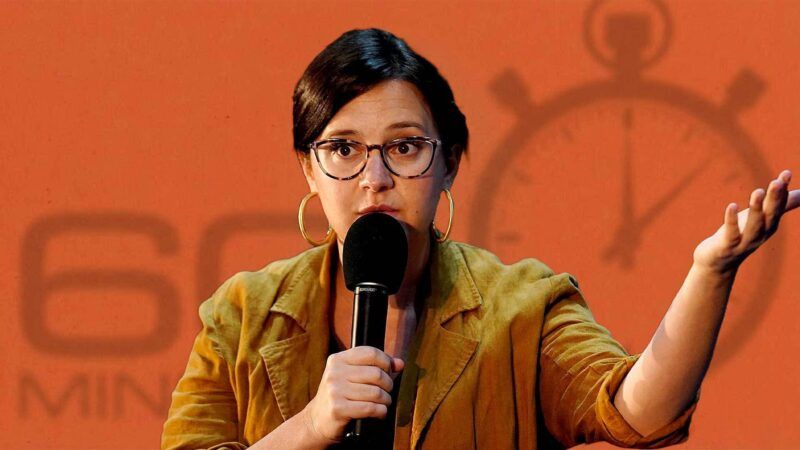
CBS News Editor in Chief Bari Weiss intervened to prevent 60 Minutes from airing a segment on the notorious CECOT prison in El Salvador, and her many critics elsewhere in the media are worried that there's one obvious reason for such a call: appeasing President Donald Trump. Defenders of Weiss, on the other hand, note that it's perfectly typical for an editor to offer feedback on a piece of journalism and demand changes—better sourcing, comments from government officials, etc.—before it's ready to run.
Who's right? This is one of those cases where people on both sides have made at least a few reasonable points—though there's no getting around the overarching concern that flattering Trump's ego is becoming all too powerful a motivating factor for media corporations. Here are five thoughts on the matter.
1. On the pro-Weiss side, it's true that her editorial notes are not particularly unreasonable.
New: See the memo Bari Weiss sent to some 60 Minutes staff on Sunday: pic.twitter.com/3ERieIGXLh
— Isabella Simonetti (@thesimonetti) December 22, 2025
Frustrating as it can be for a writer, reporter, or commentator to be forced by their boss to work harder to advance a story, demanding editors often require them to do just that. Anyone who has worked with Weiss in the past knows that she is an extremely demanding editor. She often has a strong view of what she expects from a piece and is perfectly comfortable asking for rewrite after rewrite until it's exactly what she wants. (And yes, I speak from personal experience.)
2. Weiss' main ask was that 60 Minutes work harder to get on-the-record comments from Trump administration officials. She also wanted the segment to advance the story in some way, given that the harsh conditions at CECOT have already been widely reported in mainstream media. Critics have said that the first demand is ridiculous, since a journalist obviously can't sit on a story forever if the relevant government officials are refusing to comment. Yet Axios reported that Trump officials did offer comment; 60 Minutes merely declined to include the comment in the segment. In his Reliable Sources newsletter, CNN's Brian Stelter reported that the comment was "a provocative jab at the media" and thus 60 Minutes' Sharyn Alfonsi decided not to use it. That strikes me as a mistake.
3. As for the idea that the segment didn't add much to the CECOT story, viewers can be the judge of that. The segment actually aired by mistake on a Canadian television app and can be watched here. Having seen it, my take is that the segment was perfectly OK as-is and wholly consistent with the usual 60 Minutes product—which is to say that it was hardly groundbreaking. Alfonsi could have certainly done more to make the segment more powerful, and Weiss' notes were inoffensive; the extremely last-minute decision to cancel an already approved piece and request significantly more reporting and comment, however, does seem a tad unreasonable.
4. It is nevertheless the case, as Washington Post columnist Megan McArdle points out, that many people who work at CBS News dislike Weiss both personally and ideologically, and have all sorts of frustrations that have nothing to do with the editorial output of 60 Minutes.
5. Trump's pathological fixation on 60 Minutes, and his insistence that CBS News' new bosses make the content friendlier to his administration, is relevant context that simply cannot be ignored. Trump balked at a 60 Minutes interview with Rep. Marjorie Taylor Greene (R–Ga.), a Trump friend turned critic, that was totally in bounds as a legitimate subject for the program: He stated plainly that the network's new owners, his "friends" the Ellisons, were worse than the old owners. The Ellisons would like to beat Netflix in the race to acquire Warner Bros., and the deal may very well hinge on which company is friendlier toward the president. These are disastrous incentives for a free media, but they are downstream of the federal government's power to thwart corporate mergers and acquisitions.
As I said previously, progressive fans of antitrust are getting precisely what they want: government oversight of large media organizations and close scrutiny of their editorial products. The idea that this oversight would necessarily be about what's good for consumers rather than what's good for government leaders is a false notion that Trump's very public corruption has laid bare.
This Week on Free Media
We're off this week, so instead I'd recommend you check out Freed Up, my new video podcast with Reason Reporter Christian Britschgi!
Worth Watching
I am closing out 2025, quite appropriately, with The Last Death of the Year, one of the new Hercule Poirot mysteries by Sophie Hannah, who has continued Agatha Christie's famous mystery series. Longtime readers know that I am a voracious consumer of all things Poirot and have eagerly awaited this title's release. Long live Poirot, and happy New Year to all!
