
The Federal Government Has Shed 271,000 Jobs This Year. That's Great.
It's also not the whole story. Federal spending isn't falling and the private sector job market is stagnant.
When President Donald Trump took the oath of office for a second time in January, more than 3 million people worked for the federal government.
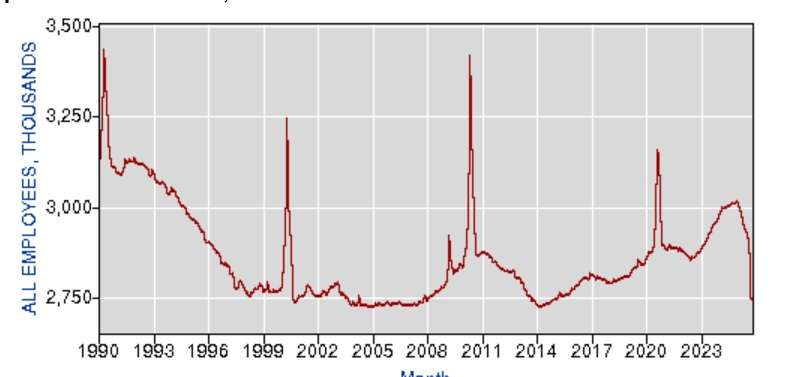
Over the 10 months since, that total has declined significantly. The newest jobs report, released Tuesday by the Department of Labor, shows that federal employees numbered about 2.74 million in November. The total number of federal workers has dropped by about 271,000 in the past 12 months, the Labor Department's data show, and job losses in the government sector have outpaced the losses in other parts of the economy over the past six months. That means the Trump administration has nearly hit its stated goal of reducing the federal civilian workforce by 300,000 this year.
While the Trump administration has taken many intentional and some unprecedented steps to grow the size and scope of the federal government during its first year back in power, by this one measure the trend has been undeniably moving in a much more promising direction. Cutting nearly 10 percent of the federal workforce in a single year is a noteworthy accomplishment. That Trump and his team have done it despite the best efforts of public sector unions and the entrenched bureaucracy makes it even more remarkable.
It is a pruning that was long overdue. When the federal government crossed the 3 million employee threshold in mid-2024, it was the first time since 1994 that taxpayers had supported so many federal workers (not counting temporary surges required by the census). Now the federal workforce has been cut back to the size it was in 2015—so, please, spare me any moaning about draconian cuts, unless you believe the Obama administration was defined by a federal government that was too small.
Still, the praise for Trump's culling of the federal workforce should be tempered by three considerations.
First, the number of federal employees matters far less than how much money the federal government spends. Simply firing workers without shutting down or privatizing governmental functions might result in longer waits whenever normal Americans have to encounter the federal bureaucracy, or more spending on contractors and the like. In the first two months of the current fiscal year, the federal government spent about 1 percent more than it did during the same two months of 2024. Before cheering too much, let's see a 10 percent cut in spending to go along with the 10 percent cut in employee headcount.
Second, and relatedly, Trump's policies are laying the groundwork for hiring more federal workers, not fewer. From immigration enforcement to tariff enforcement, much of Trump's agenda requires more spending and more federal boots on the ground—and not just in Washington, D.C., either. His ongoing desire to snatch up portions of private companies might not add to the federal workforce, but it certainly expands the scope of the federal government and the number of workers who might be, at least to some degree, under its control.
Finally, the White House is trying to frame this decline in the federal workforce as a shift toward private sector employment. "The strength of the Trump Economy is in the private sector…where it should be," an official White House account posted on X in response to the jobs report on Tuesday.
If only that were true. Unfortunately, Tuesday's jobs report shows a stagnant job market across many sectors of the economy and a rising unemployment rate. The tariffs are likely a major culprit, particularly for smaller businesses that have a harder time absorbing the added costs from those taxes, and for manufacturing firms, which have lost 81,000 jobs in the past year.
The only sector of the economy where jobs have been growing significantly is health care—which is, of course, largely funded by the government. This is not quite the victory that the Trump administration wants it to be.
It would be tremendous if workers were shifting from federal jobs to more productive work in the private sector. For now, Trump can only claim to have accomplished half of that goal.

