

Funding College Sports With Private Equity Is Way Better Than Hitting Students With Higher Fees
Plus: Fix the NBA Cup by blowing it up, World Cup ticket prices or lotteries, and more.
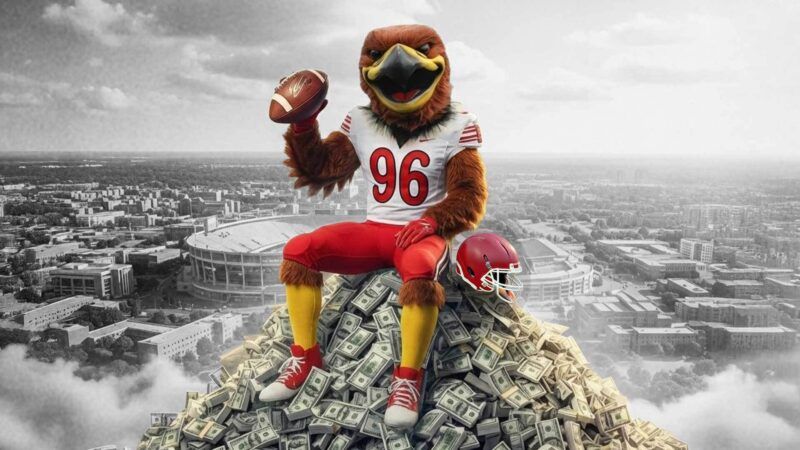
Hello and welcome to another edition of Free Agent! Keep your helmets on this week, it could be a bumpy ride.
Let's talk about everyone's favorite evil bogeyman, private equity funding, and how it's slowly making its way into college sports. Then we'll talk about a fun way to make the NBA Cup more interesting and close with a quick hit on World Cup ticket prices, again.
Don't miss sports coverage from Jason Russell and Reason.
Locker Room Links
- 1910: That's when the world's oldest active sports arena opened, until Northeastern University said goodbye to Matthews Arena last weekend.
- Root for chaos if you can't root for your team: If the stadium-sharing Chargers and Rams both host their conference championship games, the NFL would have to change the usual Sunday back-to-back schedule.
- Army and Navy playing on a standalone Saturday time might be coming to an end if the College Football Playoff expands. (I had always wondered what would happen if one of them were in playoff consideration with a decision needed to be made before that game was played.)
- Thank you, NIL Era: Can you imagine players from Indiana and Vanderbilt going first and second in Heisman voting under the old ways?
- Speaking of NIL, President Donald Trump called it "a disaster for college sports" and said "something ought to be done and I'm willing to put the federal government behind it." Maybe he should read today's newsletter! (He also totally exaggerated what's happening to Olympic sports programs at schools.)
- The NFL is worried about the rise of prediction markets—couldn't be because the league's betting partners see them as competition, could it?
- MLB will start regulating what technology and data teams are allowed to use in the minor leagues. Were the teams that didn't feel like investing a relatively small sum in equipment for that able to regulate the advantage away from those that did?
- Reason's Matt Welch talks Baseball Hall of Fame and so much more on the great House of Strauss podcast.
- Elsewhere in Reason: "Trump's Plan To Reclassify Marijuana Would Leave Federal Prohibition Essentially Untouched"
- How immigration helped create the Miracle on Ice:
Dumbest tweet of the day.
Mike Eruzione — family came from Italy
Mark Pavelich — family came from Croatia
Dave Christian, Neal Britten — family came from Noway
Buzz Schneider, Bob Suter, Dave Silk, Herb Brooks — families from Germany
Steve Cristoff — family from Bulgaria… https://t.co/4ZpmD8rYMj
— Marc Thiessen ????????❤️???????????????????????? (@marcthiessen) December 13, 2025
Insane Fees
When the University of Utah announced that it would spin off assets from its athletic department into a new for-profit entity, with a private equity firm owning a minority, the reactions were predictable.
Eye-roll-inducing jokes were aplenty. One person said: "Pretty soon Utah football will be eating Costco hotdogs and flying Spirit. Players will get one helmet but must purchase rest of pads on their own." Another joked that the head coaching job was being outsourced "to a remote dude in India." Maybe the football stadium will even be sold off:
I'd give it 2 years. pic.twitter.com/tbSPGDMJ9S
— Mark Ŧ ???? (@RaiderMark) December 9, 2025
What all the reactions seemed to miss was that the deal might be great for a certain group of people: Utah students (or the parents who pay for their tuition and fees, anyway).
A full-time undergraduate student at Utah must currently spend $83 a semester in fees to support the athletic department. That's not so bad, considering a year at the school can reach up to $40,000 including direct and indirect costs. Most schools, from the Power Four conferences to mid-majors, do the same. The fees are seemingly higher at less athletically successful schools, though, and sometimes nonexistent at frequent winners like Alabama. A full-time student at the University of Maryland is paying a $199.50 athletics fee per semester because a "healthy and sustainable Department of Intercollegiate Athletics (ICA) is an essential part of the University community."
Meanwhile, at James Madison University (who I root for vicariously through my alumna wife), students pay a whopping $1,518 fee per semester for athletics, providing nearly three-quarters of the athletic department's revenues. That may have helped JMU go from the Football Championship Subdivision (FCS) to the College Football Playoff in just four seasons, but that fee is higher than every other student athletics fee in the playoff combined—even when you multiply the rest by four.
"JMU is essentially taxing its students to help fund its big-time college athletic ambitions — and that clearly seems to be paying off, at least in terms of this year's playoff," as Dwayne Yancey wrote while reporting on the fees. "Why, though, must students be forced to pay for that? If deep-pocketed boosters (the adjective knocks me out) or the free market don't supply the funds for JMU to play at that level, why must my alma mater shake down teenagers (or their parents) to make up the difference?"
Even students at some FCS schools are paying through the nose. At William & Mary, students pay $1,170.50 per semester for intercollegiate athletics, plus $180.50 per semester for their arena's operations and $16.50 per semester for their tennis center. Thankfully, that's down from the $1,992 per semester they were paying for intercollegiate athletics in the 2018–19 school year.
College sports basically serve as marketing tools to woo more applicants, who pay more tuition and fees, whose fees partially go toward athletics, and so on and so forth (I touched on this more here). A longrunning funding race has schools looking for more and more ways to bankroll the best players, coaches, and facilities that money can buy. If school administrators are going to be in that race, it's far better for the money to come from private equity than milking it out of poor students year after year.
Cup It Up
While the NBA Cup final is Tuesday night, the league is already considering some changes to its in-season tournament. It won't be going away anytime soon because of its inclusion in the league's agreement with the players union and Amazon's media rights deal. But the league is moving semifinal games back to home venues and weighing which cities other than Las Vegas could host the final (I wonder what dissatisfaction with the arena atmosphere in Vegas means for the city's expansion team hopes).
But tinkering around the edges of the tournament won't give the league the supercharged results it's hoping for. Three big changes might, though: expanding the tournament to non-NBA teams, shortening games to 40 minutes, and going to single elimination.
Consider what we love about March Madness, contrary to Joel Klatt's awful take: the upsets and buzzer beaters.
Even the best NBA team losing to the worst isn't really a huge upset. That's like if a bad SEC team upsets Duke. What we really want to see is 15-seed Lehigh beating Duke. Add in G League teams so we can watch the Sioux Falls Skyforce play against the NBA. Better yet, make every G League's first-round matchup against their NBA affiliate. Or go really big, like 128 teams big, and throw in the 20 EuroLeague teams, 10 teams from Australia's National Basketball League, 10 more from the Canadian Elite Basketball League, and 14 more from Mexico's Liga Nacional de Baloncesto Profesional and you're getting close. (Bet you didn't know some of those leagues existed.) Imagine the global media rights deal if the rest of the world got to watch their basketball teams go up against NBA stars—even if they're probably going to get crushed.
Of course, the talent gap between NBA teams and everyone else is large. That's where shortened games come in (those also help get the players union on board). One reason we see more upsets in college basketball than the NBA is the shortened clock. Having 8 fewer minutes in a game makes the score more random and gives the better team less time to come back if they fall behind early. Less time in the game also means a closer score at the end, making tight scores and buzzer beaters more likely.
None of that matters, though, unless the tournament is single elimination. We love to see Lehigh beat Duke because it means Duke is eliminated and Lehigh goes on, not because it's just a ding to Duke in group standings.
If the NBA can do all that, I'll tune in instead of just paying attention when I happen to be in a sports bar when my Pistons are playing.
Feeling Lucky?
The World Cup's high ticket prices are in the news—again. Even though I thought I'd said everything I have to say about it here, here, and here, let's go at it again.
When I posted on X that "I would rather have a passionate traveling fan pay $500 to get in than a casual person from the local area pay $50," I got a load of responses displeased with me and FIFA (who, clearly, I'm not a big fan of). Some said fans from local areas weren't going to go, some said traveling fans from abroad weren't going to go, some said the stadiums will be empty, some said wealthier people aren't passionate about sports, and some said FIFA should have designated more tickets to a given game to fans from the participating countries (totally fair, in my opinion).
Apparently my contention that willingness to sacrifice more money is a sign of more passion did not come across very well, nor did the idea that a high ticket price is only a small marginal cost to a foreign traveler who's already paying thousands of dollars for flights and hotels.
Despite all that, the issue is really simple. If FIFA isn't going to charge high prices for matches, then the tickets will largely get distributed by random lottery. Everyone who's unhappy with ticket prices seems to think they'd be lucky enough to win those tickets. In reality, if FIFA is going to get 5 million ticket requests in 24 hours, most of them wouldn't.
Replay of the Week
Just a 44-year-old grandfather with 10 kids throwing a touchdown pass, no big deal. (Completing 18 of 27 with just one interception is not too shabby.)
A Philip Rivers passing TD in 2025!
It's his first in nearly five years.
???? @NFL pic.twitter.com/D6h12REXeb
— The Athletic (@TheAthletic) December 14, 2025
That's all for this week. Enjoy watching the real game of the weekend, Commanders against Eagles on Saturday (shoutout to subscribers Tony and Santoine).




