

These Researchers Are Turning Plastic Waste Into Fuel
Recent innovations could help address plastic pollution.
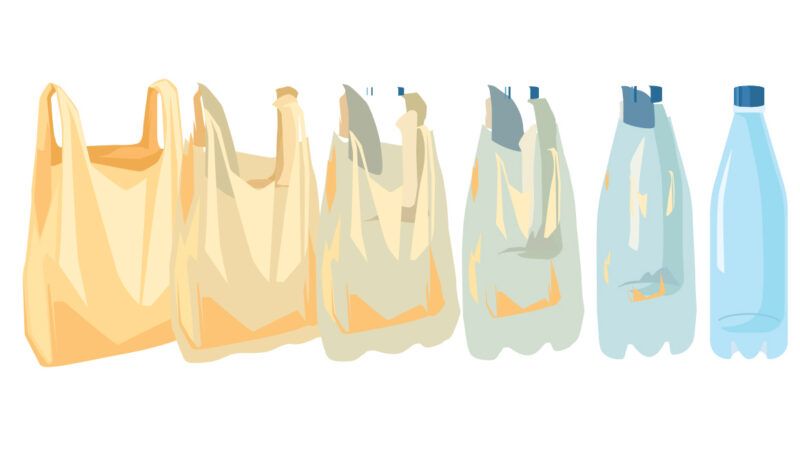
A recent innovation could make it easier to transform plastic waste into usable products.
In September 2025, the University of Delaware announced a breakthrough in hydrogenolysis, a chemical reaction that uses hydrogen gas and a catalyst to break the bonds of a molecule. In plastics, hydrogenolysis can make it easier to convert items such as grocery bags and food containers into different products. While exciting, this process is often slowed down by inefficient catalysts (which are meant to speed up hydrogenolysis).
This is where the University of Delaware comes in. A research team has taken a commonly used catalyst in plastic hydrogenolysis and made it more porous, allowing the "reaction to flow more easily," per the team's first author. This simple fix "enhances conversion of plastic waste into liquid fuels more quickly and with fewer undesired byproducts than current methods," in the words of the researchers' press release.
The development could provide an answer to one of society's most pressing problems. While plastic has provided several benefits to key industries, its pollution is widespread and is now showing up in unprecedented places, including the floor of the Arctic Ocean, the bottom of the Mariana Trench, and even human brains.
As a result, Americans increasingly support steep measures to curb this waste. A February 2025 poll from the ocean conservation group Oceana found that 80 percent of registered voters favor state and local policies to reduce single-use plastic foam. This tracks closely with the results from a 2024 World Wildlife Fund poll, which found that over two-thirds of Americans support either placing a fee on or banning single-use plastics.
Governments, in turn, are using this public dissatisfaction to consolidate more power; eight states and several cities have banned single-use plastic bags, and others have outlawed plastic straws. California (which also has a plastic bag ban) has gone a step further and filed a lawsuit against ExxonMobil for allegedly making false claims about the recyclability of its plastic products.
The University of Delaware announcement could make it harder for governments to justify top-down measures like these, but the research team still has to conduct additional R&D and further refine its catalyst before it can find an industrial partner. Luckily, the university isn't alone in its mission to turn plastic waste into something valuable. Mexican startup Petgas is operating a pilot plant to convert styrofoam and other hard plastic into high-octane gasoline and diesel. The company claims that its fuel burns cleaner than conventional gasoline due to a lower sulfur content. Canadian startup Aduro, meanwhile, has created a regenerative chemical recycling process to upcycle common plastic waste into usable products. It hopes to scale up its technology in the near future.
This article originally appeared in print under the headline "Plastic Pollution to Practical Power."

Editor's Note: As of February 29, 2024, commenting privileges on reason.com posts are limited to Reason Plus subscribers. Past commenters are grandfathered in for a temporary period. Subscribe here to preserve your ability to comment. Your Reason Plus subscription also gives you an ad-free version of reason.com, along with full access to the digital edition and archives of Reason magazine. We request that comments be civil and on-topic. We do not moderate or assume any responsibility for comments, which are owned by the readers who post them. Comments do not represent the views of reason.com or Reason Foundation. We reserve the right to delete any comment and ban commenters for any reason at any time. Comments may only be edited within 5 minutes of posting. Report abuses.
Please to post comments
Well, I hope that plastics recycling takes off! Plastics recycling is the future, man!!! Even used condoms will be lusted after, ass valuable resources!
After that, they need to move on to efficient and practical recycling of the aluminum foil in so-called "tinfoil" tricorny Magic Mind-Reading Hate-Hats, which we had a MASSIVE sourpuss surplus of, right here!
Ooooo. I'll leave the used condom collection to you. Blech...
On a serious note, the processes require a tremendous amount of hydrogen. Where is that coming from?
Using electricity to split water is an obvious choice... That, of course, does require power...
Then there's pink hydrogen, green, yellow, purple... "Colors of hydrogen" = AI says = ... (Hey man purple is missing!!!)
The colors of hydrogen refer to different classifications based on their production methods:
Green Hydrogen: Produced using renewable energy sources through electrolysis, resulting in zero carbon emissions.
2
Blue Hydrogen: Generated from natural gas with carbon capture and storage (CCS) technology to reduce emissions.
2
Grey Hydrogen: Made from natural gas without capturing emissions, currently the most common and cheapest form.
1
Brown Hydrogen: Produced from coal, resulting in higher carbon emissions.
1
Turquoise Hydrogen: Created through methane pyrolysis, which produces solid carbon instead of CO2.
1
Pink Hydrogen: Generated using nuclear energy.
2
Yellow Hydrogen: Produced using a mix of renewable energy and natural gas.
2
These color codes help differentiate the environmental impact and production methods of hydrogen.
Stupid AI missed "white hydrogen"!!!
https://www.bbc.com/future/article/20250723-the-worlds-race-to-drill-for-natural-white-hydrogen
(MeThinks it's shitty and racist that there is white, brown, and yellow hydrogen, butt there is no "black hydrogen", BTW.)
"Turning Plastic Waste Into Fuel"
Hmm, plastic waste is already fuel. It burns very easily if it's shredded into small pellets. It could be used as a fuel to generate electricity, without any additional cost-adding processing. Using it to do that would solve most of the plastic pollution problem. Plastic waste would become a valuable resource and people (especially poor people) would collect it to sell to power plants.
But, I guess we can't do that because, that would make too much sense. Maybe some day.
Directly burning plastics releases some cooties-chemicals, I think I recall reading... Often from dyes and other additives. This is still done in third-world nations, but regulated out of existence in other places, on industrial scales, at least.
Hey! You are being very dismissive of the researchers new discovery that Petroleum can be used as fuel!
Next thing you know they are going to discover that used tires have a gallon of oil in each of them that can be extracted.
Go do that in your home please, and take some deep deep breaths for me.
Ctrl+f "scrub": 0 results.
D-
Waste-to-energy incinerators, including purpose-built plastic incinerators are nearly half-a-century old at this point. This issue comes up repeatedly whenever the "ban plastic" movement gains momentum again. It is also obliquely touched upon (IIRC even by Reason, maybe Stossel, maybe even Penn Jillette) whenever activists call for "MOAR REE-PSY-CULL-ING!"
Burning the plastic directly to energy is most efficient but not necessarily the most convenient. There are multiple means of catalysis and even non-catalytic physio-mechanical means, including burning other waste to break the plastic down into liquid fuels, of diverting or repurposing the waste.
At either end, the primary issue or weak link is both/either scrubbing the raw plastic waste of contaminants to prevent "poisoning" of the catalytic agent or clogging reactors; or scrubbing the product free of contaminants before release (whether that's CO2 into the atmosphere or it and other products for downstream use).
Chemistry 102, Physical Chemistry 201: Catalysts don't actually speed up the reaction, that's controlled by mixing and diffusion mechanics, they decrease the activation energy required for the reaction to run. Given the number of stainless-steel-clad, single-passenger, 4-seater electric vehicles with lithium batteries to support 300 mi. trips cruising around (to say nothing of the comparitively larger number 'discarded' because of retarded socio-political signaling), there is little want of activation energy.
Damn, I can remember a time when, however misconceived, this magazine could weigh in on the Drexler-Smalley Debate.
I’m sure it’s 100% safe and effective with no downsides.
You mean, just exactly like unprovoked trade-tariff wars?
No, nothing like that at all.
In order to reduce plastic wast from getting into the ocean, we will send all of the environmentalists to China to protest emperor Xi.
Great idea. But like all things environmentalist, you admit that the tech just isn't there.
Oh well.
Until it is, I see no reason to alter contemporary behaviors on the subject.
[squints] Unable to tell if you realize that "there" means everyone gets their own invisible pink unicorn or not. Either way, well played.
When you're ready to deliver to me the invisible pink unicorn, that you want everyone to have, let me know.
In all seriousness, I don't object to green technology. I like the environment. If there's a way to live that's a little more eco-friendly, I don't object to it in principle.
I only object to premature green technology* - especially when it's disingenuously talked about like it's presently a reasonable alternative that A) meets our energy needs; and B) doesn't displace our social/commercial systems or demand significant personal sacrifice/financial burden.
*(with the exception of meats/milks that come from anything but fish/game/livestock. That's a hard pass no matter what.)
Like hybrid vehicles. They've come a long way. We've invested in the tech and that investment is paying dividends. Year 2000? Kind of a joke. 2025? Actually, pretty good alternative! But it needed those decades of refinement and troubleshooting and problem-solving to get where it is today to be genuinely considered a reasonable alternative.
EV's similarly, are still in their infancy (well, maybe toddler years is more fair). It's not there yet - but when it is, I'm not against it. Same goes for this plastic-to-fuel idea. If it indeed has any merit.
You are missing the point here. Plastics have to go. Look at Bloomberg when he was Mayor of New York City. He was advocating banning the use of plastic utensils in restaurants. It had nothing to do with the environment, it was all about "hurting Big Oil". Every few years a process like this comes up. It's in all of the news that it's going to "save the planet". Then it just fades away.
Ctrl + f = “China, India”: 0 results.
Until these two countries and a few others in southeast Asia stop dumping plastics (and other stuff) into the oceans, anything done here is less than a drop in said ocean.
Indonesia probably deserves specific mention as well.
E = mc2.
No matter how power-mad insane the [WE]-RULE tyrants get.
Maybe they aught to find something better/constructive to do than packing around (Gov) 'Guns' all day.
Luse, they've been doing this for 50 years.
Call me when someone is doing it on an industrial scale - because they assume they can make money doing so.
Otherwise this is just another research project being hyped up way past its utility.
You read this article and realize how Ameri-centric Reason is.
The problem with plastics is not the US. Its not even with the amount of plastic.
Its that third world Asian countries have no trash collection and landfill engineering.
I've seen restaurants in Asia burning plastic to cook food. It isn't the cleanest process.
It isn't the cleanest process.
... and the fumes of the plastic byproducts aren't very good for the pangolins and raccoon dogs either. [rimshot]
Funny anecdote: Growing up, garbage service was frequently unreliable and, as a result, we frequently burned trash (You clear and burn fencerows... sometimes hay or straw would get moldy... bonfires weren't unusual, why not?). After moving to Chicago, we had a barbecue, complete with outdoor fire pit. Grandma finished her Pepsi and reflexively, fixed, but not sealed, the cap and tossed the bottle on the fire. You'd have thought everybody watched her punched one of the toddlers in the face.
Growing up my house had an outdoor incinerator. We didn't use it anymore, but I used to play on it.
Yes, but like guns, if America can stop or curb it's love of plastics, then poor brown people won't abuse them.
We could also just bury it all underground until someday in the future when we need it. Then in 1000 years we can have plastic mines.
Yeah, people are way too scared of landfills. And if you are a CO2 reduction enthusiast, then burying plastic is a great way to sequester carbon. Recycling is great if it's economically viable, but the more important thing is having good waste management so it doesn't end up in rivers and oceans.
I work for a manufacturing company and one of my good friends/co-workers was an engineer who was highly knowledgeable about plastics. We used to talk a lot about recycling and he was the head of our recycling commission. He explained that pretty much none of the plastic you're dumping into your blue bin and bragging about recycling on Earth Day is recyclable. He and I also used to talk about how most recycling that can be done is more energy intensive than just making new stuff, and that which actually can be recycled meaningfully actually has a monetary/market value- which was why I've always contended that the price signal you can use to determine if recycling is doing anything is the fact that you have to pay to have it hauled away. If it had value in 2ndary post-waste markets, they'd be paying you for it. Anyhoo, what he thought was the ultimate solution is to simply separate all this garbage into categories and bury it in landfills. That way you'd know what landfill had what in it and if it had to be dealt with 20, 30, 70 years later, you'd know where it was and what was in it.
Better than the previous process of shipping it overseas to a "recycling" company who always planned to dump it in the ocean.
Newspapers, magazines, wooden homes, fences, fax machines, paper bags, brought fear of environmental destruction cutting down all the forests and simply not enough wood for the amount of demand for products.
Viola, plastic! Plastic offset some of the burden on forests. Recycling plastic to make decks and fences. Change to steel studs in home building and other adjustments to further offset the burden on forests.
The internet. Viola. No more magazines, newspapers, letters, etc coupled with plastics and the burden on the forests is off.
Oh hey, evil oil is destroying the earth, lets burn wood pellets, call it bio mass and save the planet!! The coal plants can be refitted for burning wood and garbage and we can call it green and sustainable! And the wood industry can pick up some of it's lost income.
Hey plastics are a massive burden. Switch bag to paper bags and hey make paper straws to virtue signal in the west.
Meanwhile 2/3rds of the earth is simply tossing their plastics into the river to end up in the ocean. Out of sight, eventually, out of mind. The fish are doing a good job eating the microplastics created as the plastics break down from running down the river and the force of the ocean.
Then the fact that forests take 50+ years to regrow and bio mass volumes are diminishing due to the new virtue signaling of reducing the use of coal that Europe and North America jumped onto.
Oops, switch those power plants back to coal, we can't get enough wood to power the people and call it sustainable. The jig is up, we can't say we powered the country on renewables since solar and wind only account for less than 10% of the generation and bio mass is not sustainable or renewable.
Hey, let's take plastic and figure out how we can burn it and call it clean energy. Since this was made from evil fossil fuels we will save the planet by burning it and we don't have to call it fossil fuels.
genius...
Let me guess, it's really expensive and difficult (which is another way of saying energy intensive which results in more co2 emitted/energy used than we get in return goddamned thermodynamics blah blah etc. etc.) but in *checks notes* ten years when it comes up to scale... we should have a functioning prototype right around the time you're eating lab grown meat by the light of a thorium reactor which uses nanotechnology and zero point energy which will of course be stored in a hydrogen cell at zero emissions which is contributing to the global ice age.


