
Survey: 91 Percent of College Students Think 'Words Can Be Violence.' That Could Feed Real Violence.
But there's a silver lining—sort of.
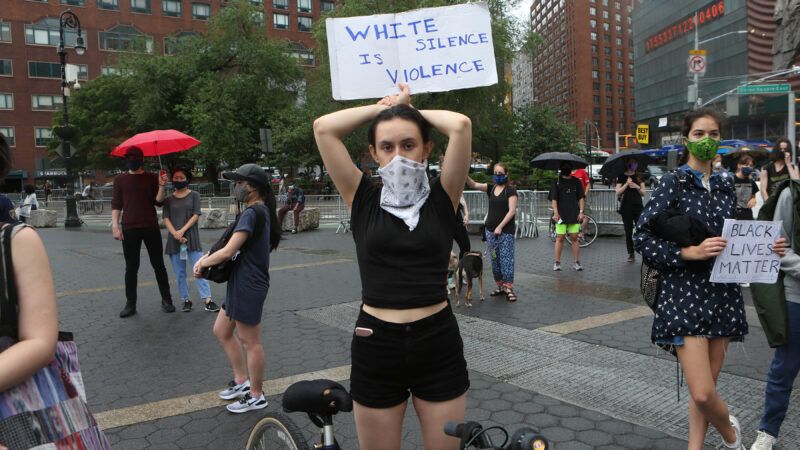
Of all the stupid ideas that have emerged in recent years, there may be none worse than the insistence that unwelcome words are the same as violence. This false perception equates physical acts that can injure or kill people with disagreements and insults that might cause hurt feelings and potentially justifies responding to the latter with the former. After all, if words are violence, why not rebut a verbal sparring partner with an actual punch? Unfortunately, the idea is embedded on college campuses where a majority of undergraduate students agree that words and violence can be the same thing.
You are reading The Rattler from J.D. Tuccille and Reason. Get more of J.D.'s commentary on government overreach and threats to everyday liberty.
Most Believe Words Can Be Violence
"Ninety one percent of undergraduate students believe that words can be violence, according to a new poll by the Foundation for Individual Rights and Expression [FIRE] and College Pulse," FIRE announced last week. "The survey's findings are especially startling coming in the wake of Charlie Kirk's assassination—an extreme and tragic example of the sharp difference between words and violence."
The survey posed questions about speech and political violence to undergraduate students at Utah Valley University, where Kirk was murdered, and at colleges elsewhere—2,028 students overall. FIRE and College Pulse compared the student responses to those of members of the general public who were separately polled.
Specifically, one question asked how much "words can be violence" described respondents' thoughts. Twenty-two percent of college undergraduates answered that the sentiment "describes my thoughts completely," 25 percent said it "mostly" described their thoughts, 28 percent put it at "somewhat," and 15 percent answered "slightly." Only 9 percent answered that the "words can be violence" sentiment "does not describe my thoughts at all."
It's difficult to get too worked up about those who "slightly" believe words can be violence, but that still leaves us at 75 percent of the student population. And almost half of students "completely" or "mostly" see words and violence as essentially the same thing. That's a lot of young people who struggle to distinguish between an unwelcome expression and a punch to the nose.
Depressingly, 34 percent of the general public "completely" or "mostly" agree. Fifty-nine percent at least "somewhat" believe words can be violence.
In 2017, when the conflation of words and violence was relatively new, Jonathan Haidt, a New York University psychology professor, worried that the false equivalence fed into the simmering mental health crisis among young people. He and FIRE President Greg Lukianoff wrote in The Atlantic that "growing numbers of college students have become less able to cope with the challenges of campus life, including offensive ideas, insensitive professors, and rude or even racist and sexist peers" and that the rise in mental health issues "is better understood as a crisis of resilience."
Conflating Words and Violence Encourages Violence
Telling young people who haven't been raised to be resilient and to deal with the certainty of encountering debate, disagreement, and rude or hateful expressions in an intellectually and ideologically diverse world plays into problems with anxiety and depression. It teaches that the world is more dangerous than it actually is rather than a place that requires a certain degree of toughness. Worse, if words are violence it implies that responding "in kind" is justified.
"At a time of rapidly rising political polarization in America, it helps a small subset of that generation justify political violence," Haidt and Lukianoff added.
Sure enough, last week Gallup reported that "age is the strongest predictor of attitudes toward political violence, with young adults aged 18–29 more likely than other age groups to say that it is sometimes OK to use violence to achieve a political goal." Thirty percent of respondents 18–29 say it is "sometimes" acceptable to use violence to achieve political goals, compared to 21 percent of those 30–44, 13 percent of those 45–59, and 4 percent of people 60 and older.
And yes, acceptance of political violence has changed over the tears. For those 18 to 29, it was 22 percent in 1970 and 21 percent in 1995. For 30-to-44-year-olds, it was 16 percent in 1970 and 15 percent in 1995. The percentage remained largely unchanged for those 45–59 and dropped for people over 60.
Kirk was assassinated by, allegedly, a 22-year-old who strongly disliked what the conservative activist had to say. The incident is a real-life example of the dangers of conflating speech and violence. It's not acceptable to respond to words you don't like with physical force.
There's a Silver Lining—Sort of
That said, there is encouraging news. The percentage of college undergrads who say it is at least "rarely" acceptable to shout down speakers to prevent them from speaking on campus has dropped to 68 percent from 72 percent last spring. Forty-seven percent of students say it is at least rarely acceptable to block other students from attending a campus speech, down from 54 percent in the spring. And 32 percent find it acceptable to use violence to stop a speech, down from 34 percent.
But sentiments can be overshadowed by high-profile incidents like assassinations. "Because of what happened to Charlie Kirk," 45 percent of students are "less comfortable" expressing their views on controversial political topics during in-class discussions, notes FIRE in its findings. And neither sentiments nor comfort in self-expression have universally shifted.
"Moderate and conservative students across the country became significantly less likely to say that shouting down a speaker, blocking entry to an event, or using violence to stop a campus speech are acceptable actions," writes FIRE. "In contrast, liberal students' support for these tactics held steady, or even increased slightly."
As a consequence, 84 percent of Utah Valley students say the country is headed in the wrong direction when it comes to people's ability to freely express their views. At other colleges and universities, 73 percent feel the same way (almost identical to the feeling of the public at large). It should be noted, however, that the news is more positive when students are asked about their own campuses; 53 percent say their own schools are headed in the right direction.
These students are headed into a world in which many of their peers see little difference, if any, between words and violence. They adhere to this position even after Kirk was murdered for, almost certainly, what he had to say. And they do so in an environment of surging political violence.
Americans worry that the country is becoming less friendly to free expression. But the insistence of too many people that words and violence are the same thing is a big part of the problem.
