
The Free Market Can Connect Rural America Faster Than the Government
Private innovation is connecting rural America faster than Washington’s $42 billion broadband program.
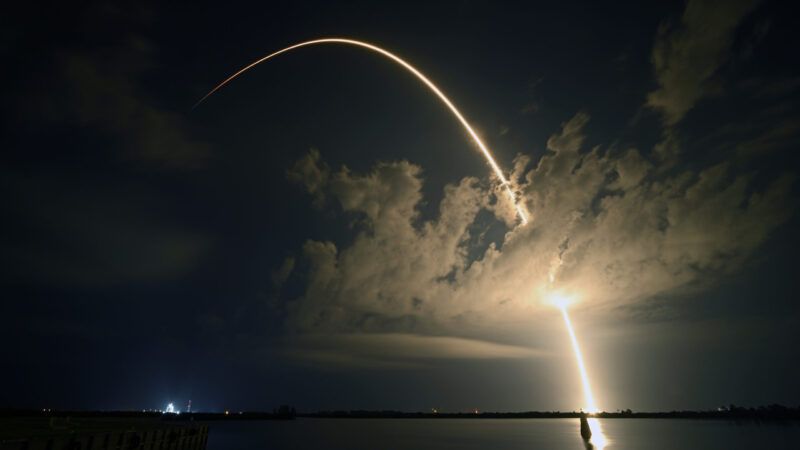
Elon Musk's satellite internet service, Starlink, announced a new milestone in November: 8 million users worldwide, up from its previous high-water mark of 7 million in August. Many of these users would otherwise have no connection at all. For decades, reliable internet service has been out of reach for too many, with traditional fiber-optic broadband rollout slow, challenging, and costly. Starlink and new innovators are changing that, revolutionizing how we connect rural America.
A service of SpaceX, Starlink delivers broadband through a constellation of low-Earth-orbit (LEO) satellites, a technology unconstrained by the traditional "last mile" problem of physically connecting homes to high-speed networks. Each terminal links directly to satellites, providing high-speed internet worldwide. Because Starlink's satellites orbit roughly 340 miles above Earth, versus about 22,000 miles for geostationary satellites, latency is dramatically lower, reducing signal delay and enabling high-quality, bandwidth-intensive uses like video calls and online gaming.
Starlink isn't the only player in this arena. Amazon Leo (formerly Project Kuiper) unveiled its new branding in November as it gears up to offer direct-to-consumer internet service. It is investing billions into LEO technology and already has more than 150 satellites in orbit.
Fiber broadband depends on laying long stretches of physical cable, something that is often expensive or unprofitable. For example, The Wall Street Journal reported in 2023 that the federal plan to expand broadband into Nebraska's Winnebago Tribe was expected to cost an average of $53,000 per household or workplace; in parts of Montana, some connections are estimated at a whopping $300,000 each. These costs frequently mean rural fiber expansion depends heavily on government subsidies.
The economics of satellite internet are fundamentally different. Starlink installs for about $600 in hardware. There's no cost per mile, deployment is immediate, and maintenance is minimal. It's a self-sustaining model with minimal subsidization necessary.
The federal government has poured billions of dollars into expanding rural broadband, primarily through fiber-optic buildouts. Most recently, the 2021 Infrastructure Investment and Jobs Act allocated over $42 billion for the Broadband, Equity, Access, and Deployment (BEAD) program.
Should the federal government involve itself so extensively in broadband expansion, and if so, who should benefit on the supply side?
Under the Biden administration, the National Telecommunications and Information Administration (NTIA), empowered to define what constitutes "priority" broadband service, was engaging in a policy of picking winners and losers. In a December 2024 notice, LEO satellite internet service is explicitly named as an "alternative technology," effectively sidelining it from BEAD funding in favor of legacy providers.
This was shortsighted. In a short time, Starlink has undergone rapid improvements, expanding its user base from roughly 140,000 in 2021 to 8 million today. Further, from the third quarter of 2022 to the first quarter of 2025, U.S. median download and upload speeds rose from 53.95 megabits per second (Mbps) and 7.50 Mbps to 104.71 Mbps and 14.84 Mbps, respectively. Since then, performance has accelerated even further: Globally, Starlink reported typical download and upload speeds exceeding 200 Mbps and 30 Mbps, with median latency averaging about 23 milliseconds (ms).
All of this easily outperforms the Federal Communications Commission's broadband benchmarks of 100 Mbps download speeds, 20 Mbps upload speeds, and latency below 100 ms. Starlink says it offers download speeds of 400 Mbps or higher where available. Meanwhile, Amazon Leo rolled out its plan to offer LEO internet service with download speeds of up to 100 Mbps, 400 Mbps, and 1 Gbps.
Achieved primarily as a privately financed, market-driven venture, Starlink already offers much of rural America high quality internet service. And with SpaceX continuing to launch not only more LEO satellites but higher-performing ones with its second generation, the company's service quality is poised to continue advancing.
We shouldn't let government subsidies distort the market. U.S. Commerce Secretary Howard Lutnick embraced this thinking with his June 2025 decision to drop the NTIA's "fiber preference," shifting the agency toward a technology-neutral, cost-driven framework. The policy emphasizes cost-effectiveness among technologies meeting speed and latency standards.
The Communication Workers of America (CWA) pushed back, accusing Lutnick of prioritizing the "interests of a few billionaires and satellite companies," and dismissing LEO technology as "expensive and unreliable." CWA represents tens of thousands of technicians employed by legacy telecom firms reliant on fiber models, along with unionized workers who install and maintain fiber-optic infrastructure.
Days before the announcement, other fiber-aligned groups issued statements pressuring the Trump administration to preserve the status quo. The Fiber Broadband Association (FBA) sent its own letter to Lutnick urging that BEAD remain centered on fiber deployment, while five other industry associations issued a joint letter to President Donald Trump, emphasizing BEAD as a "golden opportunity" to "drive as much fiber infrastructure as feasible into our country."
In many areas, fiber expansion will continue to make sense, but if LEO-based broadband can offer high-quality internet connectivity virtually instantaneously and on the cheap to many in the targeted regions, why should the federal government stand in the way? After all, as Starlink celebrates its 8 million and counting user base, something largely accomplished absent heavy subsidization, a congressional report notes that, as recently as August 2025, "no eligible broadband deployment projects" had received BEAD funding yet.
Just five years ago, direct-to-consumer LEO service was only an idea. Today—built and scaled overwhelmingly through private investment rather than being dependent on federal broadband deployment subsidies like BEAD—Starlink reliably connects millions, and with additional and higher-performing satellites coming, it is set to expand in quality and reach. New entrants also underscore that this industry is steadily advancing. While fiber-based, last-mile broadband infrastructure will remain part of the solution, the federal government should steer clear of tilting the playing field and let innovation lead. If the government steps aside, the free market can finally finish the job of connecting rural America.
