

SCOTUS Tackles Illegal File Sharing, Internet Music Piracy, and Copyright Law
Plus: It’s webathon time.
Greetings and welcome to another edition of Injustice System. Before we dig into the legal news, I wanted to let you know that Reason's annual webathon is currently underway. If you find this newsletter to be valuable, interesting, or informative, I hope you will consider donating to support my work and the work of my colleagues.
Now on to the law.
You’re reading Injustice System from Damon Root and Reason. Get more of Damon’s commentary on constitutional law and American history.
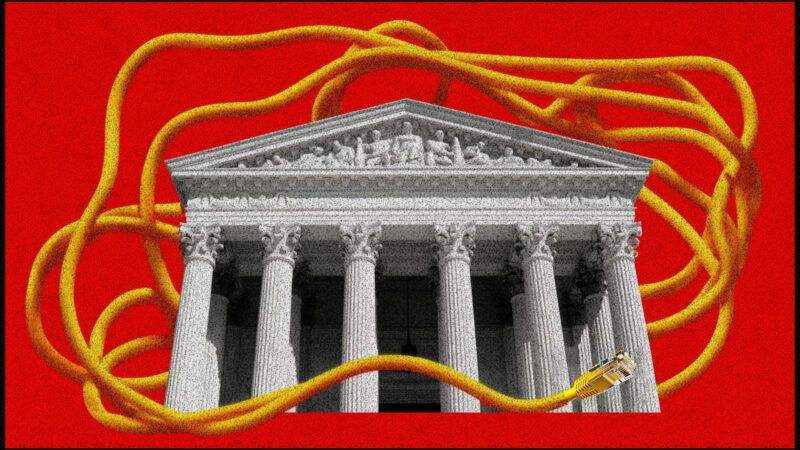
The U.S. Supreme Court heard oral arguments this week in a case with far-reaching implications for how millions of Americans use the internet.
I am going to assume that most readers of this newsletter are virtuous, clean-living types who always follow federal copyright law to the letter. But I also must assume the existence of a certain scofflaw minority. This case might just be about you rogues.
At issue this week before the Supreme Court in Cox Communications v. Sony Music Entertainment is whether "an internet service provider (ISP) can be held liable for 'materially contributing' to copyright infringement merely because the ISP knew that people were using certain accounts to infringe but did not terminate access, without proof that the ISP engaged in affirmative conduct with the purpose of furthering infringement."
Sony, the corporate parent of various record labels and music publishers whose artists include the likes of Bob Dylan, Beyoncé, and Eminem, told the Supreme Court that Cox Communications was fully aware of numerous "repeat offenders" among its customers who are guilty of illegally sharing music files. "What set Cox apart" from other ISPs, Sony claimed, "is how uniquely disinterested it proved in stopping its paying users from infringing, even as it terminated internet access for hundreds of thousands of users for late payments."
Cox, by contrast, told the Court that "less than 1%" of its customers "have have also used the service to swap infringing music files; and Cox's anti-infringement measures got 95% of that less than 1% to stop."
Cox lost in the lower court, however, and now wants the Supreme Court to change its fortunes. "The consequences" here are "cataclysmic," declared Joshua Rosenkranz, the lawyer representing Cox during this week's SCOTUS oral arguments. "There is no sure-fire way for an ISP to avoid liability, and the only way it can is to cut off the Internet not just for the accused infringer but for anyone else who happens to use the same connection. That could be entire towns, universities, or hospitals."
In other words, the same legal reasoning that would require Cox to cut off internet access to the home of a single repeat offender would also require Cox to cut off internet access to an account that featured many lawful users and only a small number of lawbreakers, such as a library or a university.
That argument seemed to find some purchase among the justices, several of whom expressed fears that any ruling in Sony's favor might go too far.
"What is an ISP supposed to do with a university account that has, let's say, 70,000 users?" Justice Samuel Alito asked Paul Clement, the lawyer representing Sony. Even if the school cut off internet access for "a thousand students" who had swapped illegal music files, then "another thousand students are going to pop up doing the same thing. I just don't see how its workable."
Clement responded by suggesting that the university might find other ways to discourage illegal file-sharing among its students. "I don't think it would be the end of the world if universities provided [internet] service at a speed that was sufficient for most other purposes but didn't allow the students to take full advantage of BitTorrent," Clement said.
Of course, the same high-speed internet access that makes illegal file-sharing possible on a university campus also makes various lawful academic activities possible on a university campus (hello computer science department!), which, as Alito's questioning suggested, may prove to be a fatal weakness in Sony's overall case.
A decision in Cox Communications v. Sony Music Entertainment won't be coming our way until sometime next year, so until then, we'll just have to wait and see.




