

Switzerland Just Overwhelmingly Rejected a New Wealth Tax. Will California Lawmakers Learn?
The hammer of heavy wealth and inheritance taxes falls hardest on those still climbing the economic ladder.
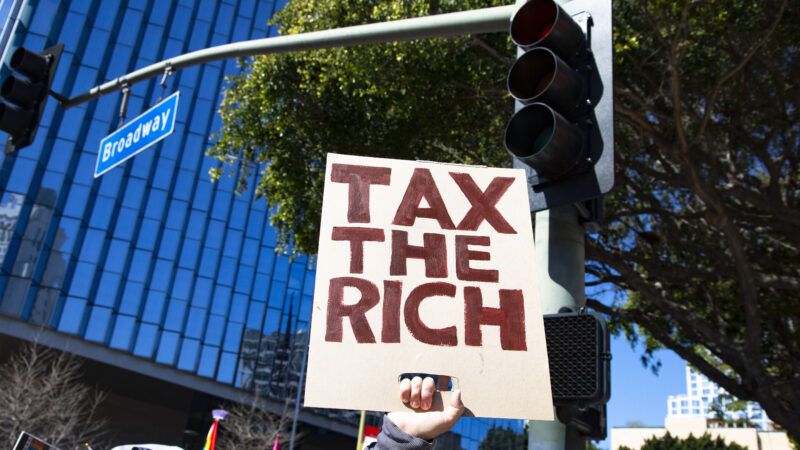
California progressives are pushing a wealth tax that would skim 5 percent of the assets of billionaires to cover the state government's fiscal gap. That is, it would hit billionaires to start—there's no telling who would come to be regarded as wealthy enough to be fleeced as the state's spending likely continues to outstrip its revenues. But before Californians proceed down the path of chasing high earners out of the state, they should consider the example of Swiss voters, who just rejected a billionaire tax of their own.
You are reading The Rattler from J.D. Tuccille and Reason. Get more of J.D.'s commentary on government overreach and threats to everyday liberty.
Swiss Say 'No' to Soaking the Rich
"Switzerland on Sunday overwhelmingly rejected a proposed 50% tax on inherited fortunes of 50 million Swiss francs ($62 million) or more, with 78% of votes against the plan, an outcome that even exceeded the two‑thirds opposition indicated in polls," Reuters reported this week.
All Swiss cantons already tax assessed gross worldwide assets, minus debts and with exceptions, making it one of the few countries in the world to retain a wealth tax. But competition among cantons keeps the tax burden relatively low and, as the Tax Foundation notes, "the Swiss wealth tax acts as a substitute for a capital gains tax and an estate tax, which are common in other countries." The referendum would have imposed an additional and very steep national tax.
This was actually the second recent failed attempt to impose a national wealth tax on inheritances. Seventy-one percent of Swiss voters rejected a 2015 proposal for a 20 percent tax on estates and gifts of over 2 million francs. The revenues would have been earmarked for old-age pensions.
'Inequality in Opulence is Better than Equality in Poverty'
The 2025 tax scheme openly played to envy. It was targeted at combating "inequality" by seizing half the assets of the rich and allocating proceeds to offset the climate damage they allegedly cause.
Finance Minister Karin Keller-Sutter opposed the proposal, warning that "many wealthy people would simply emigrate to avoid the tax and keep their wealth." She also pointed out that while all but two of the country's 26 cantons tax inheritances, "the people have abolished inheritance tax for children and spouses in many cantons." She added, "I think it is right that what was developed in the nuclear family can be passed on."
Philosopher Olivier Massin, a professor at the University of Neuchâtel, criticized the motivation driving much of the campaign for the tax. He wrote that "inequality is by nature neither good nor bad" and that envy is the main driver of egalitarianism. "Envy being inglorious, we grimace in indignation, making what is ultimately only the expression of resentment a moral cause."
Massin added that "inequality in opulence is better than equality in poverty."
And Switzerland is undoubtedly "opulent"—or, at least, prosperous—with a per capita gross domestic product of $103,669 as compared to $85,809 for the U.S., according to the World Bank. It builds that wealth with a second-place score in the current Index of Economic Freedom (the U.S. is now ranked at 26), suggesting that less government meddling in economic matters is the best way to increase prosperity.
Wealth Taxes Create an Exodus of Successful People
And Keller-Sutter is right to fear an exodus of wealth if the tax had passed. Numerous successful residents of the country took steps to emigrate when the referendum gained ballot status. That's not an empty threat—it's happened elsewhere.
In 2023, The Guardian reported that "record number of super-rich Norwegians are abandoning Norway for low-tax countries after the centre-left government increased wealth taxes to 1.1%."
Both France and Sweden experienced similar outflows of people and money to escape wealth taxes.
"The revenue it raised was rather paltry," Bloomberg observed of France's efforts. "Only a few billion euros at its peak, or about 1% of France's total revenue from all taxes. At least 10,000 wealthy people left the country to avoid paying the tax."
As a result, NPR reported in 2019 during a national U.S. debate over wealth taxes, "In 1990, twelve countries in Europe had a wealth tax. Today, there are only three: Norway, Spain, and Switzerland."
Switzerland offsets its wealth tax by substituting it for other taxes common elsewhere. Other countries use wealth taxes to penalize success and to, usually unsuccessfully, supplement the revenue generated by income taxes, value added taxes, property taxes, and more. That's the tack proposed in California.
Taxes on Wealth Do More Harm Than Good
Wealth taxes "raise little revenue, create high administrative costs, and induce an outflow of wealthy individuals and their money," Cristina Enache wrote last year for the Tax Foundation. "Many policymakers have also recognized that high taxes on capital and wealth damage economic growth."
That damage occurs because "net wealth taxes tend to be more distortive and less equitable," according to a 2018 report from the Organization for Economic Cooperation and Development. "This is largely because they are imposed irrespective of the actual returns that taxpayers earn on their assets."
That is, the targets of wealth taxes pay on assessed values of assets that may lose value in the future as easily as gain it, and without regard to income which may be low or even negative in any given year. They're taxed on profits they have yet to realize and may lose to a business failure or stock market crash. As a result, the report adds, "a net wealth tax reduces the amount of capital available, which may in turn affect entrepreneurship and business creation."
Counterintuitively, the hammer of heavy wealth and inheritance taxes falls hardest not on the superrich, but on those still climbing the economic ladder. "While inheritances contribute to wealth persistence across generations, they also reduce inequality by proportionally benefiting households lower in the wealth distribution," the Tax Foundation's Enache wrote regarding the Swiss referendum. "Transfers are proportionately larger (relative to their pre-inheritance wealth) for households lower in the wealth distribution. This has an equalizing effect on the overall wealth distribution."
That is, taxes on wealth, whether imposed at the time of inheritance on during people's lifetime, leave the richest less burdened than those have yet to reach the top and often have fewer escape routes.
Not that California's wealthiest are any more likely to face confiscatory taxes than are their counterparts in Switzerland. If Norwegian, Swedish, and French millionaires are willing to abandon their countries to escape the tax man, Californians will have little trouble decamping to Texas or Florida. California's greedy government is less likely to seize wealth than to chase it out of the state.




