

Guillermo del Toro's Frankenstein Comes Perilously Close To Opposing Human Flourishing
In the Oscar winning director's new Netflix film, humanity is the real monster.
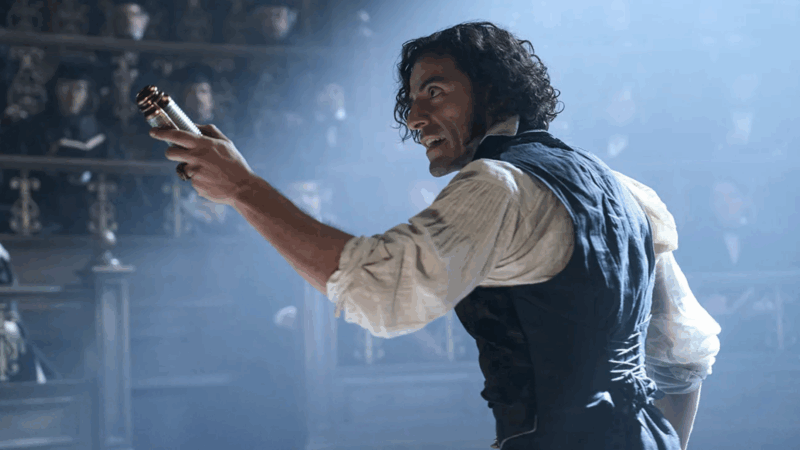
It's hardly surprising that Guillermo del Toro, the Oscar-winning director behind such monster-friendly films as The Shape of Water, Pan's Labyrinth, and Hellboy, would eventually take on Frankenstein. Nor is it any surprise that his gothic fright is lavish, luxurious, a Grand Guignol of sumptuously bloody production design. Del Toro has always had an eye for what makes monsters beautiful as well as what makes them terrifying, and his aesthetics have typically been matched by a profound empathy for the misunderstood horrors that haunt his films. In del Toro's horrors, the real monsters are never the actual monsters. The real monsters are fascism, bigotry, oppression, and social shunning. The real monsters are always us.
So it is in his Frankenstein, now on Netflix, which casts the monster as a tender innocent brought into a cruel world by an even crueler man, a father and god figure whose mad ambitions make him more monstrous than his stitched together creation. It's a gorgeous movie, but, like The Shape of Water, it's also a cloying and self-satisfied one. And it comes perilously close to opposing the idea of human progress itself.
In some ways, del Toro's film sticks closely to the 1818 Mary Shelley novel from which it, like so many previous Frankenstein movies, was adapted. But Shelley's novel offered a complex portrait of the titular scientist and his monstrous creation, one that allowed for real terror and real fear at the prospect of a violent and powerful man-creature reanimated from the body parts of the dead.
Del Toro, in contrast, gives us a monster, played with lithe grace by Jacob Elordi, who is still powerful and even violent at times, but always righteously so. He is, in del Toro's simplistic moral worldview, good because of his innocence, because he was not complicit in the horrible facts of his creation.
For that, the movie lays all blame squarely on the shoulders of Baron Victor von Frankenstein (a sweaty, miscast Oscar Isaac), the surgeon-scientist who dreams of sparking life from the dead. Frankenstein was himself abused by a cruel and emotionally unavailable father figure as a child, and thus, he is too. The film is shot through with terror of fathers, including the Biblical God. Over and over again, there are unsubtle visual allusions to the garden of Eden, the apple of sinfulness, and the fall of man. The god of creation is the real monster, the progenitor of evil, an uncaring overseer, cold and indifferent to the pain of its creations.
I do not remotely object to this or any other movie taking a secular or atheistic stance on matters of the divine. What I object to is the self-satisfied simplicity of the way del Toro pursues his metaphorical project, the easy and unbearable smugness of his "but who is the real monster?" twist on Shelley's gothic fable.
His script, for which he receives sole credit, never reckons with its complications or complexities, never seems to want to explore the noble upsides of the impulse to create, invent, and give life. At most, he allows that Frankenstein is a profoundly sad being, a man whose psyche was destroyed by the childhood trauma of being born to a callous father. But far too often, del Toro's tragic vision comes across as a brief against the acts of life-giving and invention themselves, which is to say that it comes perilously close to being a movie about the horror of human flourishing. This is maybe not surprising given his priors about humanity's monstrousness.
But while there has always been a strong element of skepticism about science and the potentially destructive power of man's creations in Shelley's story—in the taxonomy of Isaac Asimov, it's a "robot as Menace" story—del Toro, in some ways, goes further. It is remarkable that a man who has spent three decades as one of Hollywood's most formidable filmmakers, someone who pours life into strange and often wonderful projects, seems, whether intentionally or not, to oppose the act of creation itself.




