

New Speaker Mike Johnson's First Good Idea: A Debt Commission
A debt commission won't solve any of the federal government's fiscal problems, but it's the first step towards taking them seriously.
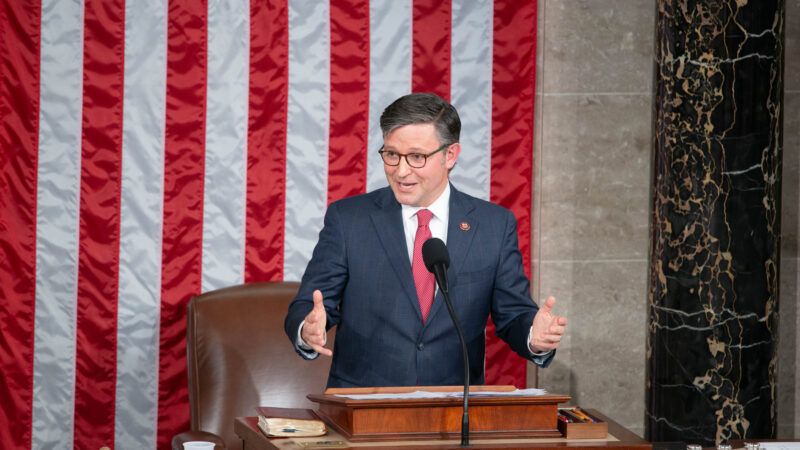
Just moments after picking up the gavel, newly elected Speaker of the House Mike Johnson (R–La.) endorsed an idea that manages to be both eye-roll-inducing and really important.
"The greatest threat to our national security is our nation's debt," Johnson said during his first speech from the speaker's dais in the House chamber. "We know this is not going to be an easy task and tough decisions will have to be made, but the consequences—if we don't act now—are unbearable."
Then, Johnson promised to "establish a bipartisan debt commission to begin working on this crisis immediately."
This is, in some ways, a pretty silly idea. After all, Johnson is the newly elected leader of Congress, which is a group of elected officials from two political parties who have the constitutionally granted power to control the federal government's fiscal policies like borrowing and spending.
Congress is, quite literally, a bipartisan commission tasked with managing the debt.
Within Congress, there's also a Budget Committee, which is, of course, a bipartisan group of lawmakers tasked even more explicitly with determining how much the government can afford to spend, what it should spend tax revenue on, and when there's been too much borrowing.
So, yes, the very notion of a new and special bipartisan commission that's going to do the thing Congress is already supposed to be doing is a little funny and more than a little redundant.
And yet, it's obvious that something new has to be tried. "In the time that it's going to take me to deliver this speech, we'll go up another $20 million in debt. It's unsustainable," Johnson pointed out on Wednesday—and it wasn't a very long speech.
What can a bipartisan commission on the debt accomplish? The Committee for a Responsible Federal Budget (CRFB), which has been advocating for such a commission, argues that special congressional task forces can focus discussions, generate greater public awareness of major issues, and create the opportunity for lawmakers to put all ideas on the table.
In 1983, for example, Social Security was approaching insolvency—a problem that sounds pretty familiar today—when a commission of congressional leaders and presidential appointees worked out a series of potential fixes. Afterward, Congress enacted many of those reforms, making Social Security solvent for another five decades.
More recently there was the National Commission on Fiscal Responsibility and Reform, formed by President Barack Obama in the aftermath of the 2008 recession. It produced a plan that could have reduced the debt by $4 trillion over 10 years by raising taxes, cutting spending, and selling off federal property. Even though most of those proposals were never enacted, the CRFB points hopefully to the fact that 11 of the 18 commission members supported the final recommendations, including five Republicans and five Democrats.
The idea for another commission on the deficit has been kicking around for a few years but has recently gained steam. The moderate lawmakers in the bipartisan Problem Solvers Caucus have endorsed the idea. Polling by the Peter G. Peterson Foundation, which advocates for balancing the budget, shows that majorities of both Republican and Democratic voters support the formation of a commission.
How would it work? Reps. Bill Huizenga (R–Mich.) and Scott Peters (D–Calif.) have introduced a bill to establish a 16-member commission that would include four experts from outside Congress (to be appointed by party leaders from both the House and Senate). The commission's recommendations would receive priority consideration by Congress and would be scheduled for a final vote during the lame-duck session after the 2024 election.
That timing reveals something about the real reason why members of Congress like this sort of idea: because it allows them to avoid accountability for doing the thing they're supposed to be doing in the first place.
Recall what Johnson said on Wednesday: this will be a process that requires "tough decisions." There's nothing all that complicated about balancing the federal budget. Members of Congress don't need special experts or a bipartisan commission to tell them that closing the deficit will require raising taxes or cutting spending (or some combination of the two). That's literally all there is to it.
But those decisions become tough because politicians know that voters don't like having their taxes raised. They also know that cutting even the most useless and wasteful government spending will spur outrage from whatever special interest group benefits from it.
In the end, the right way to think about a bipartisan commission on the debt is as a sort of political suicide pact. It means that members of both parties are committed to at the very least proposing ideas for how to balance the budget—and that, in turn, should limit some of the partisan screeching that makes it so hard for Congress to make these decisions under normal circumstances. Both sides will have to take responsibility for putting an end to the government's addiction to borrowing.
Will it work? Probably not, but nothing else seems more promising right now. Johnson's got his work cut out, but this is a worthwhile effort.




