

Dems' Hazard Pay Proposals Are a Recipe for a Lot Fewer Essential Workers
We need essential workers right now. We also need markets and the price signals they provide.
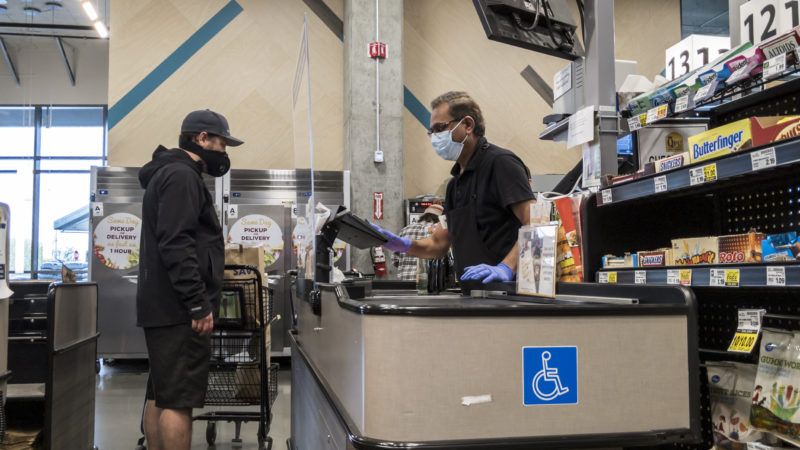
Frontline workers are doing the Lord's work right now ensuring that grocery store shelves are stocked, hospital patients are cared for, and trains are running (mostly) on time. Congressional Democrats have a couple of proposals to put them out of a job.
This week, Rep. Bonnie Watson Coleman (D–N.J.) introduced the Essential Pay for Essential Workers Act, which would guarantee essential workers an extra $15 an hour on top of whatever they are currently earning.
These essential workers are "putting their lives and their families' lives at risk with little protection and even less compensation, and they are often already the individuals with the least financial security," said Watson Coleman in a press release. "This bill is about recognizing something we've always known but have never admitted—that we can't function without these workers."
Her bill, which has picked up three co-sponsors so far, would guarantee this wage premium to workers in a string of industries, including health care, agriculture, energy, transportation, and law enforcement.
The text of the bill has yet to be released. Coleman said on Twitter that employers would be required to pay the extra $15 an hour up front, for which they would receive a 100 percent tax credit.
The employer provides the $15 per hour cost upfront and it's treated as a 100% tax credit
— Rep. Bonnie Watson Coleman (@RepBonnie) April 30, 2020
Hazard pay for those working in environments where they might contract COVID-19 is both a popular idea among policy makers and an economic reality at many companies. Amazon has temporarily bumped pay for warehouse workers by $2 an hour, and it is offering double overtime pay in the U.S. and Canada. A number of grocery chains and state governments have followed suit with pay bumps of their own.
But not all employers have introduced increased hazard pay, and some workers say their employers' increases are insufficient to compensate them for the added risks they face.
Cue the calls for government-provided and/or government-mandated hazard pay.
Coleman's proposal is the most recent, and the most generous, but it's similar in kind to other bills that have been floated by congressional Democrats.
Rep. Matt Cartwright (D–Penn.) introduced legislation last week that would require employers to pay high-risk health care workers an additional $18.50 an hour and other essential workers an additional $13 an hour. The mandated increases would be capped at $35,000 per year for health care workers and $25,000 per year for other essential workers. The bill would create a fund within the U.S. Treasury Department to cover this hazard pay.*
Senate Democrats have also been pushing the idea of a Heroes Fund. This would also provide essential workers with an additional $13 an hour, and it would give certain health care workers a $15,000 recruitment incentive bonus for taking a job right now. The pay bump would be capped at $25,000 a year for those earning under $200,000, and $5,000 for workers earning $200,000 or more.
Unlike Coleman's proposal, the federal government would fund this hazard pay upfront through grants to employers.
The American Action Forum (AAF), a center-right think tank, estimates that the Heroes Fund would cost between $153.9 billion and $672.8 billion, depending on the duration of the program and how broadly it defines essential workers.
Molly Kinder of the Brookings Institution, a liberal-leaning think tank, has published an analysis of various hazard pay proposals. She argues that the $2-an-hour pay bumps adopted by some corporations are too little, and that the Heroes Fund levels of hazard pay would be more appropriate.
Both AAF and Brookings point out that the Heroes Fund's singular pay bump would be simple, and therefore easy to administer. It would still be a massively expensive program. The higher $672 billion cost estimate puts the Heroes Fund in spitting distance of what we spend on our bloated Defense Department each year. It would come in addition to the trillions in new coronavirus spending that Congress has already authorized.
And while a single, flat pay increase might be simpler to administer, it wouldn't reflect the varying levels of risk that come with different essential jobs. Workers would, therefore, be incentivized to migrate to the least risky jobs covered by a Heroes Fund, leaving many crucial industries and positions understaffed.
On the other hand, by having the federal government pay for this hazard pay directly, it would also avoid the more serious defects contained in Coleman's proposal.
Many private employers of essential workers are already coping with coronavirus-induced increases in expenses and reductions in sales. Even companies that are doing more business are often seeing profits shrink.
Amazon CEO Jeff Bezos, for instance, told investors yesterday that despite a 26 percent increase in earnings, the company's profitability was likely to decline over the next few months. Grocery stores, which saw a similar surge in sales last month as people stockpiled goods, are bracing for a drop-off in demand.
Telling these same employers that they'll have to find the money to pay for $15-per-hour pay increases overnight is a recipe for big layoffs, price increases, or cuts in crucial investments in safety and expanded production to meet the demands of the current crisis.
There's a fierce academic debate about whether a minimum wage increase of $2 or $3 phased in over time reduces employment. But mandating an immediate doubling of many workers' pay certainly would. Coleman's offer of a 100 percent tax credit to employers for this increased hazard pay wouldn't address the immediate cash crunch many would certainly face trying to pay these higher wages.
Things would be even worse for local governments that employ first responders, bus drivers, and police officers. The coronavirus pandemic has devastated local tax revenues, making it difficult if not impossible for many places to fund the pay increases mandated by Coleman's bills. And Coleman's tax credit would be worth nothing to local governments.
The result: higher wages for some workers, but fewer workers overall. If these workers are truly essential, that'd be a counterproductive result.
Frontline workers are doing dangerous, crucial tasks at a very stressful time. They deserve to be compensated for the increased risks that they're taking on. But the debt we owe them doesn't eliminate businesses' and governments' budget constraints, and it doesn't purge government programs of bad incentives and unintended consequences.
Correction: The original version of this article said that Rep. Matt Cartwright's legislation made employers responsible for funding employees' hazard pay, when in fact the U.S. Treasury would fund it.




