Racing to a Non-Petroleum Future
With the "Escape from Berkeley" alt-fuel road rally
Northern California's early October cold can be bracing, up there in the mountain passes. Long before it gets seriously uncomfortable for a human, though, the cold is already treacherous for vegetable oil, transmuting it from something pleasingly viscous to a clumpy, still, gooey mess.
Most of us don't have to think about frigid vegetable oil as we drive from, say, Berkeley, California, to Las Vegas, Nevada.
However, this reality cost an extended family of very nice, very earnest, very hardworking homeschooling machinists a chance at a $5,000 prize in a unique road rally in early October, as the mountain cold caused their home-altered Mercedes-Benz to choke and die in remote Lee Vining, California, before they could beat the competition to Vegas.
I was a judge in this road rally (not "race," if you please, which is illegal on public roads) for alternative fuel vehicles called "Escape From Berkeley (By Any Non-Petroleum Means Necessary)." The race's organizers, spearheaded by builder and conceptualizer Jim Mason, had a chip on their shoulders about Berkeley, the home of their experimental art and energy complex known as "The Shipyard." (I chronicled the Shipyard's legal fights with Berkeley and technical fights with self-generated power in the May issue of reason.) Beyond their animus toward Berkeley was their love for home-hacked automotive solutions, especially ones that offered possible ways around the greenhouse-gas-producing petroleum economy.
The rally's rules were demanding, though not complicated: participating vehicles had to be powered by something other than petroleum; you had to begin the race with only a gallon (or gallon equivalent) of it, and you could not exchange money for fuel along the way. Fuel had to be begged, bartered, or scavenged. Why? Not from hatred of markets or commerce. For one thing, the rules emulate the post-automobile "statist dystopia" fantasy world in which the race was imagined to be taking place. Also, it made it more challenging in an interesting way.
When I was invited to be a judge—along with futurist Paul Saffo, Burning Man organizer Michael Michael, and Internet archivist Brewster Kahle—the idea sounded exactly like one of the amusing and excessively imagined larks that these people, whom I knew through my participation in and coverage of the Burning Man Festival, regularly engaged in. But the rest of the world seemed fascinated. Some of the obvious suckers for politically engaged tech-hacks, such as Wired, weighed in. But so did local alt-weekly the East Bay Express, resulting in a massive cover story. Even the august and serious New York Times gave detailed and respectful coverage, both pre- and post-race. (The rally even got mocked with little mercy, and only a smidgen of accuracy, by the Colbert Report.)
The rally began Saturday morning at the Shipyard roughly near the planned 10 a.m. start time, with six vehicles (of the 18 or so whose creators had expressed interest in participating—attrition was hard and fast, and wasn't over yet) crossing the start line. Due to public transportation snafus, I missed the actual start, but as Mason gave me a lift to the airport (I had to give a speech in Los Angeles that evening) we saw one crew, known as the "Green Team," who had already driven their gasifier-powered Dodge truck from Alabama to Berkeley, chopping up portions of the Shipyard's old fence for fuel. The fence was made of pressure-treated redwood—a choice the team would later regret.
I planned to rendezvous with the organizers, support vehicles, and racers at the Sunday end checkpoint in Lone Pine, California, an agglomeration of quaintness, cafes, gift shops, and real estate offices at the eastern foot of the Sierra Nevadas surrounding state road 395. I drove in to Lone Pine Sunday afternoon with my sidekick, Heathervescent, an L.A. tech promoter and consultant.
Heather's and my L.A. bones rebelled against the deepening chill that accompanied the thin clear mountain air as it went from blue to black. We hid out in Jake's Saloon until the other judges and organizers crawled in way behind schedule. Six alt-fuel vehicles had left the Shipyard; only two arrived in Lone Pine that evening. The route shifted on the fly as the intended Tioga Pass was snowed out. Much had gone wrong—which is the most interesting part of adventures like this. We learned what we missed over many rounds of beer.
The casualties? Steampunk craftsmen Shannon O'Hare, Kimric Smythe, and crew knew that "Kristie's Flyer"—their complicated, vegetable-oil-burning steam-powered fantasia—could never cross the mountains, so after ceremonially starting they just hauled it on a trailer to Vegas. The tandem-bike vehicle, with an ethanol engine augmented by the pedal power of the two drivers, developed engine trouble and gave up at Concord, California. The gasifier Vanagon contribution of Mike Thielvoldt, whose gasifier parts were inside the vehicle, became filled with dangerous amounts of carbon monoxide before he escaped Berkeley.
The real heartbreaker, however, was the veggie oil 1984 Mercedes Benz 300SD driven by 16-year-old Calund Llaguno and his dad Lundy, with other family members following along as support. They got stuck in Lee Vining, though they had arranged through their network of churches to have veggie oil ready for them along the route.
They started off strong. But not everyone in their church network understood that the vegetable oil should be at least somewhat clean. Lundy told me bemusedly of being proudly handed used goop with chicken bones floating in it. Their filter system was quickly clogged with white coagulated lard balls.
Their oil, moreover, which flowed in from outside the engine compartment over the firewall, got unusably cold in the mountains. They finally made it to the end of the race in Vegas Monday night—hours after the award ceremony was over—using what they called "the Newman tank." This was a Paul Newman juice bottle ziptied in the engine compartment to keep warm, so small they needed to pull over to the side of the road every 10 miles or so to refill.
The "Green Team" I had seen chopping the Shipyard fence at the race's start were one of the only two ralliers who made it to the deserted, amenity-less dirt lot in Lone Pine that the local chamber of commerce had rented to Mason as a "campground." They were early favorites, with big university backing. Team leader Wayne King has his own biofuel business and a partnership with Auburn University to practice and spread the gospel of gasification, which can turn any carbon-containing material into gas that can be burned to run a car engine (or generator).
The Green Team beat the time for both the first and third day of the race, but the second day they were stymied from poorly cut chunks of the Shipyard fence, which wasn't burning well to begin with, causing them to have to stop too often and for too long to shake out the giant enclosed wood-burning kettles in the truck's bed that fed the wood gases to the engine. As I heard it, with smoke billowing to the sky when they pulled over, a state trooper warned them he had just about called in a fire engine.
As we started off Monday morning for the last stretch from Lone Pine to Vegas, the "Green Team" was draining off some tarry-looking liquid byproduct from their gasification process out into the lot. As some of the crew kicked dry dirt over it, someone muttered about our brave experiment in carbon sequestration.
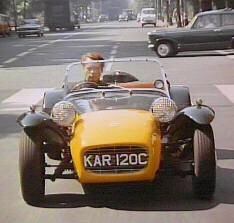
Heather and I trailed the eventual winners, Jack McCornack and Sharon Westcott. The grey-bearded McCornack was an old hand in the 1970s with the hippie-tech journal Mother Earth News. McCornack makes cars himself, and his creation was a sweet, low, windowless two-man tubular roadster, green with a yellow nose, meant to look like a vehicle Number Six used in The Prisoner. "Danger" is literally McCornack's middle name. Really; he showed me the driver's license. It's an old French family name, but still. I made sure that they indeed were not buying the off-the-shelf vegetable oil that powered the Kabuto engine in the roadster. They didn't even have a filter, so it had to be the pure stuff.
Five times that day, after tailing him zipping a solid 60 mph or better clip over the stunning, dizzying mountain ranges on the way to Nevada, I watched as they parked in front of small town grocery stores or diners or gas station minimarts, took off the hood, and waited for people to come ooh and ahh over the cute little roadster.
Then he and Sharon would give a spiel about how they needed other people to give them oil to win this weird little race, and every time, usually within the first or second try, either a customer or a store employee would joyfully give in. In one case they were handed the store's entire stock of cooking oil. The stuff he got from a Lone Pine diner fryer was too thick and orange for them to dare use; the olive oil they got from the mayor of Death Valley Junction, retrieved from his crumbling abandoned warehouse of a home, didn't mix well with the rest of the canola oil they mostly used.
But except for some problems with air in the fuel lines on the first day, and the pain of driving through very cold weather with no windows, they had it made, drove their time easily, and won the race and the $5,000. In the meeting to decide the winners of the various other prize categories, judge Michael Michael and I argued for splitting the prize between the two finishers. The varied technical and social challenges they faced made straight time measurements—to us—misleading. How to measure whose achievement was truly more impressive than the others? The organizers were adamant in a tense half hour meeting in a dark corner of the old-school Sahara casino that for the race to be taken seriously we needed one winner according to the announced rules.
The three teams that actually drove all the way to Vegas—the two official finishers and the Llaguno's—made for a beautiful fable of community building, with old hippie fabricators, southern agricultural businessmen, and Christian homeschoolers all admiring and learning from each other in near-perfect harmony, under the guidance of Bay Area art-freaks.
Walking into the Shipyard—a showcase for many absurd excesses of California bohemianism—the elder Llaguno tells me that all his son and he could think of as they looked around at the clutter of lathes, grinders, forklifts, shipping containers, vehicles in random states of disrepair, and mutation, was…it's just like home. Even in the heat of competition, this sociologically and culturally varied crew saw in each other nothing but brothers in the quest to make auto-locomotion more interesting, more challenging, more personal, more—despite or because of all the unexpected setbacks and frustrations—fun.
The race was not about building a new system for everyone to fall in line with, or for changing our car fueling systems from the top down. While McCornack's winner worked off a straight kit conversion from the company Plant Drive that anyone slightly handy could imitate, and not some exotic home-made hack, the veggie oil they begged for was always more than three times the already very high price of petroleum. Undoubtedly, an entire national system of veggie oil distribution could probably cut costs—and greatly increase the cost of food as more and more land and edible vegetable matter goes into our engines and not our stomachs. National economies are complicated things; as are car engines. But the latter are at least under our control, beneath our hands, mutable to our creative desires or our damn-it-all truculent whims.
In the 10 days since the race ended, the price of a barrel of oil fell to a 16-month low. But that's not going to deter the quest of those who tried to Escape from Berkeley into a more personal and potentially less polluting energy future.
Senior Editor Brian Doherty is author of This is Burning Man and Radicals for Capitalism: A Freewheeling History of the Modern American Libertarian Movement.