

The Volokh Conspiracy
Mostly law professors | Sometimes contrarian | Often libertarian | Always independent
Blockbuster NYT Reveal About Judge Ross Scandal
The Times spoke to three of Judge Ross's clerks and obtained the "offensively vague" apology letter.
For several weeks now, I have been surprised that the major newspapers have not covered the Judge Ross scandal. In particular, I was shocked to see nothing from the New York Times and the Washington Post. I even noted how Bloomberg Law was winning the coverage.
Well, it seems the Times was working on something big. Nicholas Bogel-Burroughs and Mattathias Schwartz published a story this morning about Judge Ross. And we learn a lot. They got three law clerks to speak, plus they got a copy of the "apology" letter.
The New York Times confirmed it was Judge Ross through interviews with three of her former clerks and two people familiar with the matter, and obtained a signed apology letter that she wrote as part of a judicial reprimand.
First, this "secret" was passed down from year-to-year among law clerks:
For years, Judge Eleanor Ross's secret was passed down from law clerk to law clerk.
They whispered about the sultry jazz music that emanated from her chambers when a uniformed police commander, a man they called her "visitor," disappeared into her private office. The clerks could sometimes hear the unmistakable sounds of sex from behind the door.
They chalked it up as one of the burdens of working for Judge Ross, who routinely rubber stamped their draft orders and added little else before issuing them as rulings. But the clerks in the Atlanta courthouse felt helpless: Do you report your married boss, a federal judge no less, for having a clandestine in-office affair with a law enforcement officer?
One day last year, a clerk did exactly that.
Second, Judge Fogel—unlike Judge Wood—stated the obvious. The punishment handed down was woefully inadequate.
Jeremy Fogel, a retired federal judge who consults with judges on ethics questions, said some in the judiciary disagreed with how Judge Ross's case had been resolved. "Many of the sitting judges with whom I've spoken believe the findings as a whole warranted a more significant sanction," he said.
Another judge who shall remained unnamed wrote to me, saying that my post about Judge Wood was out of line, and demanded and I should apologize. I added an update to my post, but my criticism stands even stronger in light of the correction.
Third, we get more details about her chambers:
She soon settled on the 17th floor of the federal courthouse, in an office with two couches, a meeting table and windows that overlooked the Atlanta Falcons' stadium.
Among the décor in her chambers was a picture of Justice Ruth Bader Ginsburg with a quote from a Beyoncé and Drake song overlaid: "All them fives need to listen when a ten is talking." Elsewhere, she hung an apology letter from a lawyer she had chastised for being underdressed and underprepared in court.
In their first year of the prestigious two-year clerkship, Judge Ross's clerks would sit at a desk just feet away from the door to her office. In addition to their legal work, they were tasked with greeting visitors, and they kept a small CCTV screen nearby to see who was outside.
And details about the sex:
So it was odd when they would see a uniformed police officer walk down the hallway toward the back door of Judge Ross's office.
The walls were thin, and the clerks could sometimes hear music and the judge and officer chatting. Then the music would continue, and the talking would stop. Other times, what they heard was more explicit.
The three clerks told The Times that their stomachs churned when they realized what was taking place. But, coupled with her other actions, it also represented something fundamentally painful to them: that a person with a role they revered, a person whose job it was to decide America's laws, seemed not to care the way they cared.
Fourth, the clerks were even more troubled about her utter disregard for the civil docket. They insist barely 5% of the civil orders were reviewed, and only then for typos and grammar.
One clerk said it felt like their belief in the legal system had been yanked out from underneath their feet, and that they wondered whether to continue working in law.
While the clerks said they might have been willing to overlook isolated personal foibles, they were more broadly disturbed by the lack of attention Judge Ross paid to the civil disputes that came before her.
While Judge Ross was engaged on her criminal cases, the clerks — often fresh out of law school — told investigators that she largely let them decide how to rule on key motions in lawsuits. It was not unusual to go weeks without hearing much from her except for a brief email — "Please docket." — a few minutes after they sent her a draft order, three clerks told The Times.
They estimated that she provided edits on roughly 5 percent of the civil orders that they drafted in her name, and even then mostly just for grammar or typos.
Judge Ross later disputed the clerks' account to the judicial committee, saying that she made edits to 30 to 40 percent of drafts.
The Eleventh Circuit could have compared her draft orders and published orders, but decided not to investigate this ground.
Fifth, the Times obtained a copy of the "apology" note. I put "apology" in quotes because this is woefully inadequate. It's like saying, "I'm sorry you were offended."
Ultimately, the committee required the judge to send apology letters to the six law clerks who spoke to investigators.
The committee said the letters "should be sufficiently specific so as to make clear to the recipient the sexual misconduct for which the judge is apologizing."
The letters she sent, dated May 27, were three sentences long and identical.
"Thank you for your contributions to our court during your clerkship," Judge Ross wrote, according to a copy obtained by The Times. "I convey my deepest apology for not taking steps to ensure that it was a more positive experience. I wish you all the best in your future legal endeavors and in life."
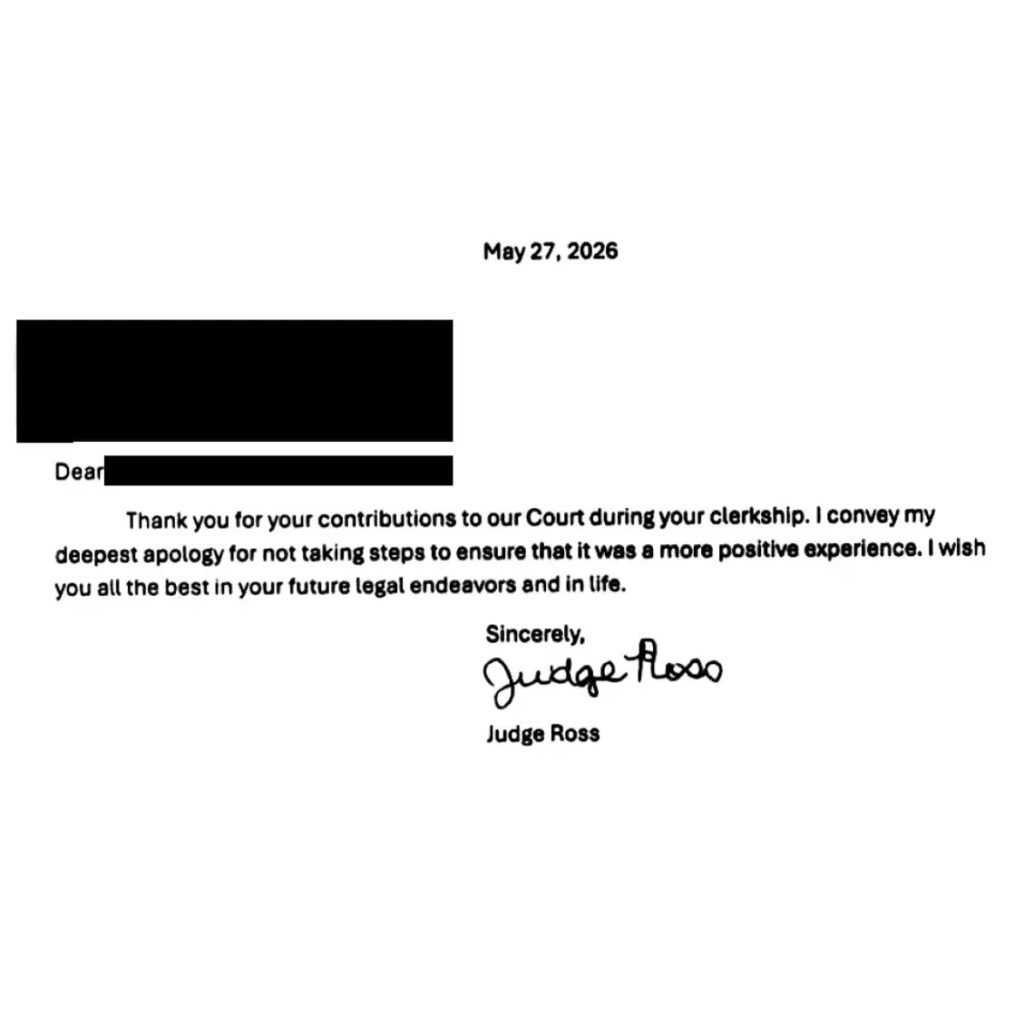
I wonder if ChatGPT wrote this?
Sixth, the clerks found the letter "offensively vague."
The three former clerks who spoke to The Times said that they viewed the letter as offensively vague. One decided to share it with the chief judge of the 11th Circuit, believing it didn't comply with the committee's order.
I agree. The whistleblower clerk should appeal this matter to the Judicial Conference of the United States. The Chief Justice needs to confront this mess.
Seventh, the Times actually got members of the Atlanta bar to go on record.
Judge Timothy C. Batten, Judge Ross's former colleague in the U.S. District Court for the Northern District of Georgia, worried that her misconduct would affect how courts and judges were viewed by the public.
"I'm really sorry this happened and reflects poorly on the court," he said in an interview. Judge Batten retired last year as chief judge of the district court and said he had never gotten wind of Judge Ross's misconduct.
Now, some in the Atlanta legal world wonder if Judge Ross's career will survive.
"I don't know where you go from here," said Don Samuel, a criminal defense lawyer in Atlanta who has long known, and respected, Judge Ross.
"There's so much snickering going on by everybody that I can't imagine what it will be like to be on the bench and wonder what everybody's thinking," he said.
I hope this reporting jumpstarts impeachment talk.




