

The Volokh Conspiracy
Mostly law professors | Sometimes contrarian | Often libertarian | Always independent
Use of Still from "Girls Do Porn" Video to Criticize Later Employer of Alleged Participant Is Fair Use, not Copyright Infringement
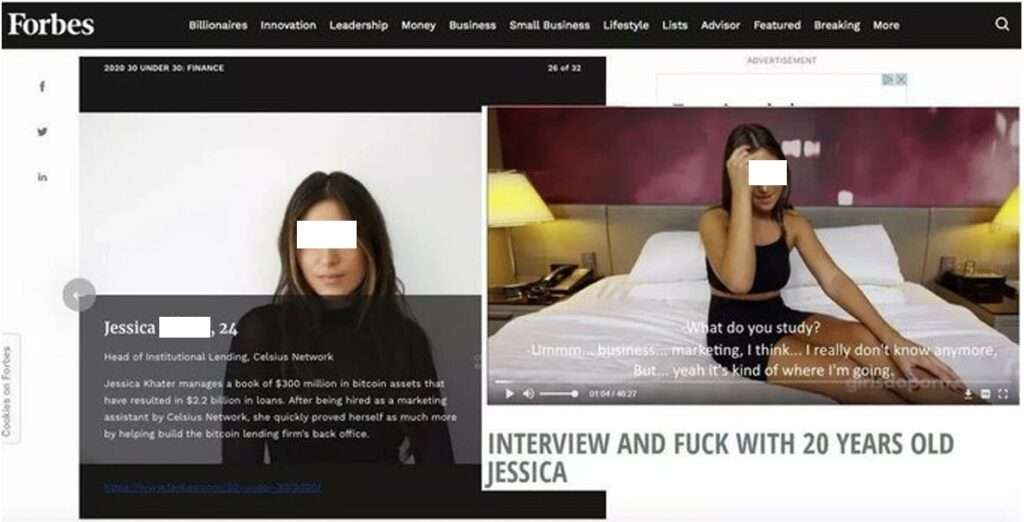
From Judge George Daniels' opinion Tuesday in MCM Group 22 LLC v. Perry (S.D.N.Y.), which strikes me as quite correct, given the fair use doctrine:
Plaintiff is a limited liability company and the owner by assignment of a registered copyright for the Video. Plaintiff's predecessor-in-interest is a non-party to this suit and is referred throughout the Complaint as "Jane Doe." In 2015, Jane Doe appeared in the Video, which was filmed by the founders and operators of Girlsdoporn.com and Girlsdotoys.com (collectively, "GDP"). As revealed by a series of criminal cases [which led to guilty pleas], GDP was a criminal sex trafficking enterprise, in which the website's operators recruited victims to appear in its videos by fraudulently representing that the videos would never be posted online or released in the United States.
On December 14, 2021, Judge Janis L. Sammartino of the Southern District of California … issued a restitution order in Garcia's case … that provided, inter alia, that the victims specified in the order "hold[ ] superior right, title, and interest in the images, likenesses, and videos depicting that [victim] produced by GDP" and "shall have and recover all property that GDP … took from them, including images, likenesses, videos, and copyrights." Jane Doe was one of the specified victims, so the Restitution Order awarded her "superior right, title, and interest" in the Video. She subsequently assigned her rights in the Video to Plaintiff "for the purpose of prosecuting the use of copies, still images, and derivatives of the [Video] through DMCA takedown notifications and, when necessary, civil actions."
On June 13, 2022, Defendant Lyndon Perry published a post (the "Tweet") on the social media platform Twitter (currently known as X). The Tweet included a composite of two images: a still frame from the Video superimposed onto a screenshot of an online article from Forbes. The still frame from the Video depicts a fully clothed woman—who is identified as "Jessica" in the Video's title—sitting alone on a bed. The still frame includes text of an apparent conversation between the woman and an off-screen interviewer in which the woman states that she is studying business and marketing.
The screenshot from the Forbes article shows a profile of an individual, who is identified as the head of institutional lending at Celsius Network, in the publication's 30 Under 30 list for 2020. The Tweet juxtaposes these two images, suggesting that they are the same woman.
The Tweet was Perry's second post in a larger thread. The first post in the thread shows an advertisement for Celsius Network next to a screenshot of a Reuter's article entitled, "Crypto Firm Celsius Pauses All Transfers, Withdrawals, as Markets Tumble." Defendant then replied to this post with the Tweet, which included the composite image and the message "Same company btw."
MCM Group (the assignee of the copyright in the videos) sued for copyright infringement, but the court rejected the claim:
"In 1976, Congress enacted § 107 of the Copyright Act, giving statutory recognition to the long existing common law doctrine of fair use." Section 107 provides that:
[T]he fair use of a copyrighted work, … for purposes such as criticism, comment, news reporting, teaching (including multiple copies for classroom use), scholarship, or research, is not an infringement of copyright. In determining whether the use made of a work in any particular case is a fair use the factors to be considered shall include—
- the purpose and character of the use, including whether such use is of a commercial nature or is for nonprofit educational purposes;
- the nature of the copyrighted work;
- the amount and substantiality of the portion used in relation to the copyrighted work as a whole; and
- the effect of the use upon the potential market for or value of the copyrighted work.
The fact that a work is unpublished shall not itself bar a finding of fair use if such finding is made upon consideration of all the above factors….
"A use that has a further purpose or different character is said to be 'transformative.'" This includes uses that "transmit a message that differs from the message communicated by the original." But as the Supreme Court recently clarified, accepting "any further purpose, or any different character, would narrow the copyright owner's exclusive right to create derivative works." Thus, in addition to a further purpose or character, "there must be justification for copying." Examples of further justifications include instances in which the copying critiqued or commented on the original, "provided information to the public about the copied work, [ ] enabled the furnishing of valuable information on any subject of public interest, or rendered a valuable service to the public." Notably, "the more transformative the [ ] work, the less will be the significance of the other factors, like commercialism, that may weigh against a finding of fair use."
Defendant argues that his use was transformative because Defendant posted the Tweet squarely for the purposes of commenting on Celsius' business struggles and its message differed from the original pornographic film. Plaintiff counters that the Tweet was "commercial" in nature and that additional facts must be developed through discovery to determine exactly what message the Tweet conveyed.
It is clear from the face of the Complaint that the Tweet utilized the still frame for a transformative purpose. The Video is a pornographic film with the express purpose of displaying explicit sexual content. Conversely, the Tweet does not contain any nudity or sexually explicit imagery and is framed as a commentary on Celsius. Defendant posted the Tweet as a direct reply to his previous tweet, which juxtaposed Celsius' marketing with critical reporting on the company. The Tweet's text—"Same company btw"—is a clear reference to Celsius when viewed in the context of the entire thread.
The Defendant's reproduction of the still frame in the composite image is in service of this commentary. The reproduction of a copyrighted image in a larger collage is transformative where "the copyrighted work is used as 'raw material,' in furtherance of distinct creative or communicative objectives." Here, Defendant superimposed the still frame from the Video over a Forbes profile of Celsius' former head of international trading. By arranging the images of two women, both identified as being named Jessica, side by side, the composite image vaguely implies that a Celsius executive appeared in a pornographic film. The still frame's accompanying text stating that Jane Doe was studying business and marketing further supports this implication.
In short, a reasonable observer would understand the Tweet as a commentary on Celsius with a markedly different purpose from the original pornographic video. Further, as a commentary on a "subject of public interest" (i.e., Celsius' decision to pause its customer's transfers and withdrawals), the Tweet's transformative use of the still frame justifies its copying.
{This Court makes no finding as to what Defendant subjectively intended to communicate through the Tweet, as the Defendant's intentions are not alleged within the complaint or obvious from the Tweet itself. That said, one could likely surmise that Defendant intended to cast aspersions on Jane Doe's character and the judgment of Celsius for perhaps employing someone who had appeared in a pornographic film. This opinion in no way approves or endorses that view. For the purposes of deciding this motion, it is enough for this Court to note that whatever Defendant subjectively intended to communicate, it is clearly not sexually explicit or pornographic in nature.}
Plaintiff argues that the alleged "commercial" nature of the Tweet weighs against fair use. But even assuming that the Tweet was posted "for the purpose of achieving additional donations or pledges," "that is not dispositive of the first factor, particularly in light of the inherently transformative role" of the Tweet. Thus, this Court's determination that the Tweet was "substantially transformative" allows it to discount the alleged "secondary commercial nature of the use." …
[The amount-and-substantiality factor also] weighs in favor of the fair use defense. It is undisputed that the Tweet reproduced a single frame of a forty-six-minute video. Plaintiff contends that this objectively small amount of copying is not a fair use because "the 'heart of the work' is any portion [of the Video] that identifies [Jane Doe], specifically images of her face, given that she is the victim of criminal sex trafficking and the [Video] is the evidence thereof." But the central inquiry under this factor is not whether the portion copied is the most important part of the work to the copyright holder, but rather whether the portion copied contains the central creative expression of the original such that "the secondary work might serve as an effectively competing substitute for the original."
The Tweet does not capture the central expression of the Video and is not a substitute for the original. The heart, or core, of the Video is its sexually explicit imagery. The Tweet is not pornographically explicit and shows a fully clothed woman describing her career interests. Accordingly, because the Defendant copied an insubstantial amount of the Video in furtherance of a transformative purpose, the third factor weighs in favor of fair use….
The … "the effect of the use upon the potential market for or value of the copyrighted work" … factor focuses on "whether the copy brings to the marketplace a competing substitute for the original, or its derivative, so as to deprive the rights holder of significant revenues because of the likelihood that the potential purchasers may opt to acquire the copy in preference to the original." Like the other factors, a court's analysis of the market effect is often influenced by whether the secondary use is transformative. "[T]he more transformative the secondary use, the less likelihood that the secondary use substitutes for the original." … "[W]hen a lethal parody, like a scathing theater review, kills demand for the original, it does not produce a harm cognizable under the Copyright Act." ….
[This] factor weighs in favor of fair use. As detailed above, Defendant's use of a single still frame from the Video was a transformative secondary use intended as a form of commentary on Celsius. Further, the Defendant's use of a single frame from the video did not include any sexually explicit imagery. In short, a person in the market for a sexually explicit, pornographic film would not turn to the Tweet. Because Defendant's use of the still frame would not, and could not, usurp the market for the Video, the fourth factor weighs in favor of fair use….
Note that the lawsuit alleged only copyright infringement, not defamation, false light invasion of privacy, or any other tort.
Jay Wolman and Marc Randazza (Randazza Legal Group PLLC) represent defendant Perry.

Editor's Note: We invite comments and request that they be civil and on-topic. We do not moderate or assume any responsibility for comments, which are owned by the readers who post them. Comments do not represent the views of Reason.com or Reason Foundation. We reserve the right to delete any comment for any reason at any time. Comments may only be edited within 5 minutes of posting. Report abuses.
Please to post comments
As a matter of (copyright) law this seems right, but imagine being this guy. Jesus christ on a stick...
Did she voluntarily star in that movie?
The article above cites the "criminal cases [which led to guilty pleas]" as only on the "fraudulent[] representi[on] that the videos would never be posted online or released in the United States." That characterization implies merely fraud - that those filmed volunteered but expected that they would only be distributed in ... VHS? Beta? some other format? ... and only outside the US.
An older article (over on Ars Technica) describes one of the criminal cases in more detail and specifically alleges coercion by the filmmakers. That would go beyond mere fraud about the scope of distribution. While never proven in front of a jury, the four filmmakers all apparently accepted plea deals on charges including coercion.
The Wikipedia entry for girlsdoporn also elaborates that the accusations (civil and criminal) were much broader than mere fraudulent overdistribution. (BTW, I don't understand what the point of saying "while never proven in front of a jury" is, given that the principals pleaded guilty.)
If you don't understand why it's important to differentiate between stipulations in plea deals and facts decided by a jury, see Social Justice is neither's comment below.
Robert Heinlein once said if you eat meat, you cannot consider yourself morally superior to the butcher. If you jerk off to porn, you cannot consider yourself morally superior to the ladies who make it.
And, though I don't know in this case, it seems like something akin to revenge porn without the revenge. It's a thing to track down women who have moved on and post their porn pics next to their job info page from some business. These are hateful men, men who jerk off, and who have no concern other than jollies hurting women.
Such men shall be taken into the woods and have their phones taken and legs broken, and, if they succeed to extricate themselves, shall have their debt deemed paid else they shall be consumed live by wolves, and wolverines, and badgers, and rats, and the little white mice of the fields, and marmots, and voles, and sloths, and truffle-snouting piggies, and koalas, and beavers, and feral facehuggers, and the odd travelling platypus, and the remains thence absorbed by wild rutabagas, to their beauty and benevolence.
"and have their legs broken and phones taken,"
NO! Not take away their phones! Haven't you heard of the 8th Amendment?
Awww, is women being held accountable for their actions is a bridge too far for the leftist gooner?
The case is not about the woman's reputation and it's unclear from the summary whether there was any real consequence to her.
As far as the judge is concerned, just business, no moral judgments.
There's a company that looks for strip clubs stealing pictures to use in ads, as if the models worked in the strip club. When it finds a stolen picture the photographer who took it sues. He is not suing to protect the girls' reputations. He is protecting the value of his copyrights.
The god you imagines exists knows you jerk off. Also, judge not lest ye be judged.
a bridge too far for the leftist gooner?
Who's a leftist?
https://www.youtube.com/watch?v=H6xhIAs9AVI
If it’s fair for a man to lose his job, but nothing other than being associated with Jeffrey Epstein, then it’s equally fair for a woman to lose her job for having been a porn star in college.
I don’t cry any tears for either.
"Knowingly associating with child molesters is morally equivalent to having sex for money."
The wit and wisdom of Dr. Ed.
So what if she did? What kind of pathetic person would try to shame and punish someone for that many years later?
As opposed to, nearly flying to Epstein‘s Island in the nice sunny warm Caribbean?
It’s been about three weeks in the Arctic here, if I were offered in the afternoon laying in the sun on a beach in the 70s, maybe 80s, I’d go. I take a good book and I’d go, and that alone would not make me a child molester.
Yet men are having their lives destroyed for doing just that, and at least in some cases that’s probably all they did. Heck, some of them are probably gay.
If women are equal to men, they deserve to be judged in such a manner.
I seem to recall, in the Gilgo Beach murder case, you made a comment to the effect that escorts are such garbage people that it’s not worth it for society to expend the resources investigating their murders when they get murdered. They deserved what they got and good riddance.
May I point out that exactly what you said of the Epstein people is also true of escorts? People sometimes hire them for legitimate reasons. Gay men used to hire them to attend weddings and family events to fool their family into thinking they had girlfriends. People sometimes hire them to have somebody to talk to. Etc.
Why did you assume, as you did, that all they do is sex, just because it’s quite likely that most of what they do is sex? We just don’t know for sure in each individal case, no more so than with the Epstein people. So why didn’t you give the Gilgo Beach victims the same benefit of the doubt and presumption of innocence as you are giving the Epstein people here? After all, they were murdered, which in most people’s minds would tend to elicit at least a tiny amount of sympathy. What did the Epstein people do to deserve sympathy? Why do they deserve more in your eyes than the Gilgo Beach victims?
You said yourself, above, that women deserve to be judged “in the same manner as men.” So why didn’t you do so?
"Conversely, the Tweet does not contain any nudity or sexually explicit imagery"
If the poster picked a naked frame, would the post be revenge porn?
Would it be an assault weapon? Both terms seem to be subject to broad statutory definition in the absence of any widespread agreement on precise boundaries. To me, "revenge porn" usually means making broadly available intimate material that was intended for private use, so I would use a different label for re-publishing an image that was already in commercial use. But as a legal question, I'd want to see the actual words of the statute.
There are a lot of definitions of revenge porn out there to choose from. Eugene Volokh sometimes writes about them. I'm curious if this guy could have gotten in trouble under one of the revenge porn laws for posting a naked picture.
If she was told that the video was for private use only though (which it seems like may have happened based on the history of the video), then it seems a lot closer to your definition of revenge porn than if she had signed up to make a commercial porn video.
Sure, and in that case I agree the commercial use would likely be revenge porn (both by my heuristic and how I understand typical laws to define it). By that token, the picture itself could probably be fairly called revenge porn, but I would probably still not say that the defendant in this case published revenge porn.
"She subsequently assigned her rights in the Video to Plaintiff 'for the purpose of prosecuting the use of copies, still images, and derivatives of the [Video] through DMCA takedown notifications and, when necessary, civil actions.'"
Presumably her lawyers had the benefit of the Righthaven case, which found there was no such thing as an assignment of a right to sue, and made a more conventional assignment of rights.
If MCM Group 22 LLC exists for the purpose of not publishing copyrighted material, does that count against it in a copyright case which is supposed to protect an exclusive right to publish? There is no commercial use for copies to compete with.
The Copyright Act grants the holder the "the exclusive rights to do and to authorize" a list of six things. 17 USC 106. https://www.law.cornell.edu/uscode/text/17/106
This means part of the right is to stop others from copying or publishing.
That the holder is not exploiting the work and wants to keep it private may weigh on the issue of damages and fair use, but it's still an infringement.
In Harper & Row v. Nation Enterprises, 471 U.S. 539 (1985), the court held that the copyright holder had the right to determine where the work would be first published. The case invovled memoirs of then-president Ford.
This doesn’t strike me as the way these terms are used in ordinary discourse. If a person is acquitted of murder by reason of self defense, we say the person is not guilty, period. We say the person didn’t commit a murder. We don’t say the person is a murderer who had an affirmative defense.
This strikes me as similar. If a person has a valid affirmative defense to copyright infringement, we just say the person didn’t commit an infringement.
First of all, I did not say that it's definitely a fair use. It's one factor among several. The defendant may still be found liable as an infringer.
Second, as you certainly know, affirmative defenses are for the defendant to prove. And fair use can be a very difficult thing to predict.
In any copyright case, first inquiry is whether the plaintiff owns a valid copyright, and whether the defendant infringed on one of the exclusive rights granted in the Copyright Act. That's not always a given, and the plaintiff bears the burden on those points.
If the plaintiff shows that, then the defendant has to show fair use, or some other affirmative defense.
Yes, in the end a fair use defense absolves the defendant of liability.
If you prefer, you can use the term "prima facie infringement."
Just to be clear, under copyright law, "Notwithstanding the provisions of sections 106 and 106A, the fair use of a copyrighted work ... is not an infringement." (That said, I agree that the Court has treated fair use as an affirmative defense, and this has ended up meaning that the burden of proving this particular form of noninfringement is on the defendant.)
To expand on what Bored said, consider a Limited Edition production run. You decide to only make 100 copies of your masterpiece. Being scarce, the price shoots up. You and your patrons enjoy the prestige and sense of exclusivity. It's not the only business model for intellectual property but it's not at all uncommon. In fact, in certain parts of the art and fashion worlds, it's expected.
Now Joe Schmuck come along a year later and start mass-producing your masterpiece. The value plummets, your customers are pissed and, yes, Joe has violated your copyrights even though you have no more to sell (since you self-limited your original production).
In this case, a "fuck with 20 years old Jessica" NFT.
While the result seems reasonable, not sure it can be squared with the Prince photo case.
Andy Warhol Foundation for the Visual Arts, Inc. v. Goldsmith (2023)
https://www.supremecourt.gov/opinions/22pdf/21-869_87ad.pdf
Which just shows that fair use is often very hard to predict.
IDK. Using a tiny (and presumably not the most commercially interesting) percentage of a larger work to express a different message seems pretty different than using the whole work for largely the same purpose.
IMHO, there was a lot of "but it's Warhol" special pleading to the SCOTUS case.
This is quite similar to what happened to state representative Laurel Libby in Maine.
I don’t exactly know the legalities, but there is a public domain picture of the champions of the boys and girls statewide high school track championship each year. Libby took I pray this picture of a certain individual in the boys championship and a current picture of the same person and the girls championship.
The bleep hit the fan, Libby was accused of endangering the minor child by putting its picture on her Twitter account, but the issue is I saw it was that the state had already released the image of the child and she was only publishing a public domain image.
And as a lot of the commentary here makes clear, there's a big difference between whether something is a copyright violation and whether or not you're an asshole for posting it.
It seems that Jane Doe turned to a company set up to sue copyright infringers rather than an organization focused on protecting trafficking victim’s rights. Assuming the alleged facts are true, however, I’m not sure what other torts would be available. The basic wrong committed here seems to have been fraud rather than sex trafficking in a stronger sense. She appears to have been perfectly willing to participate as long as the video wasn’t marketed in the United States. While the fact that it was represents a breach of contract and a fraud, it doesn’t strike me as involving anything like the sort of violent coercion normally associated with the term sex trafficking. And by agreeing to making the video knowing it would be marketed, simply not in the United States, I suspect that she probably gave up any claim to privacy. This is not anything like the case of an ex-spouse publishing private videos as revenge.
Finally, it seems to me that the circumstances suggest she showed poor business judgment independent of any moral concerns. In the age of the internet, it’s simply unreasonable to expect that a pornographic video made for commercial public release won’t eventually get posted on the internet, if not by the original publisher than by some pirate or other.
So she could be criticized for exercising poor business judgment independently of criticism of her morals.
I honestly don’t know whether and to what extent appearing in a pornographic film is considered derogatory in a business context in contemporary American society. I suspect an allegation that someone once used marijuana would no longer raise many eyebrows. Regardless of this, the facts appear to be substantially true. The stipulation the video wouldn’t appear in the United States doesn’t strike me as particularly material from a moral-reputation perspective. And from a strictly business-judgment reputation perspective, it suggests poor judgment and hence would appear to be legitimate criticism.
See my reply to Dr Ed above. This court's characterization of the underlying criminal cases was incomplete. The creators of GDP were accused of and accepted plea deals including coercion, not mere breach of contract.
Because prosecutors never forum shop or pile on charges or engage in other pressure tactics. They may be dishonest but you'd be among the first blasting the plea deal as proof of anything if you felt the criminals were in the correct place on the progressive victim stack.
I think you have me confused for someone who cares about "identities". The acceptance of a plea deal is evidence about the truth of the allegations regardless of their identities. How strongly you want to weight the evidence is a choice for the reader.
When she made the film there was so much porn out there that her identity as a performer was unlikely to reach people she cared about.
I understand volume is down. The industry has cut back on porn without a paper trail to avoid getting in trouble for nonconsensual acts and underage performers. I heard all the big porn sites are owned by the same person behind the scenes so there is no real competition.
" I heard all the big porn sites are owned by the same person behind the scenes so there is no real competition."
Not disagreeing, do you have a better source than hearsay.
I was probably thinking of this guy, who has since sold or at least anonymized his stake: https://en.wikipedia.org/wiki/Bernd_Bergmair
Further reading:
https://washingtonmorning.com/2025/04/27/who-owns-porn-understanding-the-ownership-of-pornhub-and-its-parent-company/
https://en.wikipedia.org/wiki/Aylo
Thus going once again to demonstrate that politicians mislabel things for, well, politics. There may be myriad things wrong with that, but it does not match the common understanding of the phrase "sex trafficking."
I did further reading on Girlsdoporn after I posted this, and while it did much more egregious things than merely fraudulently overdistributing porn, I still don't think "sex trafficking" is really a good way to describe those things. Sex trafficking is not a euphemism for, e.g., more traditional fraud like failing to pay performers or coercing them into appearing or even sexual assault.
More than a few women do sleep their way into their jobs.
The more straightforward interpretation is she did porn in college because she needed the money and her later career is unrelated to her work in porn.


