
The Volokh Conspiracy
Mostly law professors | Sometimes contrarian | Often libertarian | Always independent
Today in Supreme Court History: February 8, 1941
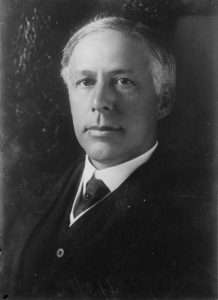
2/8/1941: Justice Willis Van Devanter dies.

Editor's Note: We invite comments and request that they be civil and on-topic. We do not moderate or assume any responsibility for comments, which are owned by the readers who post them. Comments do not represent the views of Reason.com or Reason Foundation. We reserve the right to delete any comment for any reason at any time. Comments may only be edited within 5 minutes of posting. Report abuses.
Please to post comments
WVD was the most senior of the "four horsemen" and influential in the group. He wasn't good at writing opinions, having chronic "pen paralysis." He gained his experience in the Wyoming Territory.
WVD's retirement (helped by new retirement benefits) was the beginning of the Roosevelt turn on the Court. Black filled his seat.
His fellow justices respected his abilities even if writing opinions was not his forte. He had an impressive career:
"Van Devanter had a long national public career, first as an assistant attorney general and then as an appellate judge on the Eighth Circuit Court of Appeals. President Theodore Roosevelt appointed him to this post in 1903. He served on the Supreme Court of the United States from 1910 to 1937, so his national service spanned forty-four years."
And he continued judicial work, including civil trials, after that.
https://scholarship.law.uwyo.edu/cgi/viewcontent.cgi?article=1010&context=wlr
Irvine v. California was decided OTD in 1954.
It involved a state using illegally obtained evidence.
This was before the exclusionary rule was applied to the states. So, the Court allowed it, but the writer of the plurality opinion was not happy. The home invasion was blatant:
Each of these repeated entries of petitioner's home without a search warrant or other process was a trespass, and probably a burglary, for which any unofficial person should be, and probably would be, severely punished. Science has perfected amplifying and recording devices to become frightening instruments of surveillance and invasion of privacy, whether by the policeman, the blackmailer, or the busy-body. That officers of the law would break and enter a home, secrete such a device, even in a bedroom, and listen to the conversation of the occupants for over a month would be almost incredible if it were not admitted. Few police measures have come to our attention that more flagrantly, deliberately, and persistently violated the fundamental principle declared by the Fourth Amendment
[Two justices dissented specifically since they thought the breach was particularly egregious, akin to an earlier case involving forcing a person to vomit evidence.]
Justice Jackson, joined by the Chief Justice, added a paragraph to the end of his opinion citing different remedies available other than suppression of the evidence to deal with the situation.
Justice Clark, who wrote Mapp v. Ohio a few years later, concurred on stare decisis grounds. He voiced his opposition to the non-application of the exclusionary rule and hoped a consistent policy would encourage change.
The Supreme Court, with new membership, helped things along.



