The Volokh Conspiracy
Mostly law professors | Sometimes contrarian | Often libertarian | Always independent
Today in Supreme Court History: January 20, 1953
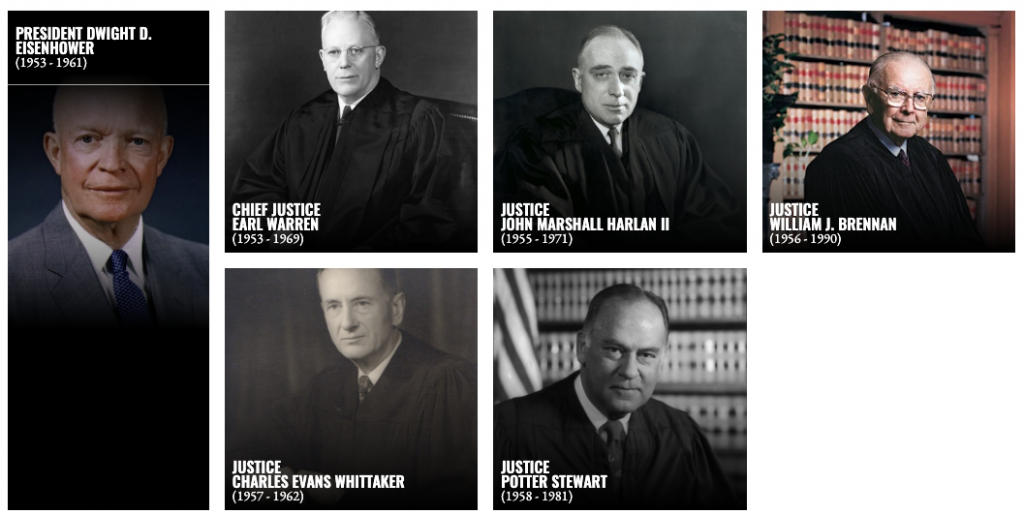
1/20/1953: President Eisenhower takes the inaugural oath on January 20. He would make five appointments to the Supreme Court: Chief Justice Earl Warren, and Justices John Marshall Harlan II, William J. Brennan, Charles Evans Whittaker, and Potter Stewart.
Editor's Note: We invite comments and request that they be civil and on-topic. We do not moderate or assume any responsibility for comments, which are owned by the readers who post them. Comments do not represent the views of Reason.com or Reason Foundation. We reserve the right to delete any comment for any reason at any time. Comments may only be edited within 5 minutes of posting. Report abuses.
Please to post comments
Justice Jackson appears to have started a practice of dissenting from prohibition of noncriminal IFP filing for imprisoned "frivolous" litigants. She has a point - pro se, IFP cases do sometimes present meritorious issues. Holt v. Hobbs is one example; that religious freedom case was filed, pro se and IFP, by a prisoner.
I was wondering if she would do something like this given her overall criminal justice leanings. Not sure why it took her this long.
What are the odds that the next landmark case is going to come from a prisoner who previously filed dozens of frivolous petitions?
2 of the Votes that in January 1973 led to the deaths of over 60 million Unborn.
Ironically, 6 months earlier the same 2 In-Justices said Executing Convicted Murderers/Rapists was Unconstitutional.
Neither decision has "Aged Well"
Frank
Two of the 5 worst justices ever, one dud, one mediocre and one good one.
An historic disaster of picks, especially after 20 years of Dem picks.
JB had a good discussion of the Bost opinion, underlining that he can do that if he wants to do so. He prefers to go another way.
The discussion suggests that all three of the opinions written for the case had problems. A comment followed the theme by noting he didn't think there was a fully satisfying answer to the question presented. I think that happens more than we like to admit.
Cases that reach the Supreme Court particularly are regularly hard questions. Decisions have to be made, weighing a variety of things, including a variety of legal principles. The result is an imperfect compromise. Thus, the "Roberts blue plate special."
JB had a good discussion of the Bost opinion, underlining that he can do that if he wants to do so. He prefers to go another way.
Think it through just a little more ... the other side of the equation is the reader, you. Just because your two opinions aligned for that article does not mean that his other articles are shite.
It doesn't mean that, but his other posts are nevertheless in fact shit.
I don't generally agree with JB, but I disagree with Adler a lot, too. I still think Adler does a much better job providing non-trolly discussions. Some people I agree with are troll-y.
Mere disagreement is not my core problem with Blackman.
Whittaker was a reject.
Stewart was a good middle-of-the-roader. He had some special moments, including dissents from the bench. And, eventually, he provided some details to "I know it when I see it."
Harlan was a "judge's judge," honored by both sides.
Warren and Brennan were political picks. Of course, conservatives hated them. Brennan started as the median of the Warren Court and then pined for the days of his heyday while finding wins when he could. His dissents were eventually strident, showing his anger and distress. They also appealed to state courts that went another way.