

The Volokh Conspiracy
Mostly law professors | Sometimes contrarian | Often libertarian | Always independent
Judge David Weinzweig (Ariz. Ct. App.) Guest-Blogging About "Zen and the Art of Persuasive Writing "
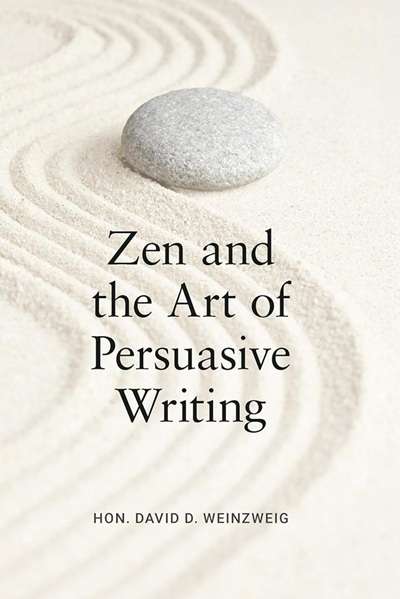
I'm delighted to report that Judge David Weinzweig will be guest-blogging this coming week about his new book. From the publisher's description:
Why is legal prose so hard to read?
One reason is obvious: Legal writers rarely think about their audience. When legal writers account for the preferences and expectations of their readers, legal writing can be sublime. Lucid. Easy to navigate and simple to understand. This species of legal writing leaps from the page to grab its readers by the collar, holding their interest and attention to the very last word. It is comfortably understood, employs concrete words and concrete grammar, shows—not tells—with concrete facts and concrete arguments. And this motivates the reader forward.
Zen and the Art of Persuasive Writing tackles abstract questions in fresh and relatable ways, imbuing the dharma of mindfulness and cognitive science into the conversation on persuasive and legal writing. It dissects persuasive writing into 9 mantras:
- Be aware of the audience. Persuasive writers understand that readers and writers are separated by time and distance, so they channel the readers to prognosticate and answer questions.
- Be less categorical. Persuasive writers know that few rules are absolute.
- Be clear and concrete. Persuasive prose conveys hard facts and ideas in plain and simple words.
- Be concise. A persuasive writer severs the meaningful from the meaningless. He is focused and assured.
- Be cohesive and coherent. Persuasive prose is easy on the eyes and simple to navigate.
- Be compelling. A persuasive writer holds the attention and interest of his readers for long enough to move their hearts and minds.
- Be credible. A persuasive writer earns his reputation with colleagues and the courts, knowing a fine reputation is not purchased or invoked.
- Be a reader and writer. A persuasive writer reads and reverse-engineers the language, style and approach of stuff he likes.
- Be meticulous and rewrite. A persuasive writer toils to ensure the audience will understand the point. He knows that persuasive prose is the end product of many drafts and myriad decisions.
And the blurbs:
"If 'the law is a profession of words,' it's not carried out very professionally, as anyone who has struggled through the legalese in a statute, a contract, or a brief will attest. To the rescue comes Appellate Judge David Weinzweig and an enjoyable book filled with charm, actionable advice, and yes, good writing. —Steven Pinker, Johnstone Professor Psychology, Harvard University, Author of The Sense of Style: The Thinking Person's Guide to Writing in the 21st Century
"An excellent tool for any aspiring legal writer - informative, specific, and enlightening, and fun to read to boot. Highly recommended." —Eugene Volokh, Gary T. Schwartz Distinguished Professor of Law, UCLA Law School, Author of Academic Legal Writing




