

The Volokh Conspiracy
Mostly law professors | Sometimes contrarian | Often libertarian | Always independent
President Trump's New Housing Policy Should Include Massive Privatization of Federal Land
The U.S. government currently owns 28% of the land in the United States, which is way too much.
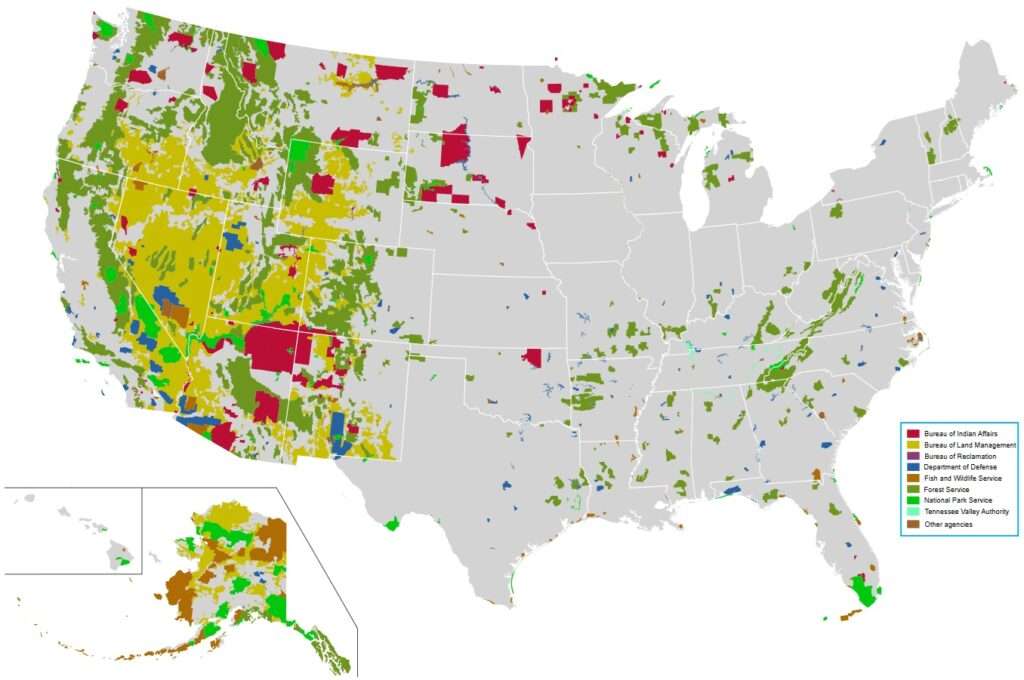
The federal government owns approximately 640 million acres of the 2.4 billion acres that constitute the United States of America. You might be astonished to know that less than one half of that total consists of our invaluable Great National Park system, our U.S. protected forest lands, and our protected grasslands. Moreover, the federal government's holdings are almost entirely in twelve western states, where they create weird real estate markets, for reasons that can only be characterized as an historical accident. The map below shows federally owned land in various colors other than red (Indian reservations) and grey (other land):
The enormous amounts of twelve western states that are federally owned are revealed again by this chart:
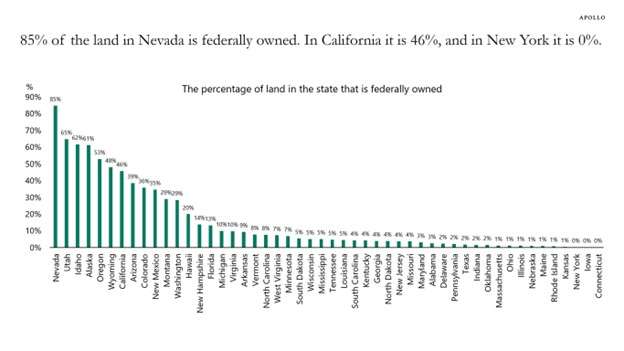
Twelve Western states account for the unequal treatment of the fifty states by the federal government, which grossly stifles private investment and skews real estate development in the States affected. The twelve Western states with skewed real estate markets include: Nevada; Utah; Idaho; Alaska; Oregon; Wyoming; California; Arizona; Colorado; New Mexico; Montana; and Washington State. 92% of the federally owned land in the United States is federally owned in these twelve Western states. There is no good policy ground for holding such huge shares of federal land in twelve states, while holding very little federal land in the other 38.
Of the 640 million acres of U.S. land, which the federal government owns, the U.S. National Parks Service manages 85 million acres, while the U.S. Forest Service manages another 193 million acres of forests and grasslands. Adding these two figures together suggests that about 278 million of the 640 million acres of federally owned land needs to be federally owned for environmental reasons.
That means, however, that 362 million acres of federal land is currently surplus government land that could be used by private people who have been squeezed out of the American dream of home ownership, suffer from a housing affordability crisis, and in the worst cases are homeless while the government squanders hundreds of millions of acres of private developable land that it owns but does not use. This crisis is especially visible in California where the federal government owns 46% of a state in which housing affordability and widespread homelessness are at crisis proportions.
To put this problem in context, the State of Texas has 172 million acres of land in total, while California has 100 million acres of land in total for a sum of 272 million acres. The federal government is thus sitting on and squandering an area of land that is 90 million acres larger than the combined size of Texas and California, which are the second and third largest states in the Union. And all of this while there is a very serious housing affordability crisis and a homelessness crisis that are separately going on.
Now it is true that some of the nationalized 362 million acres in surplus land that the federal government owns is uninhabitable because it is in Alaska, which is too cold, or in the Southwestern deserts, which are too hot for human habitation. But, having traveled to these states, I simply do not believe that 65% of Utah, 53% of Oregon, 46% of Wyoming, or 46% of California are uninhabitable, and I could go on and on down the list.
The fact is that private ownership of property under the common law yields much more efficient management of that property than does government ownership. Yale Law Professor Robert Ellickson proved as much in a famous law review article wherein he showed that the 1607 colonists of Jamestown, Virginia nearly died of starvation when all the land was all publicly owned. But they then thrived economically once the communally owned land was privatized, which saved the Jamestown colony. Ellickson, Robert C. Property in Land, 102 Yale L.J. 1315. More recently, when the Soviet Union collapsed, two-thirds of its food was being provided by the 3% of the total land in the U.S.S.R. that was privately owned. Private property owners are much better stewards of their property than is the government.
Why then did federal land not all get privatized through homesteading, which President Abraham Lincoln, after all, got enacted into law way back in 1862? The are multiple answers to that question. One is that the landowners next to federal undeveloped land want it to stay that way so they can have their own private parks in their backyards, which they pay no property taxes on, and which cost them nothing to maintain. Western hunters, hikers, miners and others have the same sort of not-in-my-backyard (NIMBY) attitude toward land privatization. Another problem is the environmental movement, which wants to reduce the human footprint on the planet more than they care about the crises of housing affordability and homelessness, which I frankly think is cruel. Finally, there is bureaucratic inertia, something a real estate developer like Donald Trump should be skilled at cutting through.
What do other nations around the world do with respect to government ownership of land? In the United Kingdom, the government own 8% of the country's land (see the data here). In China, Vietnam, and Cuba, in contrast, the government owns nearly 100% of the land. In the United States, the federal government owns 28% of the land and the state and local governments own another 8.7% for state and local park., so in a land that prides itself on free-market capitalism 36% of the land—more than one third of the country—is government owned.
There is a reason why the homesteading privatization of federally owned land, which started in 1862, came to an end in the early 1900's. President Theodore Roosevelt was in many ways a trust-busting advocate of progressive taxation, and he wanted the development of the Western United States to stop. A noble legacy of this effort was the creation of our great National Parks and Forests, but this came with a huge unappreciated cost—the end of privatization of more ordinary public land.
From 1901 to Margaret Thatcher's and Ronald Reagan's Privatization Revolution of the 1980's, Big Government in Europe nationalized healthcare, all banking in France in 1981, car production, steel mills, airline companies, electric companies, and telecommunications companies. Margaret Thatcher, Ronald Reagan, and Jacques Chirac in France reprivatized many of these industries, realizing—as President Bill Clinton famously put it in his 1996 State of the Union Address—that "the era of big government was over." But it turned out to be much easier to privatize most industries than it was to privatize land in the United States with its NIMBY Westerners and its over-aggressive environmental lobby. This crucial sector of the economy got overlooked, contributing to the crisis in housing availability and homelessness that we see today.
We can all hope that President Trump's housing reform policy to be announced next year takes a big look at privatizing federal land. We could use some of the proceeds to help retire the national debt. And who better than a savvy real estate investor to pull this one off. This could be the pivotal moment of the second term of Donald Trump's presidency.
I cannot think of a better way to celebrate the 250th anniversary of the Declaration of Independence on July 4 of this year than by selling a huge amount of this excess federally owned land. Once the land is in the free market, it will naturally find its way to its highest and best use, as Professors Robert Ellickson and Richard Epstein have long argued in other contexts.
UPDATE: The post originally misstated the area of California, and included a map that showed Indian reservations (which make up about 2.3% of U.S. land) as federal land. It has since been revised to correct this.

Editor's Note: We invite comments and request that they be civil and on-topic. We do not moderate or assume any responsibility for comments, which are owned by the readers who post them. Comments do not represent the views of Reason.com or Reason Foundation. We reserve the right to delete any comment for any reason at any time. Comments may only be edited within 5 minutes of posting. Report abuses.
Please to post comments
But does anyone want to live on those lands? My impression is that much of those are remote, desert or mountains.
Partially because they are not available for use in private hands.
Also those lands are significantly biased towards western states....as the map shows.
A great many people want to live in remote regions, often including mountains and sometimes including deserts. Contrast the map's western vs eastern jurisdictions - or, as the article suggests, look at other countries. Lots of places with mountains (Poconos, Alleghenies, etc) and deserts (middle east) nevertheless have people. And remember that they are only "remote" because the regulations prevent development that would make them 'not remote'.
The vast majority of those people are the superwealthy, who can afford to have a large estate built and staff it so they're super-comfortable.
Not very many people want to Unabomber it and that's the real practical option of us normies.
No one can rebut you. They just argue it is impractical. So what? The land is empty now and unused.
Honestly, 90% of the commenters here just have reflex responses that demonstrate no discernible thought.
If a conservative wants it, no matter how innocuous, we must have an irritable mental tic in response.
Nonsense. The Allegheny National Forest, for exxample, is dotted with small weekend/holiday/hunting cabins and cottages that are definitely not owned by the super wealthy. My wife and I would love to retire to the middle of nowhere alpine Wyoming. We need no mansion, and we definitely don't plan on living at Kamp Kaczynski. A few modest off grid systems for backup power, a traditional well and septic, just like I am living with now, a kitchen, bedroom, and small study to read and relax in, and we'll be happy. My wife would probably like a small space to paint, and a plot to garden. I'd like a small radio shack.
How to say you've never been to the mountains without saying you've never been to the mountains. Mountainous areas are full of small shacks and tiny homes in small, remote communities. Just think of Appalachia. And yes, some of those people are desperately poor and want to get out of there - and others really like it there and want to stay.
Claiming you're a "normie" just exposes your own bias and ignorance.
Steve-o capably addressed this objection by summarily asserting:
The demonstration being left to the reader, I suppose.
"But does anyone want to live on those lands?"
Yes!
One of the more fascinating items from federal land ownership in the West is the "checkerboard" pattern. In the 1800's, in order to promote development, the government granted some land to the railroads. But they didn't just want big blocks sold off to private investors. So, they also kept some land, with the idea that it would go up in value. And did it in a "checkerboard pattern" of 1 mile blocks. Later they changed their mind, and decided not to sell those 1 mile by 1 miles blocks.
So what you got was those 1 mile by 1 mile blocks owned by private developers being developed and used for economically useful causes. While the feds did little with their land. As a result, you can see "checkerboards" in space...developed land, undeveloped, developed, undeveloped in a checkerboard pattern.
https://eros.usgs.gov/earthshots/checkerboard-pattern
Undoubtedly people could use the federally owned checkerboard pieces...they use everything around it. But the feds won't sell.
Actually, the large swath in the middle of Arizona is forest. There are mountains, but it's not really "mountainous". At ~7000 ft, we get monsoon rain in the summer and have some of the snowiest spots in the country. Flagstaff is an island of ~100,000 people in the middle of a sea of trees--it would be nice for the USDA to part with some of it.
Erase the red areas with an inhospitable climate, no water, or bad terrain. We don't want another Phoenix.
Boy howdy. I suspect that filtering the red parts of the map in WY and MT for 'can reasonably access in the winter w/o a snowmobile or skis' and there is a lot less red.
(As a nit, as well, the map title says '...and subsurface'. When the govt sold (granted?) the land our cabin is on in the 1800s, they kept the subsurface rights. What is stopping someone building on our land isn't ownership - we own the land and built a cabin on it - it's that most people don't want to ski in 6 months of the year.)
Who you calling "we" Kimosabe?
Why should the feds own land at all? For the sake of argument we can handwave the parks and any land under federal facilities.
I cannot think of a better way to celebrate the 250th anniversary of the Declaration of Independence on July 4 of this year than by selling a huge amount of this excess federally owned land.
How about replacing a tyrant?
We got Maduro.
Yep.
We need something for the upcoming event in July. Maybe a local one this time.
Putin has nukes. And Kim and Xi are too hard to get to.
Biden decided not to run solving the problem for us.
“But, having traveled to these states, I simply do not believe that 65% of Utah, 53% of Oregon, 46% of Wyoming, or 46% of California are uninhabitable, and I could go on and on down the list.”
Appeal to incredulity? That’s the argument? FFS. Selling off BLM rangeland in SE Oregon to private interests as a solution for homelessness in Portland has got to be one of the most elite-law-prof-brained things I have heard in my entire life.
It's true that you're not going to relieve homelessness significantly by releasing federal land, but you probably would drastically improve the economy. The federal government has locked up a lot of resources over the years, often deliberately.
This is not an appeal to help the homeless. It’s Calabresi for god’s sake. It’s an appeal to private wealthy interests.
I am absolutely down with appeals to private wealthy interests, who, lacking private armies, must build and preserve their wealth by benefiting others, rather than just offering to refrain from shooting you if you ante up.
I'd restart the homestead program, frankly. With Starlink and online jobs, a lot of people WOULD be perfectly capable of making a go of it in wilderness areas.
Yes, Brett, I’m sure there will be people lining up to move to Harney county— 6 hour drive to a major hospital over snowy passes in the winter. After all, they have starlink!
Who cares? You aren't making an argument. Selling that land harms no one.
Sure it does. Steve alludes to who that might be, for starters.
You . . . you can't *homestead' with an 'online job'. Homesteading *is your job*. You're building a house, growing food, you need to make almost everything you need yourself.
What you're describing is subsidizing the building of more suburbs for 'knowledge workers'.
And I'm not for or against that but that is what it is, not homesteading.
"What you're describing is subsidizing the building of more suburbs for 'knowledge workers'."
I'm not suggesting any subsidy at all. I'm suggesting that the government stop obsessively hoarding land in order to keep the public from getting some use out of it.
Well, sure you are. Your brave starlinkers scratching out an existence in the blue mountains of eastern Oregon— snowed in all winter, 7 hours to chemo in Portland, 2 hours to Baker City for fuel to run the generators to power the computers to use for their online jobs— are getting the land for free, right? That’s the deal with your blessed Homestead Act, isn’t it?
The idea is so self evidently laughable and transparent. That you come in here stridently proposing these moronic things in comments above and beyond the OP makes me wonder. Did you jerk off to little house on the prairie as a kid or something?
No, the knee jerk leftie comments against it are what is self evidently laughable and transparent. Not everyone is on chemo, not even piece is snowed in all winter, not everyone need generator fuel when they have solar. If a conservative found a cure for cancer you'd argue against it for some reason.
No one can rebut you. They just argue it is impractical. So what? The land is empty now and unused.
Honestly, 90% of the commenters here just have reflex responses that demonstrate no discernible thought.
If a conservative wants it, no matter how innocuous, we must have an irritable mental tic in response.
Historically, what happened is that in the late 19th, early 20th century, governing elites became hostile to the very idea of private ownership of land. They have used a variety of excuses for keeping land out of the private sector, and transferring it to the government wherever possible, but that's what it boils down to.
But as President Donald Trump ramped up pressure on Maduro in recent months, the U.S. has been sending in fighter jets, drones and other military hardware to the territory, making it the key U.S. staging ground in the region. Some of that hardware is at former bases like the airport in Aguadilla, a two-hour drive from San Juan and about a 30-minute drive from my hometown of Mayaguez. The naval station at Roosevelt Roads in eastern Puerto Rico has sprung back to life after closing in 2004.
https://www.politico.com/news/magazine/2026/01/05/trump-maduro-puerto-rico-venezuela-00710379
Giving the
colonyterritory ability to enjoy taxation with representation [having the power to elect the president] would be a nice way to celebrate the anniversary.Except we're told its Congress who taxes, not the President.
The president has the power of veto and other powers that significantly involve taxing and spending.
Then PR should vote unambiguously for statehood.
The District of Columbia isn't a state. It has three electoral votes.
You'd think a law professor would know a president doesn't have the authority to privatize federal land.
And "savvy real estate investor" ?!?!?
https://www.thoughtco.com/donald-trump-business-bankruptcies-4152019
If it were anyone other than Trump, he could go to Congress and promote a scheme of land sales. That's how presidents have done things -- use the bully pulpit to promote a policy, and ask Congress to enact it.
And Musk had a lot of rockets crash before he had a lot of success with them. Most successful people have some mistakes on their way up.
This would be an interesting topic if addressed by someone who dug a little deeper. I am not an expert by any means, but with some effort found:
- the map paints red areas where the federal government owns either surface or subsurface rights. I would expect those to affect markets very differently and it would be informative to have them broken out.
- it would also be good to know how much of the land is sitting idle, if that is what is implied by the "squandering" charge. Is the land being squandered if grazing or logging or drilling rights are leased rather than sold? Do ranchers and loggers and drillers prefer to only pay for the rights they need?
- this map shows which federal agency is responsible. 50 to 60 million acres are actually Native American land, held in trust by the federal government and administered by the Bureau of Indian Affairs.
Details don't matter to psychophants.
"But, having traveled to these states, I simply do not believe that 65% of Utah, 53% of Oregon, 46% of Wyoming, or 46% of California are uninhabitable" I get that this is a blog post, but can't you just get an intern to estimate the viability of privatizing this land for housing? If it really was viable, I'd assume that multiple lobbying groups already have reports you could pull from. "Not uninhabitable" doesn't mean "commercially viable."
" "Not uninhabitable" doesn't mean "commercially viable." "
Much this. I'm sure there is federal land - say forest service land next to a ski area - that developers would snap up to build luxury condos. I'm sure developers would pay well to build condo towers in Central Park, for that matter.
But I have real doubts that the solution to Seattle's homeless problem is building houses by Miles City. This is an example of 'every complex problem has a solution that is simple, obvious, and wrong'.
"I simply do not believe that 65% of Utah ... is uninhabitable."
Well, it is: About 70% of the state is desert (33%) or semi-arid (40%) and receives little precipitation. It is the second driest state and the inhabitable region is a narrow corridor.
https://en.wikipedia.org/wiki/Geography_of_Utah
Same with Nevada. Oregon and Idaho both come up on lists of driest states in summer (but not in winter). Wyoming is drier overall than Arizona based on state-wide precipitation.
You can't judge by the places you've visited, these are generally in or near the inhabitable regions. You have to look at climate. Where is the water coming from for the people who live here? Most of Nevada is unlike Las Vegas.
Hear! Hear! Drastically reduce the footprint of the federal government west of the Mississippi.
would selling off federal lands raise enough to pay the debt? what is the current estimated value of us government land holdings?
ok grok suggests that the debt is around 38 trillion, and the land value is likely between 2 and 10 billion. so, no, even if it sells the land, the government is broke except for its ability to tax its sheep.
Why do people rely on Grok? Even for a ballpark estimate of an unimportant matter?
The most housing demand is in areas with a lot of foreigners and migrants. A better solution would be to deport the foreigners.
A lot of land in the West is leased out to Republican voters for grazing, logging, etc. at sub-market rates. If you open it up for sale then environmentalists or New York bankers or the PLA will buy it up and charge market rates. There has to be a mechanism to prevent this.
Why does their have to be a mechanism to subsidize cattlemen and loggers? These people are generally more affluent than the average American. Respectfully, I prefer a system where the affluent subsidize the poor, not the reverse.
I prefer a system where the affluent subsidize the poor, not the reverse.
That's socialism!
Because there's a lot of Republicans in Colorado, New Mexico, etc?
I am surprised the article failed to mention one source of likely opposition is that many of the current users LOVE the favorable U.S. Government rates for cattle grazing and extractive activities such as mining, oil drilling, etc. charged on public land. These fees are far below those charged by private landowners. And some users don't even pay those fees as the Government is loathe to create a ruckus by seeking to evict them.
Last year I visited a part of a national park normally not open to the public. The research people there drove us around in pickups for a tour. One of the trucks had a bullet hole, from the Cliven Bundy ruckus - apparently the feds shift their vehicles around.
Calebrisi, do you really not understand why the USG has most of the federal lands in the West? Really?
Its not a 'accident of history' - its a reaction to changing ideas about what the future of the US would be.
By the time westward expansion took off seriously most of the east had already been settled and the USG sold off land for money. By the time these western lands were being settled the USG was thinking much longer term, about a continent-sized nation, and the lost recurring-revenues from lands sold off in the east.
So they maintained control of the western lands. For the money and for the future.
>There is no good policy ground for holding such huge shares of federal land in twelve states, while holding very little federal land in the other 38.
So, this isn't strictly untrue, but there are good policy grounds for the federal government to maintain ownership of a large amount of real-estate - it makes military training for a massive military possible, for example.
The solution here wouldn't be to just sell off western lands but to sell them off while buying a similar amount of eastern land in exchange to even it out;)
But, really, who wants that?
The 'high density, we should all be living in cities' crowd doesn't want to enable sprawl.
The 'we're destroying the planet' crowd isn't going to want more people out here to suck the water out even faster.
IMO, what should be done is *leasing* the lands, to more types of development, and collect those rents rather than selling it off in a one-and-done.
>But, having traveled to these states, I simply do not believe that 65% of Utah, 53% of Oregon, 46% of Wyoming, or 46% of California are uninhabitable, and I could go on and on down the list.
Did you get outside the towns and cities? The ones that rely on imported water piped in or canal water? No you didn't because no one's there so there are no roads to let you get your 2wd rental car there.
Arizona has put into place requirements for a 50 year water plan for new communities because we're already past the point that stress on native water supplies is noticeable.
There are large parts of Utah, AZ, NM, etc where you can be dead within 48 hours from exposure and dehydration - there's no water for you 'find' if you get stuck out there.
Public ownership of vast tracts of American land is without doubt our most widely-held national fallacy. People across every political and economic spectrum believe in it. Never mind that it’s economically stupid. Or that in states like California, it’s almost single-handedly responsible for exorbitant housing prices. And, of course, for a tiny minority of outspoken private property owners and outdoor sports aficionados, it delivers spectacular rewards.
So good luck. Someone has to keep trying.
"And "savvy real estate investor" ?!?!?"
Just a quick way for Calebrisi to tell his readers, in advance, "I'm a kook. Ignore everything I say/write."
How is your TDS? Musk had a lot or rockets crash before he was successful with them. Real estate investors don't always have successes with every project. Some mistakes on the way up are normal.
This may be one of those areas where a modest trial balloon might be best. -
Sell small number of tracks near existing utban areas not being used as parkland, watershed, military bases, etc, and where existing water resources won’t be overstrained. And see how it goes before committing more.
Making this vast a policy change based on ideology and wishful thinking without regard to specifics and consequences may be a recipe for dissaster. Why not try some pilots and gather some data on what works and what doesn’t? .
Makes sense. (Actually, it makes so much sense that it clearly will never happen.) 🙁
Gee. A rational idea emerges.
This is hilarious. The ignorance of coastal elites is as astonishing as their willingness to display it -- with cast-iron certainty.
"[H]aving traveled to these states"? Maybe you should spend some time. Or look out the window of the plane when you fly over.
This is broad brush, but it applies to substantially all that land:
First, if you'd talked to a local when you "traveled to those states", he would have told you that land, as land, out here is essentially worthless. Value is a function of scarcity. Land is not scarce. Water is scarce. None of that land has water rights, unless the government voids prior appropriations wholesale. Leaving aside the Fifth Amendment, any party that proposed it would guaranty itself a permanent minority.
Second, there's a reason it's public land. If it had any productive use (other than grazing, for which see below), someone would have been homesteaded it a century and a half ago.
Third, the map is misleading, not to say disingenuous. Any land that anybody might want is in checkerboards of sections (square miles) alternating with sections of private land. People who "corner cross" over intersections of property lines between the public and private sections have been subject to civil and criminal action. They have largely prevailed on the basis of the Unlawful Enclosures Act of 1885, which prohibits a private owner from enclosing the public land by fencing in the private owner's land. That would not apply to privatized land, making it impossible to reach the privatized land.
Consequently, the only plausible buyer for those sections is the adjoining private owner, whose only incentive to buy it is to keep out corner-crossers.
Fourth, 250 million acres of federal land is subject to grazing rights. That's over 60% of BLM land, 50% of Forest Service land, and about 70% of the 362 million acres Professor Calabresi considers surplus.
That's substantially all the land that anybody could possibly want. Its only economic value is the right to graze stock on it. The only person who would buy it is the rancher with the grazing right. He doesn't need to buy it if he can graze on it. Real estate listings for ranches include the leased acreage right along with the fee acreage. The rancher might bid a dollar for it, knowing that nobody (other than maybe his neighbor, who would be insane to bid against him) will bid for it.
Consequently, no real rancher would buy. On the other hand, rich guys playing at ranching (known hereabouts as "toy ranchers") would buy to keep other hunters out of their private hunting preserve.
I'm sure there are a few thousand acres around Jackson Hole or Aspen or Sun Valley that might sell. Even that won't bring much without water rights.
With all due respect, this is a stupid idea.
I appreciate the summary though many of the 'coastal elites' know this is a bad idea. This is on the author of the OP.
I’m guessing he’s thinking more along the lines of extraction industries and playing the idea of living there as a distraction. You’re right that water is what matters out there if you’re going to live or farm it. And you need some water to drill or frack. But otherwise, just mine and log and graze it. And Calabresi and his ilk do not care about preserving any ecological values. It’s all about money.
A couple of footnotes:
1. I'm talking about the Mountain West, where almost all that land is. I don't know anything about California. There may be public land in California that could and should be sold off.
2. Federal land is already -- and has been since the General Mining Act of 1872 -- open to mining claims.
[misplaced]
Trump should also move the HQ of the Dept of Interior to Colorado and nearer to those lands. It would soothe some ruffled Colorado feathers after they lost the space agencies.


