
The Volokh Conspiracy
Mostly law professors | Sometimes contrarian | Often libertarian | Always independent
Today in Supreme Court History: December 8, 1902
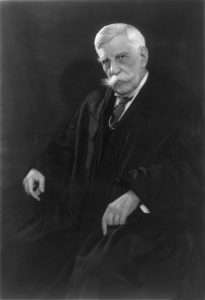
12/8/1902: Justice Oliver Wendell Holmes takes the oath.

Editor's Note: We invite comments and request that they be civil and on-topic. We do not moderate or assume any responsibility for comments, which are owned by the readers who post them. Comments do not represent the views of Reason.com or Reason Foundation. We reserve the right to delete any comment for any reason at any time. Comments may only be edited within 5 minutes of posting. Report abuses.
Please to post comments
As compared to that time during the Civil War, when he supposedly yelled at President Lincoln to get down, you damn fool, you are going to be shot.
https://www.shapell.org/manuscript/get-down-you-damn-fool-abraham-lincoln-battle-of-fort-stevens/
One of Holmes' pieces of good advice.
Of course, the issue wasn't whether a recognizable, very tall commander in chief should avoid getting shot - of course he should avoid getting shot - but whether anyone would have the guts to shout at him to warn him.
December 8, as it happens, was also the date in 1892 on which Holmes was nominated to a seat on the Massachusetts Supreme Court by the Republican Gov. John D. Long three weeks before he left office. An unexpected vacancy had arisen due to the sudden resignation of Justice Otis Lord, who was in declining health (he would pass away a little more than a year later), though Lord's timing was probably at least partly motivated to deny the incoming Democratic Gov. Benjamin Butler the appointment.
Holmes had accepted a position as a law professor at Harvard that February, though he did not begin teaching until September. One of Holmes' conditions to accept the position was that, should he be appointed to a judgeship, which he thought unlikely, he would consider, though not necessarily accept it. Harvard President Charles Eliot accepted Holmes' condition.
On December 8, 1822, three months into his teaching career, Holmes was having lunch in Cambridge with a colleague at 1 PM when his wife Fanny and his former law partner George Shattuck arrived in a carriage. Shattuck informed Holmes that one hour ago, Gov. Long had decided to nominate him to the Supreme Court, but if he wanted the job, he had to accept immediately. Long's term as governor would expire in three weeks, and gubernatorial judicial nominations had to be approved by a body known as the Governor's Council which was having its final meeting of the year that very day at 3 PM. Holmes immediately left with his wife and Shattuck to Long's office and accepted the nomination. Long submitted Holmes' name to the Council that afternoon, and the Council approved the appointment.
Holmes did not report any of this to anyone at Harvard until a faculty meeting on December 12, to the umbrage of a great many there, who thought his leaving his position so soon after he had accepted it reflected poorly upon Holmes' character, but Holmes really, really wanted to be a judge and turned out to be a pretty good one.
CORRECTION: That would be 1882, which I rendered incorrectly twice.
Instead of "so help me, God," did Holmes say, "so help me, Brooding Omnipresence in the Sky"?



