The Volokh Conspiracy
Mostly law professors | Sometimes contrarian | Often libertarian | Always independent
Today in Supreme Court History: December 1, 1897
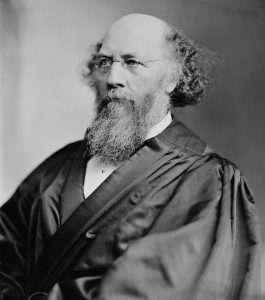
12/1/1897: Justice Stephen Field resigns.

Editor's Note: We invite comments and request that they be civil and on-topic. We do not moderate or assume any responsibility for comments, which are owned by the readers who post them. Comments do not represent the views of Reason.com or Reason Foundation. We reserve the right to delete any comment for any reason at any time. Comments may only be edited within 5 minutes of posting. Report abuses.
Please to post comments
Justice Field, of course, got his Supreme Court seat because the Tenth Circuit Act of 1863 increased the number of seats on the Supreme Court from nine to ten.
I didn't know they ever got up to ten. And when Johnson became president Congress decided to reduce the number of seats by attrition. It got down to seven.
There was a lot of this sort of thing in the 1860s, including having Nevada enter as a state in 1864 since the Republicans were worried about losing the election, and West Virginia being accepted as a new state. Nevada was for a long time not only the least popular state, but often less populous than several territories.
You mean people were gaming the senators by adding states or resisting same??????!!!?
Justice Stephen Field held the short-lived tenth seat to address the nation's expansion to California. The Supreme Court expanded from six to seven to nine earlier to address the increase in population and so forth.
The Constitution originally noted:
“The Congress shall assemble at least once in every Year, and such Meeting shall be on the first Monday in December, unless they shall by Law appoint a different Day.”
As Steve Vladeck notes in his Substack, this was related to the agricultural cycle of the day, which left that open as a good time to govern. He earlier noted:
The Supreme Court, too, eventually followed the same pattern—with its term beginning on the first Monday in January as of 1827; and the first Monday in December as of 1844 (where it remained until 1873).
Thus, 1827 saw the beginning of the term move to the first Monday in January; it moved to the first Monday in December in 1844 (which spelled the end of any hope of having SCOTUS Terms and calendar years be co-extensive); and, as the Court’s docket exploded after the Civil War, it moved to the second Monday in October in 1873.
The Constitution does not set the number of justices.
The first Congress set up a six-person Supreme Court that "circuit rode" in three circuits. Justices eventually basically oversaw a single circuit (today, a few have more than one, with a much reduced responsibility). There was a short-lived attempt to end the circuit riding process (with a plan to reduce SCOTUS to five) in 1801, but the Election of 1800 made that a lost cause.
The changing number of justices did have some partisan aspects, including a game of keep away ending once Andrew Johnson was no longer in office. Some argue that the reduction of the Supreme Court was independent of Johnson, but that goes a bit too far.
The current push to expand the Supreme Court is clearly not simply a neutral matter. OTOH, an expansion of the Court can also be part of a wide reform of the Court that is not merely ideological.
For instance, a change to a fifteen-person Court with panels deciding certain things would be tied to an increase in personnel that is not simply a matter of addressing felt problems with the current personnel. It is a wider structural reform.