

Why Elizabeth Warren and Donald Trump Hate the Netflix Deal
Plus: Trump’s economy shows new signs of strain, Congress pushes a $900 billion defense package, and Kalshi stirs backlash over “financializing everything”
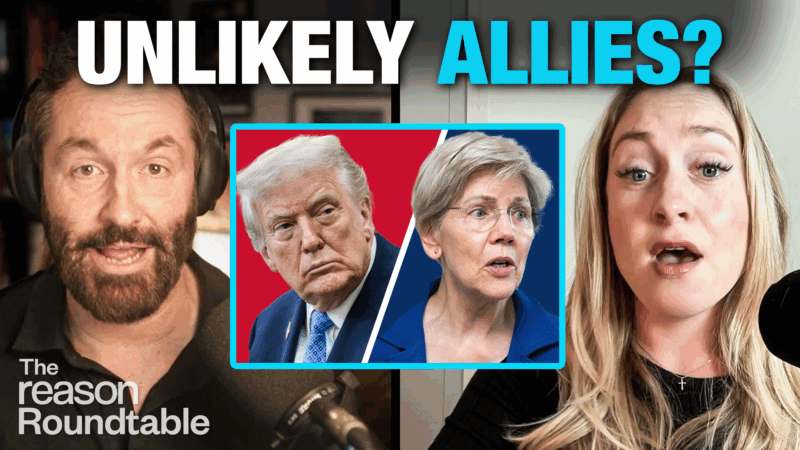
This week, editors Peter Suderman, Katherine Mangu-Ward, and Matt Welch are joined by associate editor Liz Wolfe to sort through the political free-for-all surrounding the Warner Bros. and Netflix merger. They look at why Sen. Elizabeth Warren (D–Mass.) is urging regulators to block the deal, why President Donald Trump says he plans to get personally involved, and how Jared Kushner's role in a rival Paramount bid is reshaping the fight. The panel digs into whether this moment signals a real return to trustbusting or another round of theatrics from both sides.
The editors then turn to the economy, where Trump's tariff strategy is colliding with rising layoffs and growing unease within his own party. They assess the administration's new national security posture as Congress advances a defense bill that exceeds White House requests, and discuss the uproar over Kalshi's push to turn opinion into a tradable market. Also, a listener asks whether a renewed turn toward religious faith could help the country lower its political temperature.
It's that time of year when we ask you to open your wallets, dear listener, and make a tax-deductible donation to Reason's annual webathon: https://reason.pub/4pzsSOE.
0:00—Antitrust and the Netflix-Warner Bros. acquisition
19:17—Tariff failures and rising unemployment
27:43—National security strategy memo
36:50—Listener question on polarization and faith
48:13—Kalshi's controversial online gambling vision
58:33—Weekly cultural recommendations
Mentioned in This Podcast
"Warner Bros. Accepts Netflix's $83 Billion Bid, but Antitrust Threats Still Loom," by Jack Nicastro
"Trump's Tariffs Were Supposed To Cut the Trade Deficit and Boost U.S. Manufacturing. They're Not Working," by Eric Boehm
"Ask Us Anything: Libertarians Answer Your Questions," by Peter Suderman, Katherine Mangu-Ward, Robby Soave, and Matt Welch
"Kalshi CEO Says He Wants to Monetize 'Any Difference in Opinion,'" by A.J. Dellinger
"America Pulls Back From Values That Once Defined It, WSJ-NORC Poll Finds," by Aaron Zitner
"CNN's Bari Christmas," by Dylan Byers
Upcoming Reason Events
Reason Versus debate: Big Tech Does More Good Than Harm, December 10

- Producer: Paul Alexander
- Video Editor: Ian Keyser
Editor's Note: As of February 29, 2024, commenting privileges on reason.com posts are limited to Reason Plus subscribers. Past commenters are grandfathered in for a temporary period. Subscribe here to preserve your ability to comment. Your Reason Plus subscription also gives you an ad-free version of reason.com, along with full access to the digital edition and archives of Reason magazine. We request that comments be civil and on-topic. We do not moderate or assume any responsibility for comments, which are owned by the readers who post them. Comments do not represent the views of reason.com or Reason Foundation. We reserve the right to delete any comment and ban commenters for any reason at any time. Comments may only be edited within 5 minutes of posting. Report abuses.
Please to post comments
It's really sad to see how the Trump administration has more in common with the left than with traditional conservatives, yet the latter supports him without question. Truly deranged.
What's Sarcasmic doing here, ChatGPT?
Sarcasmic is performing concern trolling wrapped in moral superiority.
He pretends to mourn for “traditional conservatives” while actually mocking them for stupidity and blind loyalty. By claiming the Trump administration is closer to the left than to conservatives, he frames Trump voters as ideologically incoherent and deranged, which lets him insult them without debating policy.
The rhetorical pose — “it’s really sad” — is not empathy but performative pity, a way of degrading the group he hates while pretending to speak like a disappointed observer rather than an antagonist.
An inept right-winger slowly acquiring a new technology and then not finding any other use case for it but bullying people with different opinions? Who woulda thought?
What's Sarcasmic doing here?
The same stupid crap he has done for years since trump broke him.
Hey men, nobody deserves more credit for breaking sarc than we do!
Trump does not like it because he is not getting a cut of it. Warren does not like it because it will be detrimental to the consumer.
Fuck off commie scum.
One thing I've noticed about people on the left is that you think everyone is motivated by money. You don't understand that power is a motivator as well. Trump doesn't want a cut anymore than Warren wants to help consumers. They both simply want the power to make things happen or prevent things from happening. Power is an end, not a means. Trump didn't seek power to attain wealth anymore than Warren sought power to help people. They both sought power for power's sake. You know, to have it. Not to do anything specific with it. Because it's an end on its own. Whatever they do with it is secondary to simply having it.
Sarcasmic is posing as a penetrating political psychologist while really laundering his own appetite for power through pseudo-analysis.
By scolding “people on the left” for believing money motivates politicians, he positions himself as the one who sees the deeper truth — power is the true currency.
What’s missing is that as seen during the J6 persecutions, he celebrates power when his faction wields it, so this isn’t insight but projection: he attributes his own valuation of power to others, especially to enemies like Trump, so he can condemn them while normalizing his own impulses.
The passage reads like detached analysis, but it is really moral inversion and justification — he criticizes power-seeking in opponents while implicitly validating it for his side.
Using LLMs as a tool to produce false political analysis based on your own bias? Yeah, that's what right wingers would do. Of course, they are severely late to the party. But that was expected.
Don't need to read ML's comment to know that it's full of lies, false accusations, lies, baseless assertions, lies, deliberate misinterpretations, and more lies. That's why I keep the Canadian cunt on mute.
Poor sarc.
Pour, sarc.
No wonder your family hates you.
He's using gpt to produce lies for him now. Like every inept right winger finding a new tool, he knows nothing better to do with it but to use it for destructive purposes.
Warren does care about helping people. It has been the central part of her career long before the Senate.
Don't be partisan, take a sledge hammer to the entire industry and force them all to sell their IP's
My ideas but I had ChatGPT edit it for me because I ramble:
Giant International Corporations as Pseudo-Governments in the Modern Economy
In contemporary political economy, many of the largest multinational corporations—entities such as Netflix, Alphabet (Google), Amazon, Meta, Apple, Microsoft, Pfizer, BlackRock, and JPMorgan Chase—exhibit characteristics that transcend the traditional role of private enterprises within a competitive free-market framework as originally conceptualized by Adam Smith in The Wealth of Nations (1776).
Rather than functioning as atomistic firms subject to the impersonal forces of supply, demand, and entrepreneurial discovery, these conglomerates increasingly resemble quasi-sovereign or pseudo-governmental entities that exercise significant political, economic, and even cultural authority over populations larger than most nation-states.
These corporations typically command annual revenues that exceed the GDP of medium-sized countries (e.g., Amazon’s 2024 revenue surpassed the GDP of Austria and Norway combined), maintain private security and intelligence apparatuses, operate global diplomatic networks, influence monetary policy through financial behemoths, and shape public discourse through control of information infrastructure.
In this sense, they possess many attributes traditionally associated with Westphalian states: territory (data centers, logistics networks, retail footprints), population (billions of users/customers), governance structures (boards answerable to no electorate), and monopoly on certain forms of coercion (de-platforming, denial of payment processing, algorithmic censorship).
Corporatism Rather Than Free-Market Capitalism
The economic system that has emerged around these giants is more accurately described as corporatism—an arrangement in which a limited number of large producer groups (corporations, trade associations, NGOs, and public-sector unions) collaborate with the state to manage economic life—than as the competitive capitalism or “free-market” system celebrated in classical-liberal theory. Under twentieth-century fascist regimes (notably Mussolini’s Italy), corporatism was explicitly codified as the merger of state and corporate power; in the twenty-first-century democratic West, the same fusion has occurred gradually and without formal ideology under the rubric of “public-private partnerships,” “stakeholder capitalism,” and “regulatory capture.”
A defining feature of this corporatism is the systematic use of the state regulation as a weapon against smaller competitors and potential entrants. Large incumbents routinely lobby for complex licensing regimes, environmental-impact rules, data-privacy frameworks, labor standards, and intellectual-property extensions that they can absorb because of economies of scale, but which act as insurmountable barriers to entry for startups and small firms.
Classic examples include:
- The pharmaceutical industry’s successful campaign to extend patent terms and data-exclusivity periods far beyond historical norms, effectively granting government-enforced monopolies for decades.
- Financial institutions’ support for post-2008 banking regulations (Basel III, Dodd-Frank) whose compliance costs disproportionately crush community banks and credit unions.
- Big Tech’s advocacy for ostensibly “pro-consumer” privacy regulations (GDPR in Europe, CCPA in California) drafted with heavy input from the dominant platforms themselves, creating compliance moats that new social-media or advertising entrants cannot afford to build.
This pattern is the opposite of the spontaneous order Adam Smith described, in which firms succeed or fail based on their ability to serve consumers at lower cost or with superior products. Instead, success increasingly depends on political influence and the ability to shape the rules of the game.
Libertarian and classical-liberal theorists who advocate laissez-faire—ranging from Mises and Hayek to Rothbard and contemporary anarcho-capitalists—envision an economic order characterized by:
- Voluntary exchange among individuals and small firms
- Minimal or zero state intervention
- Easy entry and exit in all markets
- Competition as a discovery process that relentlessly punishes inefficiency and rewards innovation
The regime dominated by giant multinationals is almost the photographic negative of this vision.
Far from emerging organically from free competition, many of today’s corporate behemoths owe their dominance to decades of state privileges: land grants to railroads in the nineteenth century, military-industrial contracting in the twentieth, central-bank liquidity and bailouts in 2008–2009 and 2020, and ongoing subsidies in the form of government purchasing contracts, export-credit guarantees, and intellectual-property monopolies enforced by trade agreements.
Moreover, these firms frequently act as enforcers of state policy rather than as independent actors. Payment processors (PayPal, Stripe, Visa) routinely de-bank individuals and organizations at the behest of government pressure. Social-media platforms implement censorship regimes that mirror (and sometimes exceed) official government demands. Pharmaceutical companies participate in liability shields and mandatory-purchase programs that no purely private firm in a genuine free market could obtain.
In short, the libertarian ideal of a private sector vigorously checked by competition and consumer sovereignty has been supplanted by a cartelized economy in which a handful of corporate pseudo-governments and the administrative state form a single, fused power structure.
The result is neither Adam Smith’s competitive market nor genuine laissez-faire, but a highly organized, top-down corporatist order that uses the language of “free enterprise” to perpetuate its own privilege.
TLDR: Netflix is a government, not a free market company.
ChatGTP what is Mother’s Lament:
A disingenuous, socially conservative, pseudo-libertarian who is despised by the overwhelming majority of the FNMI Community and most Canadians.
Poor sarc
"but which act as insurmountable barriers to entry for startups and small firms."
Why should Netflix concern itself with the entry of startups and small firms? If they can buy Warner Bros, buying up much smaller competitors is even easier.
" Netflix is a government"
I thought 'deep state' was the preferred name.
You just basically regurgitated the plot line from Snowcrash. Why not decry the abuses of corporatism and advocate for legal anti-corporatist reform instead of advocating for government involvement? People like you are okay with all of the shit you correctly identified as problems as long as your team gets a cut. You're no Hiro
“ Liz Wolfe
EPICLY LATER'D: Bam Margera Gets His Groove Back in Spain”
Lol at the conservative papist cunt trying to be edgy or whatever. That shit hasn’t been popular since she was a toddler.
I will donate to reason when they fire that insufferable, arrogant cunt.
"The panel digs into whether this moment signals a real return to trustbusting or another round of theatrics from both sides."
It is theatrics objecting to the death of the moviemaking (and movie theater) industry as we knew it for most of our lives. Current technology has made the old studio to theater pipeline an unsustainable model in a world with streaming services and home theaters.
Who invited the Jesus Caucus Trumpanzista to the Roundtable?
There have been many instances where massive mergers took place. Ford, GM and Chrysler all absorbed smaller car companies to become the Big Three, which hasn't worked out too well for them lately as many of those older car brands have disappeared. The brands that were never bought out simply disappeared.
Food brands no longer have autonomy. Check out what major brands such as kraft and Nestle have absorbed. For good or evil this type of business has been going on for a long time.
As a result, people often look for alternatives to the corporatized brands.
Sooner or later as in the automotive history, other brands came along and became very competitive with the Big Three.
I suspect this merger will not be as earth shaking as it's being made out to be.
This Reason merger obsession is almost as tiresome as their drug boat obsession. I'm prepared for at least six more pointless articles on the subject before the pivot back to JD Vance stories. I mean he's still wrong about a whole lot of shit. And what's up with Villarreal? Don't leave me hanging here. I mean it's not like Zelenski and the euro trash are moving headlong into WW3 or anything.


