
D.C.'s Statue of a Confederate General Isn't What Its Critics Think It Is
Brigadier General Albert Pike is honored for his civic and philanthropic legacy, not his role in the Civil War.
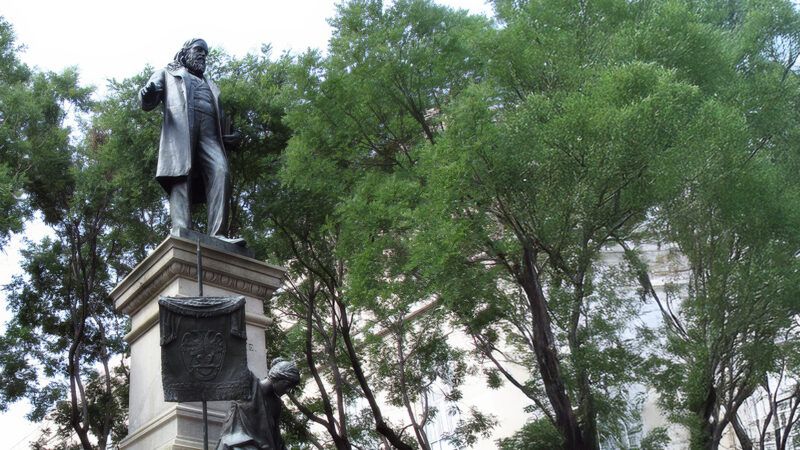
The National Park Service reinstalled Washington, D.C.'s only statue of a Confederate soldier in October 2025 as part of the Trump administration's effort to restore preexisting monuments in the capital. The depiction of Brigadier General Albert Pike was toppled by protesters in the summer of 2020, with many treating it as just another symbol of Confederate nostalgia. But it was erected to honor Pike's civic and philanthropic legacy, not his role in the Civil War.
Pike's bronze likeness was not donated by a Southern historical society or heritage league, nor funded by a Jim Crow–era government. It was privately commissioned by the Scottish Rite of Freemasonry of Washington, D.C., as part of a fundraising effort that began in the 1890s—years before the wave of Confederate monument construction. The statue honors Pike not for his service to the Confederacy but for his postwar work as a legal scholar, philanthropist, and advocate for the rights of indigenous tribes. This is emphasized by depicting him in civilian garb and holding a book rather than wearing his dress blues and brandishing a rifle.
Pike represented Native American nations in their claims against the federal government. He made various legal contributions in his home state of Arkansas, publishing The Arkansas Form Book, which helped standardize the state's legal codes. He also advocated for expanding access to quality education for those on the frontier.
The reaction to the reinstatement of Pike's statue ignores these other roles Pike played in American history and falsely lumps this specific monument in with every other Confederate memorial. Del. Eleanor Holmes Norton (D–D.C.), for example, referred to it as "morally objectionable" and "an affront to the mostly Black and Brown residents of the District of Columbia." Norton, who was at the forefront of attempts to move the statue as early as 1992, has again introduced legislation to permanently remove it.
The context surrounding the Pike statue is different from efforts in parts of the South to reerect Confederate war memorials and rename schools. It's an effort to restore the monument in alignment with its original purpose. In doing so, the National Park Service isn't celebrating Pike; it's complying with legal obligations to maintain, upkeep, and protect monuments located on federal land.
Public memory often shoehorns complex historical figures into two categories: virtuous heroes or irredeemable villains. This impulse depends on rejecting historical context in favor of theatrical certainty. Pike's life cannot be placed neatly into either box.
This article originally appeared in print under the headline "Why Did D.C. Reinstall a Confederate Statue?."
