
Trump's Legal Rationales for Prosecuting Congressional Investigators Range From Vague to Implausible
After the president ordered the Justice Department to investigate Democratic legislators for "threatening a lot of people," his underlings tried to find a crime to pin on them.
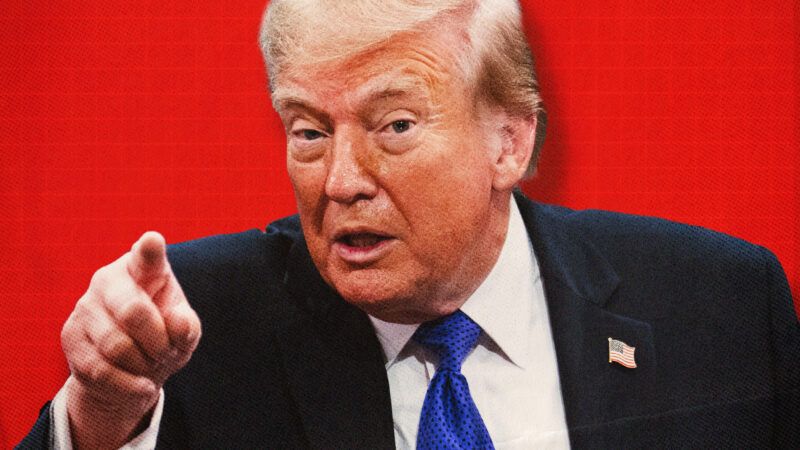
Four days after the midterm elections, President Donald Trump threatened to prosecute Democrats who plan to investigate his administration after they take control of Congress in January. Although Trump asserted that legislators had committed a "criminal act" by "going around threatening a lot of people," he was hazy on exactly what statute they had violated. Undeterred by that difficulty, Trump's underlings have echoed his threat, floating legal theories ranging from vague to highly implausible.
Trump himself described overly inquisitive members of Congress as "EXTORTIONISTS," saying they were guilty of "extortion at the highest level" and "should be held accountable for this." Extortion is indeed a federal crime, but it entails the use of threats to obtain money, property, or other things of value. It is hard to see how plans to conduct hearings and issue subpoenas fit that description.
Trump said he was "ordering the Department of Justice to look into this criminal act, immediately!" Although Attorney General Todd Blanche seemed willing to comply, he did not suggest that anything Democrats had said or planned to do fit the elements of extortion. Nor did he mention any other statute that might be relevant.
In a CNN interview the day after Trump issued his order, Blanche conceded that congressional oversight is legitimate but suggested that Democrats plan to exceed that role. "You have members of Congress who after Tuesday have done nothing but threaten everything that's happening in this administration," he said. "That is not governing. That is not leading. That is not oversight."
But is it, as Trump insisted, a crime? "It depends on what the crime is and what they have done," Blanche explained, not very helpfully. That does not "necessarily" mean that "every case is going to be prosecuted," he added, without even trying to explain what the charge could possibly be.
Blanche cited several examples of Democratic rhetoric that offended him. He mentioned the two words of advice ("lawyer up") that Rep. Robert Garcia (D–Calif.), who will chair the House Oversight and Government Reform Committee in the next session, offered to members of the Trump administration on Election Day. "It certainly bothers me," Blanche said. "I would be very worried if I was a member on that committee."
Blanche noted that Rep. Hakeem Jeffries (D–N.Y.), who is expected to be the next speaker of the House, and Sen. Chuck Schumer (D–N.Y.), who is likely to become the Senate majority leader, had harshly criticized Stephen Miller, the new White House chief of staff. "You have Stephen Miller getting promoted to chief of staff, and within moments, within moments, the leaders of the Senate and the Congress start threatening him, OK?" Blanche said. "That's not oversight."
The attorney general also alluded to remarks that Sen. Elissa Slotkin (D–Mich.) made at the University of Chicago in October, when she said she hoped Democratic investigations would send a "deterrence message" to recent college graduates who might be interested in working for the Trump administration. "I want them to be like, 'Lord, that might be buying myself a ton of problems,'" Slotkin said.
Blanche suggested that Slotkin's comments could be criminal. "When the threats become so vile and so dangerous that you are telling people in college that they better be careful if they want to work in the Trump administration because somebody will come after them," he said, "at some point, you have to draw the line." But again, Blanche did not explain in what sense that "line" had been drawn by federal law.
Later that week, Blanche clarified that, despite Trump's marching orders, there were "no ongoing…criminal investigations into words that incoming senators or congressmen have said." But he added that "the rhetoric that we saw starting" on Election Day is "something that we have to be careful of as Americans."
Contrary to the impression he left on CNN, in other words, Blanche did not plan to investigate legislators based on constitutionally protected speech. He was just offering a critique of their rhetoric. But meanwhile, White House Counsel Will Scharf was warning Democrats that they could in fact face criminal charges if their oversight becomes too aggressive.
"I write to remind you of the foundational limits that the Constitution imposes on congressional investigations and subpoenas, which you and members of the new Congress have evinced a clear intent to transgress," Scharf wrote in a November 9 letter to Garcia. To back up his point, he cited the Supreme Court's 1957 decision in Watkins v. United States and its 2020 decision in Trump v. Mazars USA.
Watkins involved a witness who refused to discuss other people's political associations when summoned to testify before the House Un-American Activities Committee. The Supreme Court overturned his conviction under 2 USC 192, which makes a congressional witness guilty of a misdemeanor when he "refuses to answer any question pertinent to the question under inquiry." That conviction violated the Fifth Amendment's guarantee of due process, the Court said, because "the question under inquiry" was unconstitutionally vague. The justices added that "investigations conducted solely for the personal aggrandizement of the investigators or to 'punish' those investigated are indefensible."
Mazars involved four congressional subpoenas seeking financial information about Trump, his children, and his businesses. The justices held that the lower courts had not adequately considered the separation-of-powers issues raised by such demands.
The principles recognized in those cases "require Congress to identify a legitimate legislative purpose underlying its investigative acts," Scharf wrote. "Failure to do so in this context represents a clear abuse of power and an affront to our constitutional system of government and to the rule of law."
If a congressional subpoena flouts those limits, the courts can decline to enforce it. But Scharf also claimed that investigations exceeding legitimate oversight could constitute a federal crime.
"Beyond being inconsistent with the clear, well-recognized constitutional limitations on your investigative functions, threats to executive branch officials designed to deter them from public service, or process designed merely to abuse or instill fear in the recipient, may cross the line into blatant criminality," Scharf wrote. "And issuing unlawful subpoenas with the intention of depriving citizens of their constitutional rights and privileges may warrant further investigation."
Although Scharf, like Blanche, did not cite any particular statute, he was apparently alluding to 18 USC 242, which makes it a crime to "willfully" deprive someone of his constitutional or statutory rights under color of law, and 18 USC 241, which covers conspiracies to "injure, oppress, threaten, or intimidate any person" in "the free exercise or enjoyment" of such rights. Two days later, Aaron Reitz, the U.S. attorney for the Southern District of Texas, made that connection explicit.
"In recent weeks, you have threatened citizens for associating themselves with the President and other public officials," Reitz wrote in a November 11 letter to Sen. Richard Blumenthal (D–Conn.). Reitz cited an October 21 press release in which Blumenthal said he wanted "answers from more than a dozen previously undisclosed donors to the White House ballroom," expressing concern that they may have "benefited from favorable government actions, including regulatory decisions and government contracts."
Blumenthal was trying to "intimidate citizens for engaging in philanthropic practices that will benefit our nation for generations," Reitz said. "The American people are entitled to freely associate without elected officials terrorizing them with aggressive, harassing government action."
Blumenthal's inquiry, Reitz averred, reflected "your intent to deprive citizens of their core constitutional rights in violation of 18 U.S.C. §§ 241 and 242." He instructed Blumenthal to "preserve all documents, communications, and other electronically stored information" relevant to "your efforts to suppress associational activities for philanthropic projects throughout the nation's capital."
Reitz sent similar letters to Garcia, Slotkin, Sen. Elizabeth Warren (D–Mass.), and Sen. Adam Schiff (D–Calif.). "As a U.S. attorney, I am free to do these things," he told The Washington Post. "I did so in coordination with Main Justice."
You might wonder why a U.S. attorney in South Texas decided to send such letters when the setting of the conduct that concerns him is Washington, D.C. Reitz "does not have any obvious jurisdiction to investigate lawmakers in Washington, more than 1,000 miles away, with no clear connection to his state," the Post noted. "Reitz brushed aside that concern, saying that congressional efforts at some point were bound to eventually affect someone in his district. If they don't, he said, then his office would not take the lead on any potential investigation."
Another problem for Reitz: Section 241 and Section 242 both require a specific intent to violate or interfere with someone's rights, an element that would be hard to prove based on the sort of statements he cites. "Those statutes require proof of a willful, specific intent to deprive someone of a federal right," Georgetown University law professor Steve Vladeck notes. "The conduct [Reitz] points to consists of television interviews, an op-ed in Time, and letters asking people for information. When members talk about investigations they plan to run, that's not specific intent to deprive someone of a federal right; it's specific intent to investigate whether the subjects of the investigations themselves broke the law. There's no federal right to immunity from congressional oversight."
More generally, Vladeck says, Scharf and Reitz "take the real limits" on congressional investigations, "which have always been enforced through civil fights over subpoenas, and recast them as criminal ones. And both mostly ignore the Speech or Debate Clause, which would almost certainly interpose a fatal obstacle to any prosecution of a member for conducting oversight."
That clause says legislators "shall not be questioned in any other place" regarding "speech or debate in either House." The Supreme Court has emphasized that the clause, which protects members of Congress from civil lawsuits or criminal prosecutions for conduct falling within the legislative sphere, was meant to give them "wide freedom of speech, debate, and deliberation without intimidation or threats from the Executive Branch."
An indictment "alleging a conspiracy to deprive people of their rights through 'weaponized' oversight would depend upon proving the illegitimacy of the subpoenas, the hearings, or the committee votes," Vladeck writes. "Every one of those is a legislative act, for which the members' motives are off the table. When the oversight itself is the alleged crime, the Speech or Debate Clause is arguably at its zenith."
To the extent that Scharf and Reitz "frame investigative demands as themselves unlawful," Vladeck adds, "the First Amendment and the Speech or Debate Clause both provide insuperable obstacles to those claims succeeding without a pretty clear showing of improper legislative purpose." And "given the subject matter we're likely to see," he says, "that's a remarkably steep hill to climb."