Senators Want To Tell the Drug Police How To Practice Medicine
Eight senators want the DEA to revive a limit it never imposed and restore a ban it never lifted.
Eight senators want the Drug Enforcement Administration (DEA) to revive a limit it proposed but never imposed and ban a drug it already bans. Their letter urges the agency to undo changes it has only proposed.
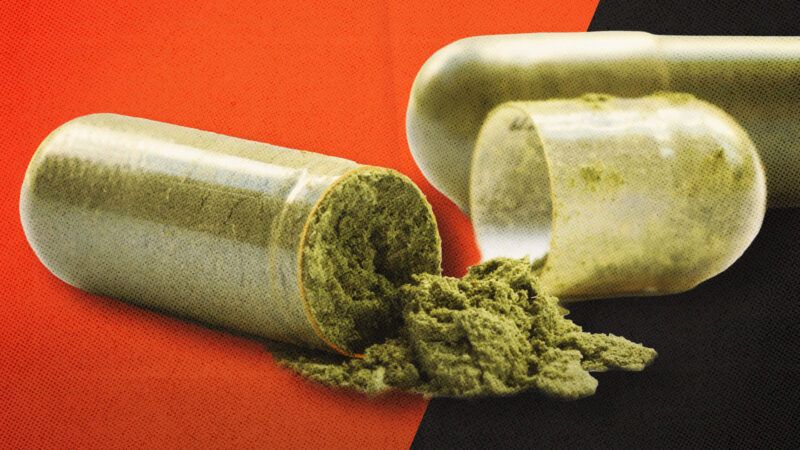
"Kratom is an opioid," the senators begin. Some compounds in kratom activate the same receptor as morphine. But that doesn't mean all kratom products are alike. Kratom leaves contain trace amounts of 7-hydroxymitragynine (7-OH), but a cup of kratom tea and a tablet containing concentrated 7-OH can deliver very different amounts of the compound. The senators' label glosses over a difference that matters when the government decides what to ban.
A new review from Reason Foundation, the nonprofit that publishes Reason, describes how people have long used kratom to manage pain and ease opioid withdrawal. In a survey, users reported taking kratom for anxiety, for pain while trying to avoid conventional opioids, or to cut back on or stop taking other opioids. In a letter to the Department of Health and Human Services, nine military veterans described using concentrated 7-OH to manage pain and symptoms of post-traumatic stress disorder and to move away from other opioids or alcohol. These accounts tell us why people seek out these products. Whether the products reliably help them remains a question for researchers.
In July, the DEA proposed putting 7-OH in Schedule I, a federal classification that generally makes possession a crime, if the compound makes up more than 0.05 percent of a product by weight. That proposal never took effect. In August, the agency issued an order putting a related compound, mitragynine pseudoindoxyl (MP), in Schedule I regardless of its concentration.
On October 14, the DEA proposed new limits. Under the proposal, Schedule I controls would apply to solid products containing more than 0.1 percent 7-OH or MP by weight, counting both together if a product contains both. The proposal sets a separate concentration limit for liquids. It also requires at least 100 parts mitragynine, the main active compound in natural kratom, for every part of 7-OH and MP combined. A product could fall below the concentration limit and still trigger Schedule I controls if it failed that second test.
The DEA said it would publish an order on or after November 13. That was the earliest date the agency could publish the order. The limits did not take effect automatically on that date, and the October notice left the August order on MP in place. As of November 19, the DEA had yet to publish an order putting the new limits into effect.
In their November 16 letter to the DEA and the Food and Drug Administration (FDA), Sen. Charles Grassley (R–Iowa) and seven colleagues said the DEA had doubled the previously allowable concentration of 7-OH and removed MP from Schedule I. The senators got the arithmetic right for solids: 0.1 percent is twice 0.05 percent. But the July and October figures both came from proposals. And the October proposal would keep MP under Schedule I controls in products that exceed either threshold. Asking the FDA to explain why health officials recommended a higher cutoff is reasonable. Demanding that the DEA restore a ban it hasn't lifted is something else.
A concentration limit tells us surprisingly little about the dose someone takes. Two tablets of different sizes can contain the same amount of 7-OH, even if one crosses the concentration limit and the other falls below it. The DEA acknowledges that controlled human trials have yet to establish safe consumption limits for concentrated 7-OH. What evidence shows that the senators' preferred cutoff would make consumers safer? What evidence would justify prosecuting adults for possessing a product that crosses it?
Federal law reserves Schedule I for substances deemed to have a "high potential for abuse" and "no currently accepted medical use in treatment in the United States," among other criteria. Congress also gave the DEA power to place substances there temporarily when the agency finds an imminent hazard to public safety. Health officials supplied the proposed thresholds in this case. The DEA decides whether to impose them. Federal drug police already decide what adults can take to manage pain or cope with withdrawal. Now eight senators want to make that decision for them, down to the decimal point.
Potency and dependence deserve attention. Adults should know what they're buying, how much of each compound a product contains, and what risks they face. Accurate labels, independent testing, and enforcement against fraud can help. A ban can change where people shop and what they buy. Some people who use 7-OH for pain or withdrawal may turn to illicit sellers or switch to riskier drugs. The senators should ask the agencies to account for those risks, too.
The senators want answers from the FDA and the DEA by November 30. What do they expect people living with pain or trying to get off other opioids to do if the products they rely on disappear? It's bad enough that we let the drug police practice medicine. Do we really want eight senators writing the prescription?