

The Next Congress Will Have the Largest Progressive Caucus in History. What Will It Be Able to Accomplish?
Progressive members of Congress have higher numbers than ever. But so do establishment Democrats.
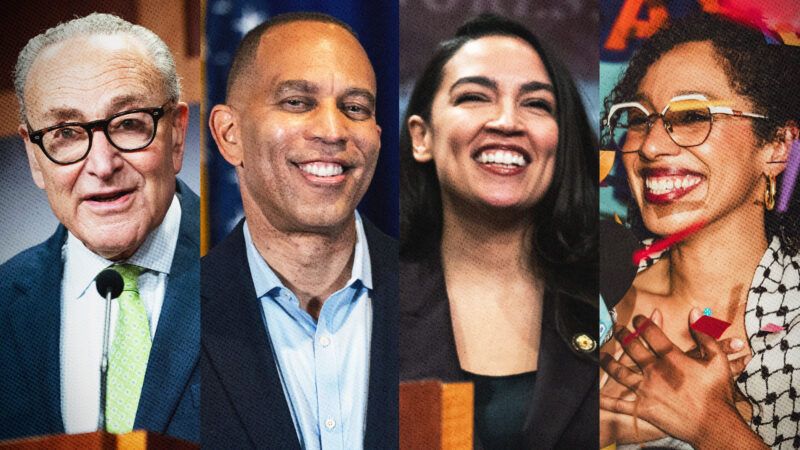
Midterm voters did not just bring in a "bluenami" last week; they elected the largest progressive Congress in history.
On Sunday, Rep. Greg Casar (D–Texas), chair of the Congressional Progressive Caucus (CPC), announced the caucus gained at least 25 members, bringing its total to at least 105 members. The CPC, Casar explained, is a big tent, including both Blue Dog Democrats and members of the Democratic Socialists of America (DSA).
"We are united in one unbreakable commitment to shake up Washington D.C., root out corruption, stand up for working people who have been screwed over by Congress for far too long," Casar said at the press conference.
The incoming members shared their legislative priorities, including passing Medicare for All, abolishing Immigration and Customs Enforcement (ICE), stopping war in the Middle East, and getting money out of politics. Already, some of these progressives, namely its DSA members, are attempting to push forward their agenda by not endorsing Rep. Hakeem Jeffries (D–N.Y.) as speaker of the House.
According to The Wall Street Journal, "demands on the table for Jeffries included wealth taxes, advancing language and votes on Medicare for All, the pro-union PRO Act, an arms embargo on Israel, raising the minimum wage and abolishing Immigration and Customs Enforcement."
"What we're demanding is an agenda. It's not about the individual," Rep.-elect Melat Kiros (D–Colo.) told reporters on Monday when asked whether the DSA supports an alternate candidate to Jeffries.
The signs of the DSA's discontent surfaced earlier this year when CNN reported that a crowd chanted "You're next!" as a photo of Jeffries appeared on a screen at Rep.-elect Claire Valdez's (D–N.Y.) primary victory party. Jeffries responded by telling CNN that the crowd lacked diversity.
Jeffries' identity-based retort falls flat in 2026, when even Democratic voters seem tired of wokeness. Luckily for him, he likely has the support to propel him to the speakership. As The Wall Street Journal noted, the party's more moderate New Democrat Coalition, chaired by Rep. Brad Schneider (D–Ill.), is expected to have a comfortable majority within the Democratic caucus, with 140 seats.
Jeffries has said the party is united in wanting to undo President Donald Trump's tariffs and end the Iran war, according to the Associated Press. While these actions will likely bring down costs, Democrats' other plans to ensure "affordability" are almost certain to involve more regulation and intervention, as he has vowed to "hold businesses and others accountable for driving up costs," according to Al Jazeera. He has not committed to holding votes on some of the CPC's other demands, including Medicare for All.
With a moderate leader in the House and Trump in the White House, the progressives' legislative agenda will likely be constrained over the next two years. But the caucus might be more focused on 2028, which is increasingly being shaped by a new blue kingmaker: New York City Mayor Zohran Mamdani.
According to Axios, Mamdani has been meeting with labor leaders, "urgently talking up the need for a labor-aligned or leftist candidate to run for the White House." And if his success in backing three elected House members is any indication, his behind-the-scenes maneuvers could be worth watching. Democrats, who will control both chambers, will likely face more internal rifts and gridlock. But as the executive inevitably becomes more powerful, a progressive could enact their agenda from the White House in 2028.



