

After 11 Years of Muriel Bowser, D.C. Readies Itself for Its First Socialist Mayor
Come Tuesday, D.C. Councilmember Janeese Lewis George is all but assured to win election as a replacement retiring three-term Mayor Muriel Bowser.
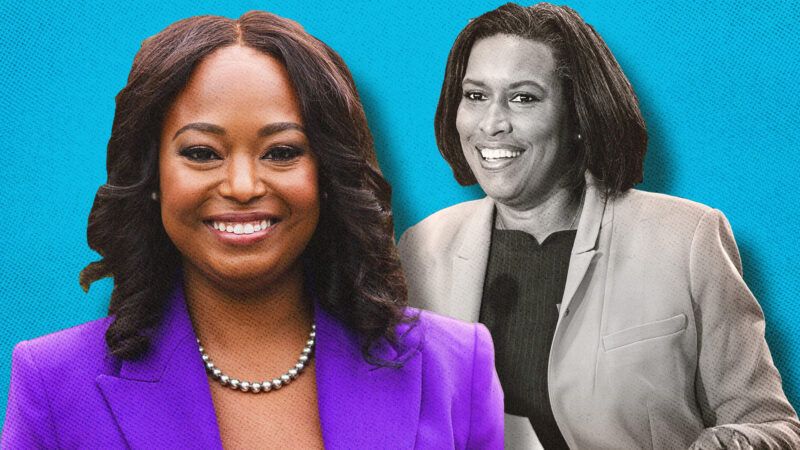
Early voting is still ongoing in Washington, D.C.'s elections, but everyone already knows who the winner of the mayoral race is going to be.
In June, Councilmember Janeese Lewis George won a commanding 54 percent of the vote in the Democratic primary. In one of the bluest cities in America, that all but assures she'll be the next mayor.
She will replace retiring three-term Mayor Muriel Bowser, who has developed a reputation for a go-along-to-get-along administration, neither a bold good-government reformer nor a progressive activist.
Her successor is more ambitious. Lewis George is a card-carrying member of the Democratic Socialists of America in the mold of New York City Mayor Zohran Mamdani (whose endorsement she sought). Her campaign platform called for more childcare subsidies, more housing subsidies, more rent control, more taxes, and, perhaps most importantly of all, a more confrontational approach to President Donald Trump.
For the past several months, District politicos have been furiously trying to read the tea leaves on what a Lewis George administration will look like in practice.
Will D.C.'s precarious fiscal situation and tense relationship with the Trump administration force her to moderate? Or will she stick to her ideological guns come hell or budget crisis and federal takeover of the city?
Budget Blues
When it comes to spending, Lewis George has the biggest ambitions and the least room to maneuver.
As D.C.'s Democratic mayoral primary was wrapping up, the District was also in the midst of a bloody fight over its FY 2027 budget.
Bowser had proposed some $450 million in cuts to bring the budget into balance as required by law. The D.C. Council, with Lewis George's enthusiastic support, rejected those cuts and filled the gap by tapping one-time revenues and the city's fiscal reserves.
Bowser let the budget bill become law without her signature in late June, warning in a letter that the council's rejection of her cuts would leave an $837 million fiscal cliff come the next budget cycle.
Lewis George, by now the presumptive mayor, clapped back with her own statement calling Bowser's proposed cuts "devastating" and "irresponsible."
In the run-up to the general election, she's promised to balance the budget and enact her new spending programs without having to raise taxes on working and middle-class residents.
This will allegedly be accomplished through "forensic" audits of government departments to identify inefficient spending.
As we learned with DOGE, however, the fraud, waste, and abuse fairly often fails to deliver the money needed to cover new permanent spending programs or tax cuts.
In this way, Lewis George's position is similar to that of fellow DSAer Mamdani in New York, who came into office with grand spending pledges, fiscal gaps to close, and only so much room and power to raise taxes.
Mamdani, at least, has a relatively friendly partner in the form of New York Gov. Kathy Hochul, who's assented to some new taxes and state aid to the city's budget.
Lewis George is likely to benefit from a Democratic takeover of Congress, which will be more likely to assent to local tax increases. But for her first two years in office, she'll still be left dealing with a Republican president who's proven remarkably willing to interfere with local D.C. policy.
The Trump Question
The most thankless task a D.C. mayor can have is appeasing a Republican president. In his second term, Trump has made this task more thankless still.
In August 2025, he surged federal law enforcement personnel and National Guard members onto D.C. city streets and placed the city's Metropolitan Police Department under federal control as part of a showy anti-crime crackdown in the District.
Under the Home Rule Act, which established D.C.'s elected municipal government, Trump was well within his rights to federalize MPD for a period of 30 days. But the president made a number of comments about how he might try to extend his control over the police department for longer still.
The move outraged the liberal city. Protests were held. Sandwiches were thrown. Stickers and yard signs demanding the feds back off appeared everywhere.
Bowser, whose control of MPD was being usurped, largely tried to calm everybody down. At a press conference on the day that Trump announced federalization of the police, she described the move as "unsettling and unprecedented."
But she also vowed to cooperate with the administration and even said that increased police presence in some areas could be a "positive."
Her "tenor will be appropriate for what I think will be appropriate for the District," she said at that August press conference.
If the goal was to avoid prolonged federal control of MPD, the mayor's tenor worked. After 30 days, the mayor regained control of the department.
But that even-handed approach was not what the city's left wanted to hear.
Lewis George called it an "outrageous action" and vowed to fight the "weaponization" of Home Rule.
In a Democratic primary in which voters were eager to vent their frustration at the new administration, this undoubtedly helped her.
In the days before the primary, Trump threatened an end to Home Rule if Lewis George won the election. "Residents said to me, 'If Trump doesn't like you, I love you,'" she told a reporter in response.
Here too, there remains an open question whether Lewis George will continue to play the role of Trump foil once in office. Fighting the administration at every turn would cause the new mayor a lot of headaches. It was also, to a large degree, what she was elected to do.
Thus far, Lewis George has been somewhat cryptic about what her posture toward the White House will be.
"I'm willing to work with this administration to the benefit of D.C. residents, and I'm willing to stand up to this administration when it comes to just that," she told Fox 5 in late October.
View From the Top
Mayor of D.C. is generally not a great job to have for a left-wing ideologue to have. You have to balance your budget. You can't print money. Taxpayers and capitalists can escape your redistributive schemes by moving a couple of metro stops away. We don't even have any agricultural land to collectivize.
Bowser, like her last couple of predecessors, understood that paying for a large city government required keeping economic growth up and keeping the occupant of the White House happy.
Neither will be an easy task for the next mayor.
The city's economy is already in a slump. Unemployment is up. Housing development is down. And Trump has threatened time and again to end D.C.'s Home Rule and run the federal government directly.
One would hardly choose a DSA member with a long list of expensive new programs to fund and an eagerness to "fight" as the ideal mayor for the moment.
A potentially telling moment came in October, when Lewis George called for delaying consideration of a bill that would have eventually allowed autonomous Waymo taxies onto city streets. The jobs of existing drivers were too important, she said.
People who are already nervous about a left-wing mayor saw in the announcement a signal that she would not bow to reality and sensibly moderate once in office.
For an already troubled city, that would spell more trouble ahead.



