Reason.com - Free Minds and Free Markets
Reason logo Reason logo
  • Latest
  • Magazine
    • Current Issue
    • Archives
    • Subscribe
    • Crossword
  • Video
    • Reason TV
    • The Reason Roundtable
    • Free Media
    • The Reason Interview
  • Podcasts
    • All Shows
    • The Reason Roundtable
    • The Reason Interview With Nick Gillespie
    • Freed Up
    • The Soho Forum Debates
  • Volokh
  • Newsletters
  • Donate
    • Donate Online
    • Ways To Give To Reason Foundation
    • Torchbearer Society
    • Planned Giving
  • Subscribe
    • Reason Plus Subscription
    • Print Subscription
    • Gift Subscriptions
    • Subscriber Support

Log In

Create new account

History

When Mary Wollstonecraft Read John Locke

The pioneering feminist was a keen student of the classical liberal theorist.
Damon Root | 10.29.2026 11:54 AM

Share on FacebookShare on XShare on RedditShare by emailPrint friendly versionCopy page URL Add Reason to Google
Media Contact & Reprint Requests
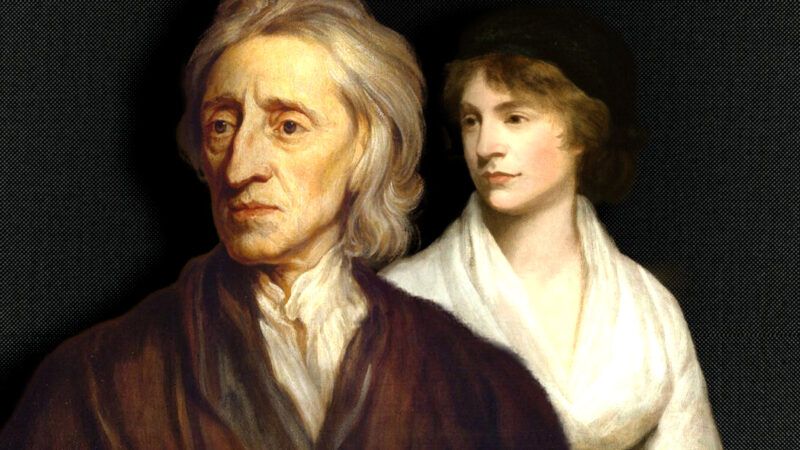
John Locke and Mary Wollstonecraft | Godfrey Kneller/John Opie
(Godfrey Kneller/John Opie)

Mary Wollstonecraft (1759–1797) was the author of acclaimed works about subjects including the education of children, political philosophy, and human liberty. She is perhaps best remembered for her great pioneering book, A Vindication of the Rights of Woman (1792), a key text in the rise and development of both feminism and liberal theory.

What is perhaps less remembered today is the fact that her landmark case for women's rights owed an important intellectual debt to the work of the political philosopher John Locke (1632–1704), who argued that the proper role of government was to protect humanity's preexisting natural rights.

Locke is sometimes mislabeled as a conservative by certain modern academics and pundits. But his ideas were deemed to be quite radical in their own day. And for the teenaged Mary Wollstonecraft, that Lockean radicalism was as welcome as the first taste of food after a grueling starvation.

You’re reading Injustice System from Damon Root and Reason. Get more of Damon’s commentary on constitutional law and American history.

This field is for validation purposes and should be left unchanged.

The year was 1775 and Wollstonecraft was 15 years old. She was a brilliant and independent-minded young woman, increasingly outraged by the vile behavior of her drunk, domineering father. He abused Wollstonecraft's mother and maintained a strict, sexist hierarchy at home, favoring her brother while she was made to suffer.

It was at this low point in her life when Wollstonecraft first read Locke. Certain passages from his greatest work, The Second Treatise of Government (1689), caught hold of her mind and never really let go. A properly constituted social order "gives the husband no more power over [his wife's] life than she has over his," Locke wrote. "The power of the husband being so far from that of an absolute monarch that the wife has, in many cases, a liberty to separate from him, where natural right or their contract allows it, whether that contract be made by themselves in the state of nature, or by the customs or laws of the country they live in."

In her superb book, Romantic Outlaws: The Extraordinary Lives of Mary Wollstonecraft and Her Daughter Mary Shelley (2015), the historian Charlotte Gordon memorably described the far-reaching effect that Locke's ideas had on the teenaged Wollstonecraft:

She had always felt that her father had no right to tyrannize her family and that the preferential treatment he and her mother bestowed on [brother] Ned was unjust. Now, after reading Locke, she had an ethical foundation for her feelings. Not only was it her right to shape her own future; it was everyone's right. In fact, Locke's social contract made protest seem the only rational response to injustice; it was humanity's obligation to overthrow tyranny.

One of the reasons why Locke is sometimes mislabeled as a conservative today is because of his writings in favor of property rights, an issue that we now associate with conservative and libertarian thinkers. But it is worth remembering that Locke's whole case for property rights began with the idea that "every man has a property in his own person. This nobody has any right to but himself."

Is it any wonder that Locke's radical case for self-ownership would appeal to a young woman like Wollstonecraft, who longed to break free from the sexist laws and cultural strictures that held her back? Nobody was going to convince her that she did not have a right to her own body.

We might say something similar about the great abolitionist Frederick Douglass (1818–1895), who also drank deep from the principles of Lockean liberalism. "You are a man and so am I," Douglass wrote in his famous open letter to his former enslaver. "In leaving you, I took nothing but what belonged to me, and in no way lessened your means for obtaining an honest living. Your faculties remained yours, and mine became useful to their rightful owner." That is about as clear and effective a restatement of Lockean self-ownership principles as you are going to find.

Locke's influence on the American Revolution, particularly on Thomas Jefferson and the Declaration of Independence, is well-known. That Locke also had a key influence on both the women's rights and abolitionist movements is perhaps worthy of further remark.


Start your day with Reason. Get a daily brief of the most important stories and trends every weekday morning when you subscribe to Reason Roundup.

This field is for validation purposes and should be left unchanged.

NEXT: Billionaires Have Already Paid Us Back. So Why Does California Want More?

Damon Root is a senior editor at Reason and the author of three books, including A Glorious Liberty: Frederick Douglass and the Fight for an Antislavery Constitution (Potomac Books). His latest book is Emancipation War: The Fall of Slavery and the Coming of the Thirteenth Amendment (Potomac Books).

HistoryClassical liberalismLiberalismFeminismWomen's RightsLaw & GovernmentCivil LibertiesJohn LockeFrederick Douglass
Share on FacebookShare on XShare on RedditShare by emailPrint friendly versionCopy page URL Add Reason to Google
Media Contact & Reprint Requests

Hide Comments (4)

Editor's Note: As of February 29, 2024, commenting privileges on reason.com posts are limited to Reason Plus subscribers. Past commenters are grandfathered in for a temporary period. Subscribe here to preserve your ability to comment. Your Reason Plus subscription also gives you an ad-free version of reason.com, along with full access to the digital edition and archives of Reason magazine. We request that comments be civil and on-topic. We do not moderate or assume any responsibility for comments, which are owned by the readers who post them. Comments do not represent the views of reason.com or Reason Foundation. We reserve the right to delete any comment and ban commenters for any reason at any time. Comments may only be edited within 5 minutes of posting. Report abuses.

  1. MWAocdoc   2 hours ago

    Putting libertarian principles into historical perspective, socialists are the real reactionaries and we are the true liberals and conservatives. Liberal because we aim to liberate the enslaved; and conservative because we aim to preserve all unenumerated natural rights.

    1. Rick James   35 minutes ago

      Liberal because we aim to liberate the enslaved

      Careful, literally every radical socialist/Marxist/Marxist-adjacent progressive (including Marx himself) believes they're liberating the enslaved.

      I haven't read enough of Locke to know whether his views were religious/utopian in this regard as were Marx's and modern progressive/social justice academics.

  2. JFree   2 hours ago

    Locke's radical case for self-ownership

    That is not what was radical. What was radical was his expansion of the original Aristotlean (and later Aquinas and Ibn Tufail) notion of tabula rasa into the basis for all knowledge. Let us then suppose the mind to be, as we say, white paper (originally called tabula rasa in the first translations), void of all characters, without any ideas:—How comes it to be furnished? Whence comes it by that vast store which the busy and boundless fancy of man has painted on it with an almost endless variety? Whence has it all the MATERIALS of reason and knowledge? To this I answer, in one word, from EXPERIENCE.

    No Calvinist/religious imprint from God that separates one from another. No rationalist structure that requires some things to be always correct and others to be always incorrect. No Burkean/Fiddler on the Roof TRADITION!!.

    It was Burke's attack on Richard Price (the inheritor of Locke's tabula rasa radicalism) re France that directly caused Wollstonecraft to write her work in response.

  3. Rick James   38 minutes ago

    Locke (1632–1704), who argued that the proper role of government was to protect humanity's preexisting natural rights.

    Locke is sometimes mislabeled as a conservative by certain modern academics and pundits.

    I suppose that depends on what you'd think his position on forced masking, vaccinations and Lockedowns would be had he lived in the modern time...

Please log in to post comments

Mute this user?

  • Mute User
  • Cancel

Ban this user?

  • Ban User
  • Cancel

Un-ban this user?

  • Un-ban User
  • Cancel

Nuke this user?

  • Nuke User
  • Cancel

Un-nuke this user?

  • Un-nuke User
  • Cancel

Flag this comment?

  • Flag Comment
  • Cancel

Un-flag this comment?

  • Un-flag Comment
  • Cancel

Latest

Wives for Sale, Poisoned Husbands, and 12-Year-Old Brides: The Grim Reality of Preindustrial Marriage

Chelsea Follett | 10.29.2026 1:25 PM

Jared Polis Warns Colorado's Progressive Tax Ballot Measure Could 'Cripple' the Economy

Eric Boehm | 10.29.2026 1:00 PM

When Mary Wollstonecraft Read John Locke

Damon Root | 10.29.2026 11:54 AM

Billionaires Have Already Paid Us Back. So Why Does California Want More?

Veronique de Rugy | 10.29.2026 11:00 AM

Video Shows ICE Agents Slashing Portland Couple's Car Tire Then Driving Off

C.J. Ciaramella | 10.29.2026 10:45 AM

Recommended

  • About
  • Browse Topics
  • Events
  • Staff
  • Jobs
  • Donate
  • Advertise
  • Subscribe
  • Contact
  • Media
  • Amazon
Reason Facebook@reason on XReason InstagramReason TikTokReason YoutubeApple PodcastsReason on FlipboardReason RSS Add Reason to Google

© 2026 Reason Foundation | Accessibility | Privacy Policy | Terms Of Use

This site is protected by reCAPTCHA and the Google Privacy Policy and Terms of Service apply.

Reason

The All-Argentina Issue is Here

New from Reason: a look into what Javier Milei has accomplished and what it will take to make the most of Argentina’s window for real change. Out now for subscribers.

Subscribe & Start Reading Learn More
