

Ireland Is Banning Vape Flavors. This Shop Owner Warns It Could Cost Lives.
The government says it's protecting children, but the restrictions could drive adults back to smoking and hand business to the black market.
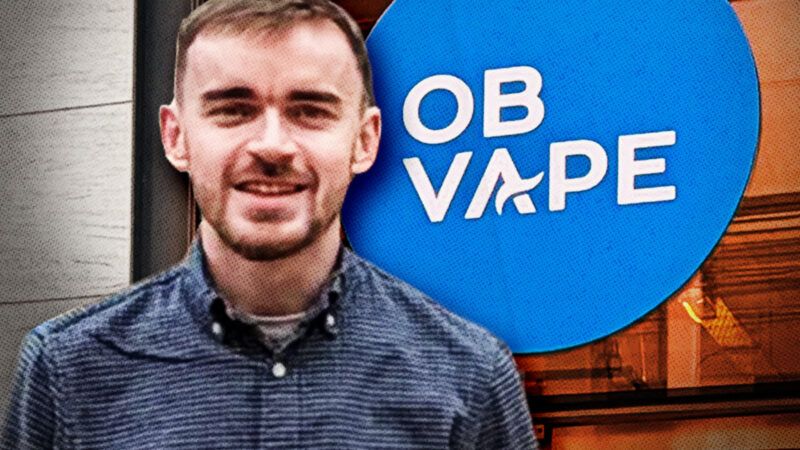
"Am I living in a fucking parallel universe here or something?" asks Eoin O'Boyle, a 28-year-old Irish vape shop owner facing the prospect of losing his business. "If there's a piece of policy that makes sense, the government will do the opposite for some reason."
Last Wednesday, the Irish Seanad passed the final stages of a sprawling public health bill, which prohibits the sale of vaping products with flavor names other than "tobacco" or "unflavored." The bill also restricts the colors and imagery permitted on vaping devices and packaging, bans advertising in shops and online, and requires most retailers to keep vaping products out of public view.
In a cliché as old as time, Irish politicians are asking the public to think of the children. "We are dealing with an increasingly aggressive industry marketing attractively packaged addictive products that appeal to children," Ireland's public health minister Jennifer Murnane O'Connor said in a statement. "We are responding strongly with measures that will protect our young people against current and future threats."
Ireland's Taoiseach (head of government), Micheál Martin, has described vaping as "nearly worse than cigarettes," calling them the "revenge of Big Tobacco." Of course, as studies by Public Health England, Cancer Research UK, the Royal College of Physicians, and countless other organizations show, vaping is vastly safer than smoking and is an extremely effective cessation tool.
"The government [is] insane to do this," O'Boyle, the owner of OB Vape in Drogheda, Ireland, tells Reason. "It's going to cause excess deaths. It's infuriating."
O'Boyle began smoking at the age of 12, before quitting when he was 18 by using vapes. "I loved smoking. I absolutely loved it," he recalls. His mother and brothers also quit cigarettes by vaping. While studying enterprise computing at Dublin City University, O'Boyle worked part-time at a vape shop, where he spotted an opportunity to build a business of his own. In 2019, he took out a small loan and opened OB Vape, hoping to create something akin to the Apple Store of vaping. He says he repaid the loan within six months and has since helped around 22,000 customers quit smoking.
Now, O'Boyle fears the business he's spent nearly eight years building could disappear. "I never thought I'd be in a position where I would have to close down my business through no fault of my own," he says.
Last week's health bill is not the first of Ireland's vape restrictions. In 2023, the country made it illegal to sell to minors, followed by advertising restrictions the following year, and an e-liquid tax in 2025.
These measures were designed to stop vaping among minors, and while Ireland's rate of teenage vaping has declined since 2019 and is below the European average, teens in the country have still been able to access these devices. As the government's own data show, 32 percent of Irish 15- and 16-year-olds have tried vaping, 16 percent said they had vaped in the previous month, and 7 percent vaped daily. By comparison, just 2 percent smoked cigarettes daily, and a 2024 report found the proportion of teens who had ever smoked once fell from 73 percent in 1995 to just 24 percent in 2024 (the lowest number on record).
Regardless of this decline among the youth, smoking remains widespread across the country. According to the government's 2025 Healthy Ireland Survey, 17 percent of the population smokes, with 13 percent smoking daily and 4 percent occasionally.
For those smokers, vaping is among the most effective tools for quitting cigarettes. An August review from Cochrane that examined 80 randomized controlled trials involving nearly 30,000 participants found that nicotine e-cigarettes are more effective at helping people quit smoking than conventional nicotine replacement therapies, such as patches and gum. The review found that vapes resulted in about four more quitters per 100 people, concluding that vaping is a "proven and viable option." Indeed, half of current vapers in Ireland are former smokers, according to government data.
Ireland's vape flavor ban could hurt adults trying to quit smoking. Vape flavors, O'Boyle argues, are crucial in helping smokers move on from tobacco flavors and successfully quit cigarettes. "People don't want to be reminded of tobacco," he says, estimating that around 96 percent of his customers use nontobacco flavors, including menthol and fruit flavors like pineapple.
Research suggests O'Boyle's experience is widespread. A 2020 study published in JAMA Network Open found that adults who started vaping nontobacco flavors had more than twice the odds of subsequently quitting smoking compared with those using tobacco flavors. A 2025 study of 886 smokers published in Nicotine & Tobacco Research found that "non-tobacco flavors were preferred and may be also more effective" at helping smokers quit.
"Without flavors, my business would be gone, and the smoking rates in the country would be up," says O'Boyle.
While the government ban will prohibit the legal sale of flavors, illegal sales are likely to be bolstered. After the Netherlands banned nontobacco vape flavors in 2024, a survey found that 47 percent of existing vapers continued using illegal flavors. Among those users, more than a third purchased them from shops abroad, while others got them from acquaintances, websites, or social media. In Australia, where vaping products can only be purchased legally at pharmacies, a 2025 government study found that 93 percent of vapers obtained their products from illicit sources. Businesses like O'Boyle's will be forced to shut down, but the missing demand will undoubtedly be met by the illicit black market.
"The restrictions that the government [is] planning to put on, and have already put on, are going to jeopardize not just my business," O'Boyle warns, "but the lives of Irish people."



