

Protesters in France and Spain Are Angry at Government Failure—and Demanding More Government
France’s education crisis and Spain’s housing shortage will not be solved with yet more government intervention.
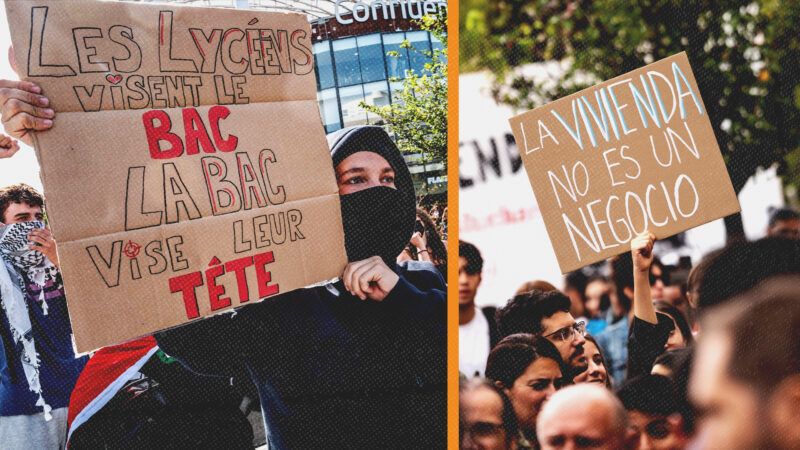
Student protests have swept across France in recent weeks—and on Friday, the protesters promised to continue, with 141 schools across the country remaining closed.
The protests began on September 21, at Saint-Exupéry high school in a Parisian suburb, against understaffing and a lack of resources. Students joined teachers on strike at the school, spurring nationwide protests that became increasingly violent. A 15-year-old boy had his hand blown off outside a high school in Lens, a northern French town, and a head teacher was doused in gasoline.
France is not the only European country feeling domestic unrest right now. Thousands of Spaniards have taken to the streets to protest the country's housing crisis after an 87-year-old woman, who has since died, was evicted from her home in Madrid after she was unable to keep up with rapidly rising rents. The protests have prompted Prime Minister Pedro Sánchez to call a snap election.
These seemingly unrelated crises were both sparked by what are obvious failures in government policy. But in both cases, protestors have sought to rectify their frustrations with the government by calling for more government action.
The French school system is heavily centralized. The national government controls recruitment, assignment, staff pay, and the curriculum, while local governments are responsible for building maintenance. The Organisation for Economic Co-operation and Development (OECD) has found that French schools have less autonomy than those in many other developed countries and has recommended giving individual schools greater control over their operations. Indeed, a 2020 OECD report found that more than half of lower-secondary education decisions in France were made centrally (compared with about one-quarter across the OECD), while only 10 percent were made at the school level.
France's carte scolaire (school map) system means that parents are not free to choose the school their children attend. Their school is assigned by the government based on where they live. Families can request an exemption, or opt for the country's heavily regulated, state-subsidized private-school sector.
Politicians have used the protests to garner support for more government funding for education. But France already spends more per student than some of the highest-performing education systems in the OECD, and its results continue to deteriorate. More than one in three French 15-year-olds now fail to reach basic proficiency in math, up sharply from a decade ago; the share of low performers has risen 12 percentage points in math and 11 percentage points in reading since 2015. France's 2025 results in the OECD's Programme for International Student Assessment—which measures competence in math, science, and reading—are "among the lowest ever" measured, and are significantly below those observed a decade before.
The OECD itself says that there is "room for efficiency gains" in France's education spending. Nicolas Marques of the pro-market Institut économique Molinari suggests that the answer is not simply more money, but greater school autonomy, including giving schools far more control over hiring teachers, organization, and teaching methods.
France's education problem is colliding with the broader squeeze on public finances. The enormous pension bill—France now spends roughly 14 percent of GDP on pensions—and mounting budget deficit, which in 2024 hit 5.8 percent of GDP, have forced the government to make cuts elsewhere, while rising borrowing costs leave progressively less fiscal room. While the French economic problem is especially acute, higher public spending driven by retirees is a problem facing much of Europe.
Spain's housing crisis is similarly a problem of big government. From 2021 through 2025, the Bank of Spain found, the country accumulated a housing shortfall of roughly 750,000 units, as household formation consistently outpaced new construction. In 2024 alone, around 240,000 new households were created while only 92,000 homes were completed. The rental market is also facing an enormous supply issue, with the supply of long-term rentals falling 33 percent across Spain between 2019 and 2024. This includes a 46 percent decline and a 75 percent decline in Madrid and Barcelona, respectively.
"As for housing, [government policies] have created this crisis," says Diego Sánchez de la Cruz, head of research at the Instituto Juan de Mariana in Spain. "With rent control comes scarcity, and that's essentially what has happened."
Spain has steadily tightened rent regulation over the past several years. Catalonia introduced rent controls in 2020, and Spain's 2023 Housing Law allowed governments to designate "stressed" housing markets, where new rents can be capped by a government reference index. Although rents initially fell in controlled areas, landlords increasingly shifted properties into seasonal and temporary leases outside the conventional rent-control regime, prompting the government to tighten the rules further.
Yet the political response has been to double down. Rather than liberalizing the housing market to allow for an increase in supply, politicians keep calling for weakening property rights even more—suggesting, in Sánchez de la Cruz's words, that "private property should be…disregarded in the name of just providing free housing for everyone."
Roxana Nicula, CEO of the pro-market Spanish think tank Fundalib, says the protests are a reaction to "a real scarcity crisis" but "are being instrumentalized clearly for electoral purposes." Nicula thinks that this will ultimately give leverage to extremes on both the left and the right.
In both France and Spain, people are right to be angry at government failure. But they're mistaken in assuming more government is the cure.




