The New Dark Ages Is Long on Alarm, Short on Scientific Literacy
The perils of blaming screens for everything

The New Dark Ages: The Death of Reading and the Dawn of the Post-Literate Society, by James Marriott, Doubleday, 208 pages, $26
The last few years have seen a glut of sky-is-falling books about kids. Jonathan Haidt's The Anxious Generation has made a generation of parents anxious. Jared Horvath's The Digital Delusion has fueled a backlash against technology in schools. The latest, James Marriott's The New Dark Ages, is the inevitable end point of the genre: heavy on lofty moral lectures but stripped almost entirely of scientific literacy or curiosity.
The book's premise is straightforward: Reading and literacy have declined among younger generations, and this is leading not just to dumb, lazy kids, but to the end of democracy itself. The culprit: the smartphone.
On the positive side, The New Dark Ages has probably the best prose of its genre. The writing is earnest and engaging, with none of the clunkiness of the other books. Marriott's love for reading is infectious, and his concerns will be catnip for the audience of adults eager to hear, yet again, that kids today are dumber, sadder, and less prepared for democratic life than prior generations.
But its scientific literacy is even worse than the other books'. Haidt has been rightly criticized many times for cherry-picking evidence, overstating research conclusions, and producing simple graphs of the sort we warn students not to make causal inferences from in Psychology 101. Those graphs are now obsolete as well: The Centers for Disease Control and Prevention have documented that youth suicide, self-reported mental health problems, and self-injuries have all declined even as screen use remains at all-time highs. (That's one danger of using time-trend graphs to make causal assertions. Often the trends inconveniently reverse.) But The New Dark Ages mostly ignores scientific data altogether.
The book's references mention very few peer-reviewed studies, and the ones it does cite say little about the thesis that screens caused such changes. Instead, Marriott relies heavily on news reports, popular books, and similar secondary sources. This is unfortunate, as the data are clear that news media tend to sensationalize weak studies that suggest social media harms, while ignoring studies that suggest social media have basically no influence on youth mental health. He depends, for instance, on the Financial Times (he thanks one of its reporters for "talk[ing] me through the data") to suggest some trends, even though that outlet has been rightly criticized for using dodgy data in misleading and alarmist ways.
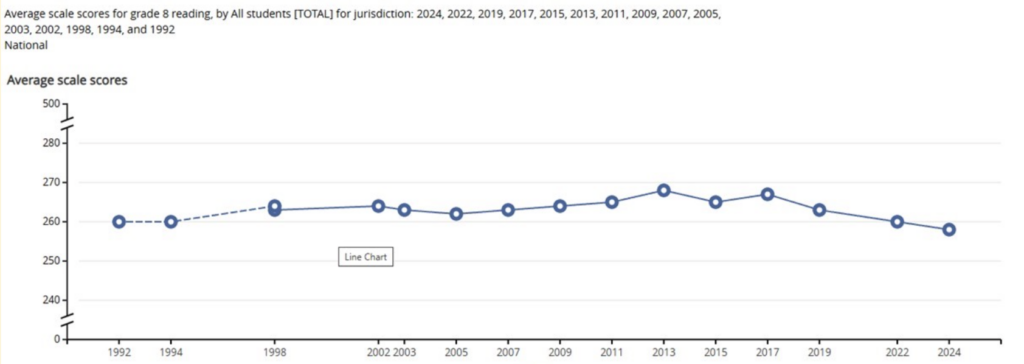
Like many alarmists, Marriott often presents data in ways that ignore a larger context. For instance, Marriott notes that America's standardized reading scores on the National Assessment of Educational Progress (NAEP) reached their lowest point in 20 years in 2024, with the implication that this is due to modern screens. He does not mention that NAEP scores actually peaked in the high-screen 2010s, declined after COVID, and now are back to levels seen in the early 1990s. Further, those post-COVID declines continued even after schools enforced more restrictive bans on cellphones and other technologies.
Further, the use of educational screens in schools is associated with slight improvements in reading and literacy, not declines (though those improvements are probably too small to be considered useful). There's a nuanced conversation to be had about screens and reading—much of which now happens on screens—but for a book that laments the loss of deep reading, Marriott doesn't seem to have bothered to do any deep reading in this area himself.
What's more, as researcher Mike Males recently pointed out, trend analysis suggests that the more kids use social media, the more they read books. I doubt very much that that's causal—but it's certainly a problem for the "screens are killing reading" hypothesis.
Another problem: Higher screen use is common for families that have a host of other troubles. Controlling for those other factors often makes the predictive value of screen time alone vanish.
Marriott presents various frightening-sounding anecdata about the decline in reading. Some of this is compelling—such as the overall decline in reading for pleasure, which began during the 1950s—and I don't want to discount every negative possibility here. But he presents all this as a catastrophic decline rather than a qualified change in society.
And I wish he were more skeptical about the common refrain that college students today can't read the books their professors assign. An entire cottage industry of such essays has sprung up, where professors ritualistically rend their clothes and gnash their teeth. But there are several potential problems with these analyses. For one thing, this concern isn't new. I've been teaching college for almost 30 years, and not once during that time have college professors thought their students were good readers. Also, some of the books assigned by professors may in fact be genuinely boring. Not everything on a course syllabus is a worthy classic.
Most important: If the average college student today is a poorer reader than 30 or 50 years ago, the reason may be more prosaic than anything related to television or smartphones. Universities are facing a demographic cliff, and many of them are being forced to recruit less-qualified students. The average IQ of college students is getting lower, not because young adults are stupider than in the past, but simply as a consequence of basic economics: Schools need warm bodies to keep the lights on.
If we're looking for patterns in time trends, we can't ignore the fact that young people today, on most outcomes, are far better than in earlier eras. Both youth violence and teen pregnancy are at record lows, more kids graduate high school than ever, and community volunteering is higher than in the 1970s and '80s. Smoking, drinking, and illegal drug use are all down, and even mental health is now improving. If we're going to use time trends, Marriott (and Haidt and Horvath and others) can't have it both ways, assigning causality only to bad outcomes and ignoring the good. If TikTok reduced reading, it also apparently reduced violent crime and teen pregnancy and got more kids to graduate high school. If we must be dumb about correlation and causation, we can't just pick the outcomes that flatter our moral sensibilities and conveniently ignore the rest.
Marriott laments the rise in authoritarianism, proclaiming a collapse of democracy and blaming it on the decline in reading. Yet 20th century Germany and Japan were at the height of literacy, and Italy not far behind, when they fell into violent, racist authoritarianism. Foolishness can certainly lead to authoritarianism, but literacy does not confer an immunity to foolishness. And while it is absolutely true, as Marriott argues, that authoritarians deprive people of reading and writing, he should consider how harangues about the dangers of screens can contribute to authoritarian controls on online speech.
Worse still, the precedents set for screens could easily be applied to books themselves. People may say they want kids to read more books, but when kids actually try to read the books they like, many adults then try to remove them too. Indeed, the U.S. has been seeing a spike in challenges to books in classrooms and libraries. Surprisingly, The New Dark Ages gives that trend little attention.
Marriott complains that music, television, and cinema have been dumbed down, with multitudes of inane sequels and remakes. Yet The New Dark Ages is itself a banal remake of complaints old people have been making for 2,500 years. Like many genre pieces, it keeps hitting formulaic plot points: that we have lost some utopian past, that there's a monocausal explanation for this loss, that some new technology or medium the kids like is to blame, and that we just need to get back to the 1980s or 1950s or 1930s or 1880s or 430s BCE. At times, Marriott seems to be at least somewhat self-aware about this, almost apologizing for being the proverbial old man waving his cane at the sky. (Technically, Marriott is in his 30s.) Yet he can't resist returning to clichéd form.
Like others in its genre, The New Dark Ages provides a trite but emotionally appealing narrative that flattens a complicated set of data into a sweeping moral story. And like others in its genre, it contributes to the erosion of our rights—including the right to read books.