

The Rise of the Non-Celebrity Celebrity
There is a form of fame where people aren't really celebrities, or even "influencers"—just folks with a fandom.
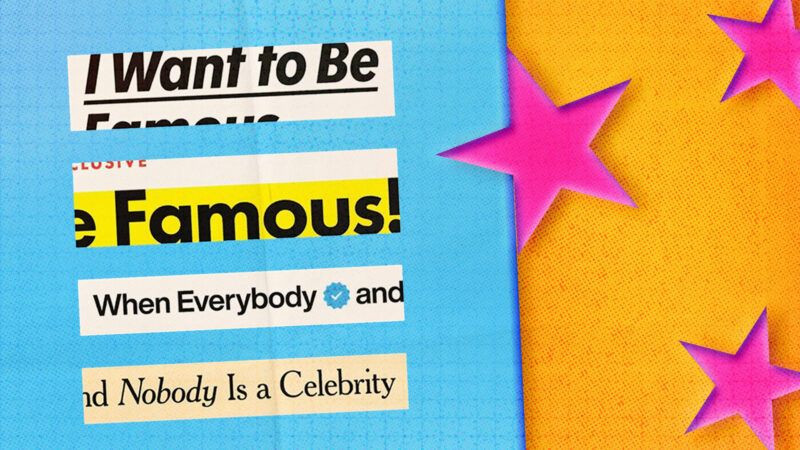
I Want to Be Famous: When Everybody and Nobody Is a Celebrity, by Bobby Finger and Lindsey Weber, Crown, 256 pages, $33
In the spring of 2025, I started seeing fan-made videos of the same young man everywhere on TikTok. Some were photo slideshows; others were ersatz music videos. They were set to all manner of obnoxious earworms, with captions like "He ascended…." One particularly memorable one compared the kid to Jesus Christ, claiming people "hated him" because he "spoke the truth."
I couldn't quite figure out who this person was. He wasn't an actor, he wasn't a singer, he wasn't a podcaster, and he wasn't an influencer either. He was just…some guy? From what I could gather, an attractive forum moderator who posted selfies to an audience of—at least on TikTok—under 20,000. These days, for a follower count to really mean something, you're usually talking about numbers in the high hundreds of thousands or millions. And still, this guy had a pretty active fanbase.
So I reached out to the star of these edits and asked him if he would be down to do an interview. "Ok sure we can do it," he direct-messaged me back. I pitched the article to a publication; the editor asked me what the story was. I actually didn't know. That more people than ever seem capable of developing a cult following is an interesting observation, but it isn't a story.
Many people online exist in this gray area where they are neither "influencers" nor really celebrities either. They're just people with a following—a fandom, even. But there isn't always a product they're selling, like music, writing, or a podcast. It's the internet equivalent of "famous for being famous." Sometimes the aura develops into something more, and sometimes it doesn't.
Anyway, the interview never happened. I got busy, forgot, and moved on. A few months later, right before Thanksgiving, I started seeing this guy everywhere again. His name was Braden Peters, but you might know him as Clavicular. And today, even my mom knows who he is.
This seems like territory for Bobby Finger and Lindsey Weber, hosts of the celebrity gossip podcast Who? Weekly and authors of I Want to Be Famous: When Everybody and Nobody Is a Celebrity.
I Want to Be Famous revolves around a binary the authors invented: Who vs. Them. The definition is simple. A Who elicits a "Who?" and a Them, "Oh, them." Beyoncé is a Them. Taylor Swift is a Them. Rita Ora, a recurring fascination for Finger and Weber, and patron saint of the show, is the paradigmatic Who, simultaneously headline-making and utterly forgettable. The Who-Them binary isn't a value judgment. It's just one of the cardinal rules of fame.
When it comes to the sometimes bewildering world of traditional celebrity—people who are on television, in movies, or making music—this is one of the best books on the topic I've ever read. It's a genuinely laugh-out-loud funny romp through gossip columns, grocery-store tabloids, reality television, sponsored content, nepo babies, and Notes app apologies. We take fascinating detours through Beyoncé's career (including back when she gave real interviews), the genesis of The View, and Tyra Banks, the ultimate multihyphenate, who since the COVID-19 pandemic has gone on to sell "hot ice cream." Kim Kardashian, Jennifer Lopez, and Britney Spears all get their due, as does Courtney Love. We learn about celebrity romances and Gwyneth Paltrow's Goop, and how Ryan Reynolds went from Two Guys and a Girl to Mint Mobile and Aviation American Gin.
This is also a book you can learn a lot from. The historical interludes woven through each chapter are especially good. An account of Ivy Lee's response to a 1906 railroad disaster takes us back to the origins of publicity. A history of gossip columns reminds us that writers as renowned as Truman Capote have practiced the craft. They contextualize President Donald Trump too: The Apprentice turned a New York celebrity into "an embodiment of the American Dream," attracting viewers who believed that getting in front of the cameras might make them rich as well; and finally, it turned him into the president.
But as much fun as I had reading I Want to Be Famous, there was something conspicuously missing: how the internet changed the nature of celebrity not just for celebrities as we understand them but for regular people. We're not just living in a time where everybody and nobody is famous; we're living in a time where it's increasingly unclear who counts as a public figure and who counts as a private citizen.
The book's Whos and Thems belong to a recognizable celebrity world, even when the individual celebrities aren't recognizable. The authors explain how people have made the jump from reality television to network television, but they pay less attention to how some people acquire such an audience without first passing through an institution. Influencers, streamers, and people who are simply very committed to posting online complicate the authors' description of celebrity. And while Finger and Weber acknowledge that fame is increasingly fragmented, I was left wondering how we got from Kim Kardashian to Clavicular.
"Whos might exist in the best position on the spectrum that goes from NO ONE CARES to EVERYONE CARES," Finger and Weber write. The Whos have fans, but they also retain some room to maneuver. "When Whos want attention, they're usually able to grab it." That might have been true a decade ago, but is it still true now?
There are people who are by no means famous but still have hordes of people who follow their every move online, treating them the same way Perez Hilton treated OC star Mischa Barton so many years ago. Then there are people like Navy vet Bella Poarch, who made the jump from "makes faces on TikTok to an audience of millions" to pop star—or better yet, Charli D'Amelio, who turned TikTok dances into a Hulu show. I don't think this is just an update to reality TV stars who somehow transformed an appearance on Road Rules or Survivor into a full-blown career. The question isn't just whether Whos can grab attention when they want it, but how attention turns someone into a Who in the first place. Even Ken Bone, the undecided voter from a 2016 presidential debate, can make money on Cameo, a site that sells personalized videos by "celebrities." Are memes Whos? And what does it mean to be a "has-been" or "washed" in this environment? What, if anything, are we to make of "The Costco Guys"?
Every time I cringe at one of the—how should I put this?—"validation junkies" I know, I end up finding out that they're not just niche famous; they're famous-famous, and now they're going to New York Fashion Week, hanging out with, I don't know, Julia Fox, and making twice as much money as me and my husband combined by streaming their dog barking in a spacious Miami apartment or something. To be clear, I'm not talking about people who don't give up on their cult podcast, music career, or writing. I'm talking about people who have an unbridled lust for attention, who were born believing they should be famous for nothing in particular and then grab life by the balls and get it. Maybe this was possible in another time; it's never been more attainable now. The reason is in the book's subtitle: Everybody and nobody is a celebrity. The exact mechanisms are still opaque.
Even if that's an exaggeration, being thirsty for fame pays dividends. Look at Trisha Paytas, the personality who ping-ponged from reality TV appearance to reality TV appearance, viral moment to viral moment, until finally becoming a celebrity in her own right. If you want an audience badly enough, in this world, you do eventually get one.
The desire for fame is eternal in a way that conventional celebrity is not. The desire to be known persists even as the meaning of being known becomes less and less discernable. The book doesn't quite explain why that desire is so durable, or what new world we're entering as the old routes to celebrity become less essential. It still works as an extremely readable history of old-school celebrity.
I Want to Be Famous left me entertained, better informed, and still curious about the same thing that puzzled me when Clavicular first crossed my TikTok "for you" page: What makes someone with an audience—indeed, a fandom—a person the rest of us are expected to recognize? Looking back, maybe there was a story there all along. Clavicular's fans had already decided he was famous. The rest of us just hadn't caught up.




