Thomas Massie Just Filed 8 Articles of Impeachment Against Pete Hegseth
The Kentucky congressman says he will force a vote on removing Hegseth, who is accused of "abusing the power of his office to ignore congressional war powers resolutions, to kidnap foreign leaders, and to intimidate critics of the Trump administration."
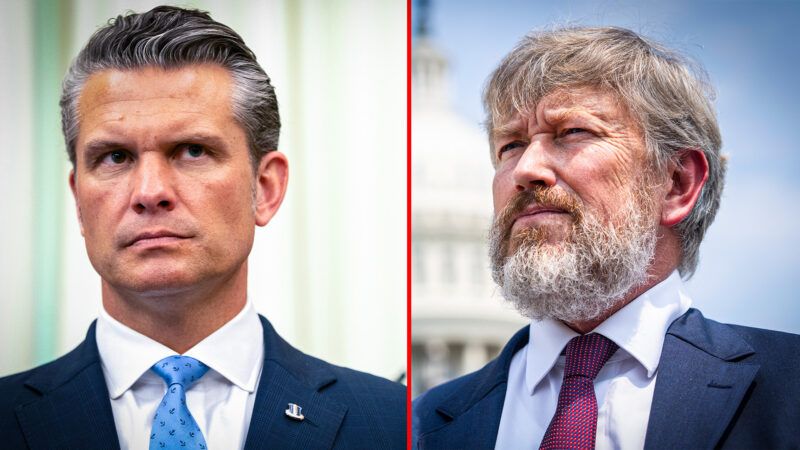
Rep. Thomas Massie (R–Ky.) says he will force the House of Representatives to vote on impeaching Secretary of Defense Pete Hegseth.
Massie filed eight articles of impeachment against Hegseth on Tuesday. The charges include his handling of the ongoing Iran war, the Department of Defense's extrajudicial killings of suspected drug traffickers, and Hegseth's attempt to illegally retaliate against Sen. Mark Kelly (D–Ariz.), among other things.
In a statement, Massie said Hegseth was "abusing the power of his office to ignore congressional war powers resolutions, to kidnap foreign leaders, and to intimidate critics of the Trump administration by retaliating against them for exercising free speech."
The impeachment effort is unlikely to pass in the Republican-controlled House, but the chamber's rules allow members to bring impeachment resolutions directly to the floor at any time. That means Massie could force all members to put their opinion of Hegseth's conduct on the record.
The first three articles of impeachment against Hegseth are related to the War Powers Act of 1973, which gives presidents 60 days to obtain congressional authorization for an ongoing conflict. That deadline has come and gone.
Massie claims Hegseth violated the War Powers Resolution by launching the war without evidence that the United States faced an imminent threat, continuing the war after Congress passed a resolution ordering the conflict to end, and ignoring the withdrawal deadlines Congress set in that order. Hegseth has "treated mandatory statutory deadlines as discretionary," the articles claim.
Two other articles of impeachment focus on American strikes in Iran and near Venezuela. Massie claims that Hegseth ignored laws that are meant to minimize civilian casualties—largely related to the February 28 strike on the Shajareh Tayyebeh Elementary School. Pentagon officials ignored warnings about outdated intelligence in the lead-up to that attack, which killed dozens of civilians, many of them children.
"Secretary Hegseth willfully and systemically refused to comply with laws and directives mandated for the protection of civilians during the commission of armed conflict, chilled and rendered ineffective such components to prevent and mitigate harm to civilians, and therefore, foreseeably effected the death and injury of over 200 civilians, to the manifest injury of the United States," the article reads, in part. "Such conduct reflects not merely a failure of judgment, but an extraordinary abuse of the powers entrusted to the Secretary of Defense and a profound disregard for the civilians his Department was obligated to protect and the service members he was entrusted to lead."
A subsequent article references the Trump administration's extrajudicial strikes against suspected drug traffickers in the Caribbean Sea, which have killed more than 200 people. Those strikes are summary executions, carried out without any charges or convictions, and they have not slowed the flow of illegal drugs into the United States.
That conduct shows that Hegseth "will remain a threat to civilians and the laws of war, the integrity of United States diplomacy, and the Constitution if allowed to remain in office," the articles allege.
The sixth article of impeachment against Hegseth alleges that he violated Kelly's constitutional right to free speech by trying to retaliate against the senator. A federal judge has already ruled that Hegseth acted unlawfully when he tried to strip Kelly of his rank and part of his military pension after Kelly reminded military members that they have an obligation to refuse illegal orders.
The last two articles of impeachment have to do with American military conduct in Venezuela and Yemen. Massie alleges that the kidnapping of Venezuelan dictator Nicolás Maduro was carried out without constitutional or legal authority. Similarly, he objects to the ongoing American strikes in Yemen, which have killed civilians and were not authorized by Congress.
"If we are to remain true to our oath to 'support and defend the Constitution of the United States,' Congress must not turn a blind eye to Secretary Hegseth's unconstitutional and illegal actions," said Massie in a statement.
Indeed, the Constitution is clear that Congress has final authority over wars and military operations. It is also quite clear about the role that Congress plays in holding executive branch officials accountable for violating the law. Impeachment is the proper remedy for Hegseth's brazen disregard for civilians' lives and the limits of his own powers.