

FCC Bans Foreign-Made Robots, Including Roombas
The ban on new foreign-made robotic devices comes soon after regulators nearly killed Roomba maker, iRobot.
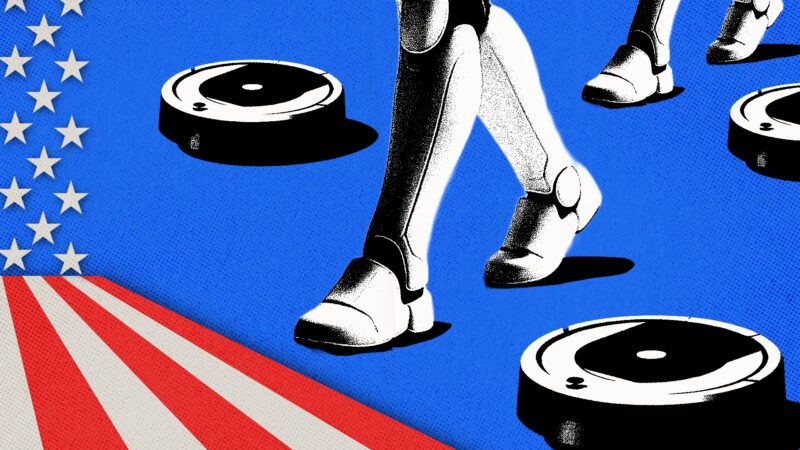
The Federal Communications Commission (FCC) recently imposed a ban on new foreign-made robotic devices, drawn so broadly as to even include robot vacuums. It's an especially devastating blow, since one of the most prominent robot vacuum manufacturers has already been the victim of overzealous regulators.
"Today, the Federal Communications Commission updated its Covered List to include two new categories of devices," the agency announced last week, including "'advanced robotic devices' (defined as mobile robots, such as humanoids and quadrupeds)."
The Secure and Trusted Communications Networks Act of 2019 directed the FCC to "publish and maintain a list" of "communications equipment or services from a company that poses a national security risk to U.S. communications networks."
Items on the list are "prohibited from getting FCC equipment authorization," effectively preventing their sale or use in the U.S.
The new ban goes much further than just humanoid robots: A National Security Determination cited in the announcement includes any automated software-controlled devices weighing more than 4.4 pounds that are "capable of locomotion, obstacle avoidance, navigation, or movement on the ground."
The ban won't apply to any devices already on the market, and it allows the government to grant exemptions "after finding that such device or class of devices do not pose such unacceptable risks." But it still seems remarkably arbitrary, especially when it's sold as a means of protecting national security.
"The FCC isn't actually targeting companies with poor security. It's targeting basically every robovac company, regardless of their security practices—because basically every robovac is manufactured outside the US," Sean Hollister writes at The Verge.
In fact, "the government isn't asking these companies any questions about security—not one—to get the waiver that lets them through," Hollister adds. "The FCC only wants to know where they're designed and made and assembled and tested and influenced, and get a specific commitment to start manufacturing them in the US instead. Even then, it appears the FCC will simply preference US companies without any new commitments to security or US manufacturing."
Earlier this year, the FCC banned all foreign-made wireless routers, and it's currently considering a proposal to ban foreign-made drones, even those it had previously approved.
But this new ban is worse, especially considering how it will hurt a company that has already endured its share of abuse from government regulators.
Amazon announced in 2022 that it would acquire iRobot, the Massachusetts-based company that makes the Roomba robot vacuum. While it was once a pioneer in the space, iRobot had fallen behind its competitors: The New York Times' Wirecutter no longer recommends Roomba products, noting they "have not performed well in our testing in recent years."
An acquisition by a company with pockets as deep as Amazon's could have been a much-needed lifeline, allowing iRobot to invest in research and development.
Instead, busybody regulators in both the U.S. and Europe opposed the merger on antitrust grounds.
In a letter to then-Federal Trade Commission Chair Lina Khan, Sen. Elizabeth Warren (D–Mass.) and five other lawmakers said the Federal Trade Commission (FTC) "should use its authority to oppose the Amazon–iRobot transaction"—which, they warned, "could harm consumers and reduce competition and innovation in the home robotics market."
The European Commission, the European Union's governing body, also objected, fearing that "because Amazon's online marketplace is a particularly important channel," it "may have the ability and the incentive to foreclose iRobot's rivals."
Amazon abandoned the deal rather than try to placate regulators on both sides of the Atlantic. As a result, iRobot laid off one-third of its workforce and soon faced bankruptcy. It also reported in a bankruptcy filing that tariffs on goods from Vietnam, where it made most of its products, added $23 million to its costs in 2025.
In December, the company announced it would instead be acquired by China-based company Shenzhen Picea Robotics, its primary contract manufacturer. At the time, iRobot owed Picea nearly $100 million.
Considering, as Reuters reported last week, that "the FCC is expected to exempt many non-Chinese suppliers from the restrictions," this means iRobot will have borne the brunt of two successive presidential administrations' regulatory actions.




