

Trump's Fertilizer Tariff Retreat Is Another Admission That Tariffs Raise Prices
The White House quietly repealed tariffs on Moroccan fertilizer this week.
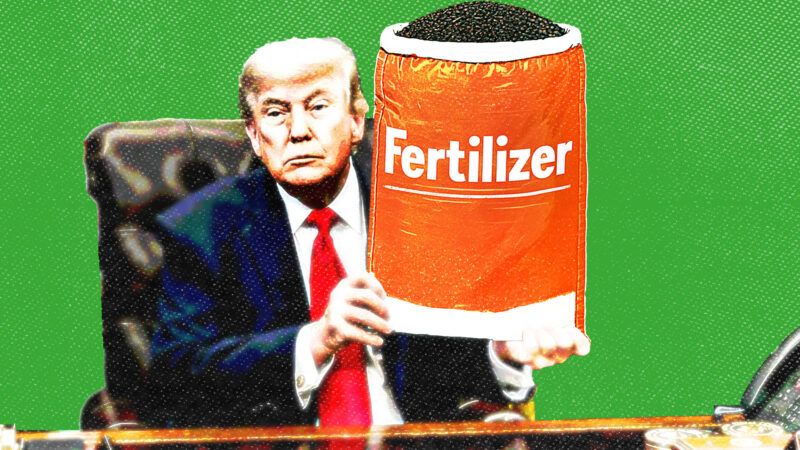
With fertilizer prices spiking due to the Iran War and contributing to rising food prices, the White House on Monday quietly dropped tariffs on fertilizer imports from Morocco.
Officially, that maneuver is meant to "ensure in the interim that United States farmers have access to a sufficient and timely supply of phosphate fertilizers during the planting and growing season, to ensure a stable domestic crop supply, and to meet our food production needs."
In reality, this is yet another admission by the Trump administration that tariffs raise prices—otherwise, how could cutting tariffs bring prices down? It is exactly like when the White House rolled back tariffs on coffee, beef, and other imported food last year. Or when the White House rolled back tariffs on farm equipment earlier this month.
Over and over again, the Trump administration is making fools out of allies who insisted that tariffs would not raise prices.
The rollback of fertilizer tariffs ought to be a particularly humiliating moment for Trump's own top trade official: U.S. Trade Representative Jamieson Greer. Greer has not only championed Trump's foolish tariffs in his current role, but has also built his political career on pushing for those same high tariffs on fertilizer that his boss is now unwinding.
As Reason has previously reported, Greer spent years lobbying on behalf of Simplot, an American fertilizer manufacturer that has pushed for higher tariffs on its foreign competitors' products. During the Biden administration, Greer testified before the International Trade Commission (ITC) in favor of those tariffs and downplayed the potential consequences.
"There has been no shortage of fertilizer for the American farmer, and there will be no such shortage," he told the ITC. "When it comes to real supply in the market, farmers have gotten everything they need, and they will get everything they need for their acreage."
Those tariffs were costly for farmers even before the Iran War. Tariffs on Moroccan fertilizer imports cost U.S. farmers an estimated $6.9 billion between 2021 and 2025, according to a report published earlier this year by the Texas A&M Agricultural and Food Policy Center.
But now that other fertilizer imports have been curtailed by the war, the crisis is getting more serious. In March, over 50 farming and agricultural industry groups signed a letter to the ITC seeking a reprieve from the tariffs that Greer had played a role in implementing.
Those tariffs had "already prevented farmers from accessing the tools that meet their crop production needs and resulted in lower yields and negative economic impacts," the groups wrote. Eliminating them would "help restore balance to fertilizer markets by providing immediate relief to growers facing elevated input costs and a lack of availability," they argued.
When you put it all together, Trump's decision to walk back those tariffs is a damning admission of failure on multiple levels. It exposes how unprepared the administration was for the economic fallout of the war. It reveals, once more, how tariffs have raised prices and harmed crucial American supply chains. It illustrates how Trump's tariffs have backfired on a specific industry—in this case, farmers—despite their political support for his election. And, thanks to Greer's role in all of this, it shows how lobbyists with protectionist agendas have infiltrated the Trump administration.
Ultimately, actions speak louder than words. Trump can talk about the benefits of tariffs all he wants, but rolling back tariffs on Moroccan fertilizer is an undeniable demonstration that America is stronger and richer when it has unfettered access to global supply chains.




