

Can You Un-Impeach a President?
Democrats may revive impeachment if they take Congress in November. Trump and his allies, meanwhile, want his two impeachments erased.
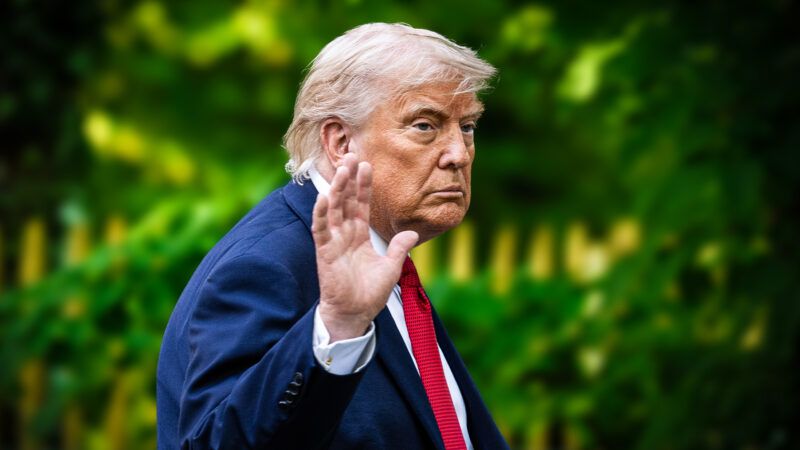
Impeachment is on the table if the Democrats take Congress in the November midterms, according to the party's leadership. Still, they're anything but irrationally exuberant about removing President Donald Trump from office. "I think it's very likely predictable how everyone would vote," Sen. Brian Schatz (D–Hawaii), the likely Democratic whip, grumbled to CNN's Inside Politics on Sunday. Impeachment's "not a panacea," adds Rep. Jamie Raskin (D–Md.), who'd be chair of House Judiciary if the Democrats win the House; it's "one more tool in the toolkit, and we will use it if we need to use it."
Meanwhile, Trump and his congressional allies are mulling a contrary scheme to get the president un-impeached. According to a recent Wall Street Journal report, the president has spoken to House Speaker Mike Johnson (R–La.) about getting his two first-term impeachments "expunged," and Alan Dershowitz is on the case.
As usual, when Trump floats a bizarre new legal scheme, the first question is: "Can he do that?" A better question, for those of us who care about presidential abuse of power, is whether symbolic impeachment fights are the best use of our time.
As to the first question, there's actually some precedent for this odd gambit. It involves one of Trump's favorite presidents, fellow rageaholic Andrew Jackson, whose portrait now hangs prominently in the Oval Office.
In 1834, Sen. Henry Clay (W–Ky.) led the Senate fight to formally rebuke "Old Hickory," after the president, in the fight over the Second Bank of the United States, fired his Treasury secretary and rebuffed a Senate demand for information justifying the move. The censure resolution, which Clay shepherded to passage, read that "the President, in the late executive proceeding in relation to the public revenue, has assumed upon himself authority and power not conferred by the Constitution and laws, but in derogation of both."
Naturally, Jackson's first inclination was to challenge Clay to a duel. When his temper cooled somewhat, he instead issued a lengthy protest of the Senate's action. Three years later, with Jacksonian Democrats back on top in the Senate, he had his allies vote to expunge the censure from the Senate records.
A clerk black-lined the censure motion in the Senate Journal and scrawled "Expunged by order of the Senate" on the page. But the original censure is still clearly visible.
What, besides a useful factoid for D.C. bar trivia, can we take away from this example? Impeachment by the House serves, in part, as constitutional censure: an official black mark that stays on a president's legacy. The Jackson episode suggests that Trump could have his congressional allies pass a measure "expunging" his two House "censures." But so what? As Rep. Don Bacon (R–Neb.) put it to The Wall Street Journal, "It's silly. What happened is history."
"It should be done because I did nothing wrong," Trump told the Journal. But it's not as if putting a historical asterisk next to his impeachments is going to change anyone's mind about that.
In fact, both impeachments were amply justified. The first, over Ukrainegate in 2019, involved a classic attempt to "use the available federal machinery to screw [a] political enem[y]," to quote an infamous Nixon-era memo by White House Counsel John Dean. The conduct leading to Trump's second impeachment in 2021 was even more clearly impeachable: He riled up a mob in an attempt to intimidate Congress and his own vice president into overturning the results of an election he lost.
If Trump wants to show his enemies he got away with it, that point has been amply demonstrated. After all, he managed to shrug off both impeachments, get his party's nomination, and win the presidency again. Now, of the seven GOP senators who voted to convict Trump in his second impeachment, only one, Lisa Murkowski (R–Alaska), has lived to tell the tale. A performative "expungement" at this point would just be spiking the ball, which is, no doubt, the point.
But there are larger lessons here about impeachment's continued utility as the ultimate constitutional check against presidential abuse. Going into the first Trump presidency, it was still possible to believe that even without removal by the Senate, the black mark of impeachment by the House remained a useful deterrent to bad behavior. Then Trump came along and, in a land-speed record, effectively doubled the number of presidential impeachments in American history. What have we learned from that experiment?
For one thing, the usual scaremongering about impeachment once again turned out to be overblown. Impeaching Trump twice didn't do America any harm. Whether it did enough good to be worth the effort is less clear.
In Trump's first term, Reason's Nick Gillespie argued that impeachment fights were "a distraction" from more important fights about the size and powers of government. Sure, Trump deserved to be impeached, but what would it accomplish? Would it make the federal government smaller or the president less powerful? Though I didn't see it that way at the time, in hindsight, I have to admit he had a point.
During Trump 1.0, Congress twice wheeled the proverbial "100-ton gun" into position, and both times, when it lit the fuse, out popped a little cartoon flag reading "Bang." Is there any reason to think the third time will be the charm?
Never say never. It's possible Trump will take it up a notch, committing some fresh enormity that's an even better test of his famous boast that he could shoot someone in the middle of Fifth Avenue and survive politically.
But right now it seems clear that the Framers set the bar for presidential removal too high. Clearing that hurdle at best gets rid of one abusive president. If Congress could muster enough political will to do that, its efforts would be better spent on reforms that outlive one administration: reining in presidential war powers, national emergency powers, and the power to make law with the stroke of a pen. Accomplishing that will be at least as difficult, but at least the juice will be worth the squeeze.





