

The Trump Administration Might Send Afghan Refugees to Danger in Congo
About 1,100 Afghans currently stranded at a military base in Qatar could be relocated to the crisis-addled African country.
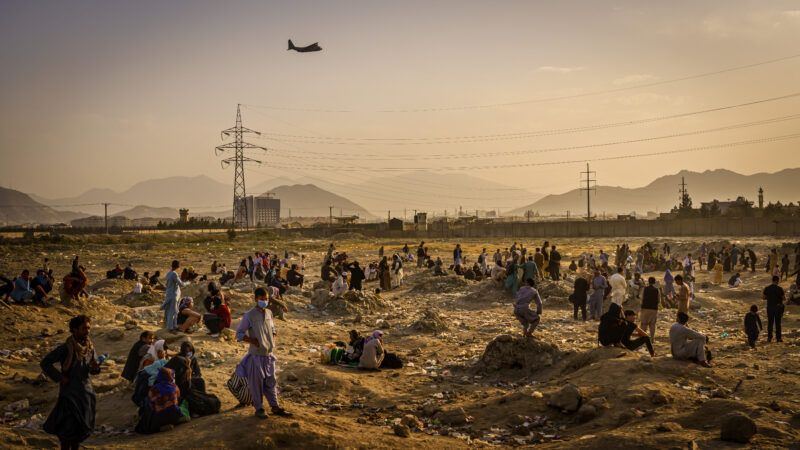
Over four years after Afghanistan fell to the Taliban, the Trump administration is making policy decisions that will keep Afghans who are stuck in the U.S. Refugee Admissions Program (USRAP) and Special Immigrant Visa (SIV) pipelines in limbo.
There are currently about 1,100 Afghans in the USRAP and SIV program who are stranded at Camp As Sayliyah (CAS) in Qatar. The U.S. Department of State flew Afghan evacuees to the base in order to carry out final vetting before relocating them to the U.S., but since the Trump administration suspended the USRAP via executive order on January 20, 2025, and ended SIV issuance in late 2025, forward movement has ceased.
Members of the Afghan National Army Special Operations Command, family members of U.S. military personnel, and 400 children reside at CAS. The State Department previously offered them financial incentives to repatriate to Afghanistan while it sought out another country that would receive CAS residents before the base's planned March 31 closure.
On Tuesday, The New York Times reported that the State Department is in talks to send CAS residents to the Democratic Republic of Congo.
In the International Rescue Committee's 2026 ranking of the 20 countries "at greatest risk of new or worsening humanitarian emergencies," Congo falls at No. 7. Afghanistan appears on the list, but it is not within the top 10 countries judged at greatest risk.
In a press conference on April 22, Shawn VanDiver, president of #AfghanEvac, said that the proposed pathway "is not a resettlement plan." Resettlement "requires durable legal steps. It requires community infrastructure. It requires a host government that has consented and is equipped to receive," he argued. "None of those conditions exist in Kinshasa for Afghan families."
"The families who are at CAS right now did not show up unvetted," Jon Finer, deputy national security adviser under former President Joe Biden, told reporters during Wednesday's #AfghanEvac press conference. "They are, by design and by implementation, the most vetted lawful immigrants to the United States."
Finer said that CAS' function was "intended to honor a wartime commitment. It was working. It was rigorous, it was orderly, and it worked for thousands of vetted Afghan allies and their families during the course of the program." He emphasized that the capacity to resume processing at CAS exists, with the only missing component being "a policy decision to go forward."
According to Finer, the current plan "is [a] terrible strategy for the United States. It shows us not meeting commitments that we make, which is going to make people less likely to rely on us, to trust us going forward."
CAS residents tell Reason that they are dismayed. One male USRAP applicant said he felt "confused" and "hopeless" at the news.
Since 2018, the International Refugee Assistance Project (IRAP) has been engaged in a legal battle against the U.S. government over its processing of SIVs and failure to adjudicate them within the nine-month timeline the State Department has promised.
Following an Afghan national's horrific November 26 shooting in Washington, D.C., of two members of the West Virginia National Guard, one of whom perished from her wounds, the Trump administration made two changes that drastically impacted SIV applicants. First, it froze SIV processing; then, it eliminated the SIV exemption from its travel ban on Afghan nationals.
While processing was halted, the State Department fell out of compliance with a revised adjudication plan designed to hold it accountable to stated processing timelines. After D.C. District Court Judge Tanya S. Chutkan ordered the State Department to resume processing Chief of Mission (COM) approvals, appeals, and denials in February, the State Department began issuing decisions once more. However, it remains unclear whether COM approval rates are near the 50 percent claimed by the State Department in 2023. The State Department did not respond to Reason's questions about how many approvals it has issued in the cases processed since Chutkan's order.
While it is now processing SIV applications, the State Department has not resumed issuing visas, justifying the halt via the ongoing travel ban. Under the travel ban, all Afghans who are interviewed for their visas in third countries are receiving 212(f) denials for their cases. Assistant Secretary of State for the Bureau of Population, Refugees, and Migration Andrew Veprek has stated in testimony in IRAP's ongoing lawsuit, provided to Reason by #AfghanEvac, that the State Department "would provide additional guidance about its handling of visa applications that were refused" under the 212(f) category if the travel ban order were amended or rescinded.
In testimony from an April 1 hearing provided to Reason by IRAP, Veprek told Chutkan that it was "unclear" whether those denied under the 212(f) designation would have to reapply for their visas and be reinterviewed.
"How is that not an end-run around my injunction?" Chutkan asked Veprek. "If they're going to have to go and start over, then that's effectively noncompliance with the terms of the plan, isn't it?"
Kimberly Grano, a litigation staff attorney at IRAP, tells Reason that IRAP has argued—and the court has agreed—that "the State Department has not been in compliance with the revised adjudication plan since it was adopted last June, because they have not been meeting the required timelines."
"The State Department should not be forcing applicants who appear for interviews now to repeat the entire interview process later," she argues. "Applicants who complete their interviews should be able to proceed with the process, so that they can get their visas as soon as the 212(f) proclamation is lifted or overturned." Requiring "those people to just continue waiting," she adds, "is clearly a drain on people's sense of hope, a drain on people's morale."
A large number of SIV and USRAP applicants remain stranded in Pakistan, where they live under increasing threat of deportation as a war rages between Pakistan and Afghanistan.
SIV applicant Farzana—identified here by a pseudonym for security reasons—recently received a 212(f) denial. Both Farzana and her husband worked on behalf of the U.S. government. As an interpreter for U.S. forces, her husband has twice been detained by the Taliban, Farzana says.
Her family sold their home and possessions to move to Pakistan for safety. While living in uncertainty there, she says, "We are not only losing our future—we are losing our present." Farzana adds that "the psychological impact has been devastating," explaining that she "recently lost [her] unborn child due to extreme stress and unsafe living conditions."
Andrew Sullivan, an Afghanistan veteran and executive director of the nonprofit No One Left Behind (NOLB), tells Reason that "the pause to SIV issuance has created an even more tenuous situation for America's closest Afghan allies." In addition to the Afghanistan-Pakistan conflict "exacerbat[ing] the pre-existing difficulties for Afghans seeking refuge in Pakistan," Sullivan says that "Pakistan's pause to visa issuance for Afghans has made it nearly impossible for Afghans to work or retain a valid immigration status in the country, and Pakistani authorities have undertaken a concerted and aggressive deportation effort."
In these tense conditions, Sullivan says that NOLB was forced to shutter a guesthouse it maintained in Islamabad, which had become "a high-profile target for Pakistani authorities." Now the organization is using "direct financial assistance" to support "over 71 families (411 people) in the month of April alone." Sullivan says that 172 additional families—comprised of 896 people—"are in the queue for NOLB support."
Still, he notes that this will only "scratch…the surface of the needs." Assessing that "hundreds of SIV cases represent…thousands of individuals currently in Pakistan without stable support," Sullivan says that "even as NOLB ramps up to provide $50,000 of support per month in Pakistan, there will likely be hundreds of cases that fall through the cracks."
"Vetting and national security remain a preeminent concern for NOLB," Sullivan adds. Sullivan says that the State Department Office of Inspector General findings shared in January with the Senate Judiciary Committee found that "proper vetting [for SIV applicants] was conducted in 100% of cases." He argues that "the U.S. can maintain the strictest levels of vetting and case scrutiny and still follow through on our promises to wartime allies."
"The time is right for the Administration to resume visa issuances for qualified Special Immigrant Visa applicants," Sullivan says.




