

Led by Republicans, Americans' Support for NATO Fades
Has the Cold War-era military alliance outlived its usefulness?
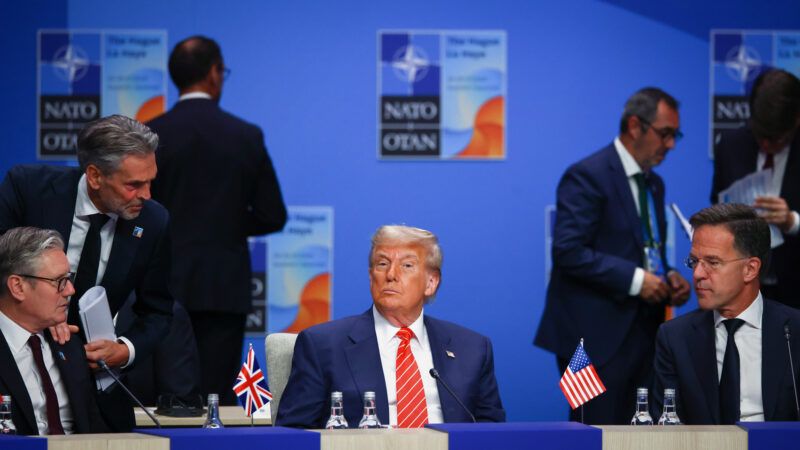
President Donald Trump's doubts about the North Atlantic Treaty Organization (NATO) date back at least to the 1980s, when he took out full-page newspaper ads questioning the value of defending prosperous allies capable of paying for their own security. So, when he voices frustration with the alliance and the lack of support among its members for the U.S. and Israeli campaign against Iran's theocratic regime, it's not a new development. What's new is growing disenchantment with NATO among Americans, led by the president's Republican supporters.
You are reading The Rattler from J.D. Tuccille and Reason. Get more of J.D.'s commentary on government overreach and threats to everyday liberty.
Rising Doubts About NATO Membership
"A majority of Republicans (60%) now say the U.S. benefits not too much or not at all from being part of the alliance, up from 50% in 2025," Pew Research reported earlier this month. That's an 11-point drop in support for NATO membership among Republicans and GOP-leaning independents—from 49 percent to 38 percent—just from last year.
As recently as 2022, 55 percent of Republicans supported U.S. membership in NATO.
An overwhelming majority of Democrats and Democrat-leaning independents—82 percent—continues to support NATO membership in numbers barely changed over the past five years. But the decline in support among Republicans means that alliance participation's favorability among Americans in general has gone from 71 percent in 2021 to 59 percent now. Most likely, that has something to do with the two-term Republican president's continuing doubts about Cold War-era military alliances that linger on.
In 1987 newspaper ads that mostly fretted over a then-dynamic Japan and oil-rich Saudi Arabia, Trump asked, "Why are these nations not paying the United States for the human lives and billions of dollars we are losing to protect their interests?"
Thirty-nine years later, Trump's doubts about such alliances haven't changed. He openly questioned NATO's value during his first term and recently told reporters that he's considering withdrawing the U.S. from the alliance which he says "wasn't there when we needed them, and they won't be there if we need them again."
The thing is, while many NATO members have recently regained some appreciation for the alliance, they really did spend decades coasting along under the U.S. defense umbrella. And Americans continue to do most of the heavy lifting.
Americans Shoulder the Lion's Share of the NATO Burden
Last year, with its economy representing 52 percent of total NATO GDP, the U.S. made 60 percent of the alliance's overall defense expenditures, according to the NATO Secretary General's Annual Report 2025. That was a significant improvement in the shared burden since 2020 when the U.S. had 53 percent of the GDP of a smaller alliance (Finland and Sweden have since joined) but was responsible for 71 percent of total defense spending.
The share of defense spending didn't represent the full imbalance of military power in the alliance. In December 2023, after Russia invaded Ukraine, The Wall Street Journal noted that "the British military—the leading U.S. military ally and Europe's biggest defense spender—has only around 150 deployable tanks and perhaps a dozen serviceable long-range artillery pieces." France, the Journal added, "has fewer than 90 heavy artillery pieces, equivalent to what Russia loses roughly every month on the Ukraine battlefield….Germany's army has enough ammunition for two days of battle."
So, the rise in the share of non-U.S. defense spending was much needed. But it's not clear that military preparedness among allied nations has yet improved.
When Iran lobbed missiles at Cyprus as part of an escalation of the country's ongoing war with the U.S. and Israel, it took a week for the United Kingdom to deploy a destroyer to defend its assets there.
"We effectively have two destroyers that are seaworthy at the moment," former Royal Navy commander Tom Sharpe told Sky News. "It just so happens neither are at immediate notice to go."
Another naval expert told The Guardian that "the UK doesn't have any air defence other than the Royal Air Force and some short-range missiles" based on vessels like the HMS Dragon, which was ultimately sent to Cyprus. At a time of rising tension with Russia, other potential demands for that capability had to be considered before the ship sailed. And that's for relatively well-armed Britain.
Europe Rearms as Its Interests Diverge From America's
That said, the NATO allies are taking their responsibilities more seriously than in the past. All members—even Canada, which trailed for decades—are now at least nominally spending at least 2 percent of GDP (the NATO guideline) on defense. Poland leads in percentage terms, at 4.3 percent, with the U.S. at 3.19 percent. Because the U.S. economy is far outstripping those of Europe, the rebalance is less impressive in dollar amounts, with Americans coughing up $838 billion vs. the $574 billion spent by the other NATO allies combined in 2025.
But there are also questions about competing risks and concerns. European NATO members worry most about nearby Russia, for good reason, with the NATO annual report observing that "Russia remains the most significant and direct threat to our security and to peace and stability in the Euro-Atlantic area." But Canada and the U.S. are located across an ocean from Europe (and isolated by another from threats in Asia). Germany, by itself, has an economy double the size of Russia's in GDP terms and should be more than capable of fielding an adequate defense—especially alongside neighbors with similar worries.
Trump rages over NATO's failure to support America's efforts against Iran. But that fight isn't why the North Atlantic alliance exists. Whether or not the Iran war is a good idea—and that's a separate discussion even from its questionable legality—the U.S. has interests that range far beyond the defined purposes of an arrangement with mostly European allies and their extremely limited (by their choice) military capabilities. NATO's other members don't necessarily share American concerns, and they have no reason to participate in conflicts beyond the scope of their agreement with the U.S.
The question is whether the U.S. needs to continue its promise of participation in future European conflicts. Polling suggests the president's supporters are increasingly skeptical about NATO participation and adopting doubts that he first raised decades ago.
In a changing world, perhaps it's time for the U.S. and its longtime allies to concede that their interests are moving in different directions. We might be better friends when we admit that the old military alliance has outlived its usefulness.




